Quick answer: Feed a complete hamster pellet as the daily base. Add a small portion of vegetables. Skip a seed-only bowl, because hamsters pick the fatty seeds and leave the rest.
Hamsters eat a complete pelleted hamster diet first, plus small vegetable portions, not a seed-only bowl. This page is a research-desk comparison of published feeding specs. We did not run feeding trials, weigh any hamster, or collect clinic records.
Our research team analyzed five currently sold U.S. complete foods. Listed crude-protein minimums on those maker pages ran from 12.0% to 17.0%.
A food entered only if it is a current complete hamster diet with a maker-page guaranteed analysis. Treats, rat-only bags, and mouse-only bags stayed out. We kept one seed-style mix so the format difference is visible.
What a hamster diet is, in one bowl
Wild Syrian hamsters are omnivores. The Merck Veterinary Manual lists green plants, seeds, fruit, and meat in that wild intake.
A pet bowl is not a copy of that forage pile. The same Merck chapter says captives should eat a complete, balanced, pelleted hamster diet.
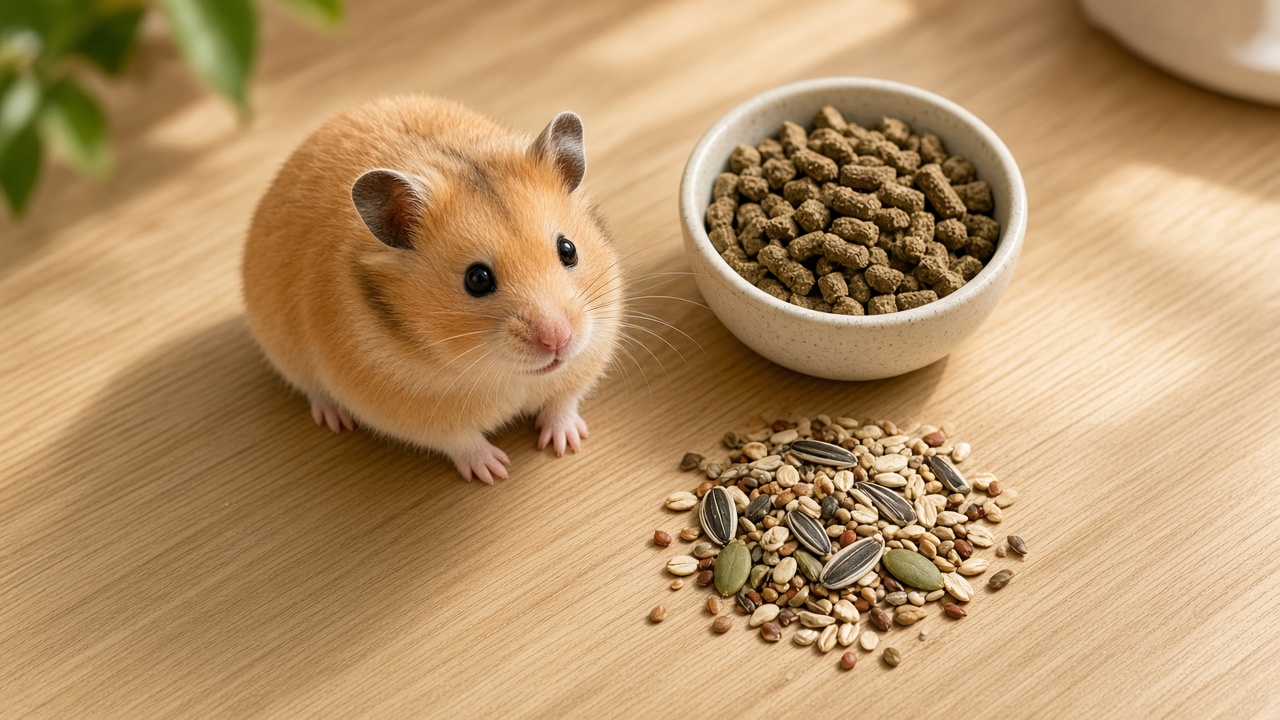
Generic seed mixes fail that job. Hamsters pick seeds and ignore pellets.
That pick-and-leave habit is the main diet error in home cages. The fatty pieces disappear. The fortified pieces stay in the dish.
Hamsters also have a two-part stomach. The National Research Council 1995 hamster chapter describes a forestomach that holds food for 10 to 60 minutes.
A uniform pellet keeps each mouthful closer to the same nutrient mix. A mix lets the animal build a different meal than the bag average.
The same NRC chapter did not publish a hamster nutrient-requirements table. The subcommittee said too few requirement studies existed.
It still offered a working protein line. A natural-ingredient diet with 18% crude protein should support weanling gains near 2 g per day.
None of the five bags we compared prints an 18% protein minimum. The listed minima sit at 12.0%, 15.0%, 15.0%, 17.0%, and 17.0%.
That gap is a label fact, not a feeding trial. Guaranteed analysis is a legal minimum, not the exact protein in every scoop.
How much food belongs in the dish
Body size sets the serving, not the bag art. The Merck Veterinary Manual gives adult Syrian hamsters a weight of 110 to 140 g.
Dwarf pets, including Djungarian and Roborovski hamsters, are listed under 100 g.
Mazuri Hamster & Gerbil Diet, formula 5M7V, splits those sizes on its own page. Adult Syrians are listed at 20 to 25 g per day, about 40 to 50 pellets.
Adult dwarfs are listed at 5 to 7 g per day, about 9 to 12 pellets. That dwarf serving is about one-third of the Syrian serving.
A shared “hamster” scoop overfeeds a dwarf. Measure the species you have.
Supreme Science Selective Hamster lists 5 to 10 g for an average adult. That band sits nearer the Mazuri dwarf range than the Syrian range.
Oxbow Essentials Hamster & Gerbil Food uses cups. Adults over six months get 1/8 cup if they are small hamsters. Large hamsters and gerbils get 1/3 cup.
Oxbow lists unlimited food for animals under six months and for pregnant or nursing animals. The Merck chapter warns that lean diets in pregnancy raise cannibalism risk. Extra measured food is the practical response, not a richer junk mix.
Kaytee Forti-Diet Pro Health Nourish+Protect Hamster and Gerbil Food lists 2 tablespoons. That is about 20 g for a hamster or gerbil.
Higgins Sunburst Gourmet Blend Hamster & Gerbil lists 2 to 3 tablespoons per day. Those tablespoon lines match a Syrian-size animal more than a 5 to 7 g dwarf.
If the bag does not name the species, start low. Then watch body condition.
Hamsters eat on a short clock. The NRC chapter says they feed at about 2-hour intervals through the day. An empty morning dish can still hide a night hoard.
Fresh food, hay, and extras
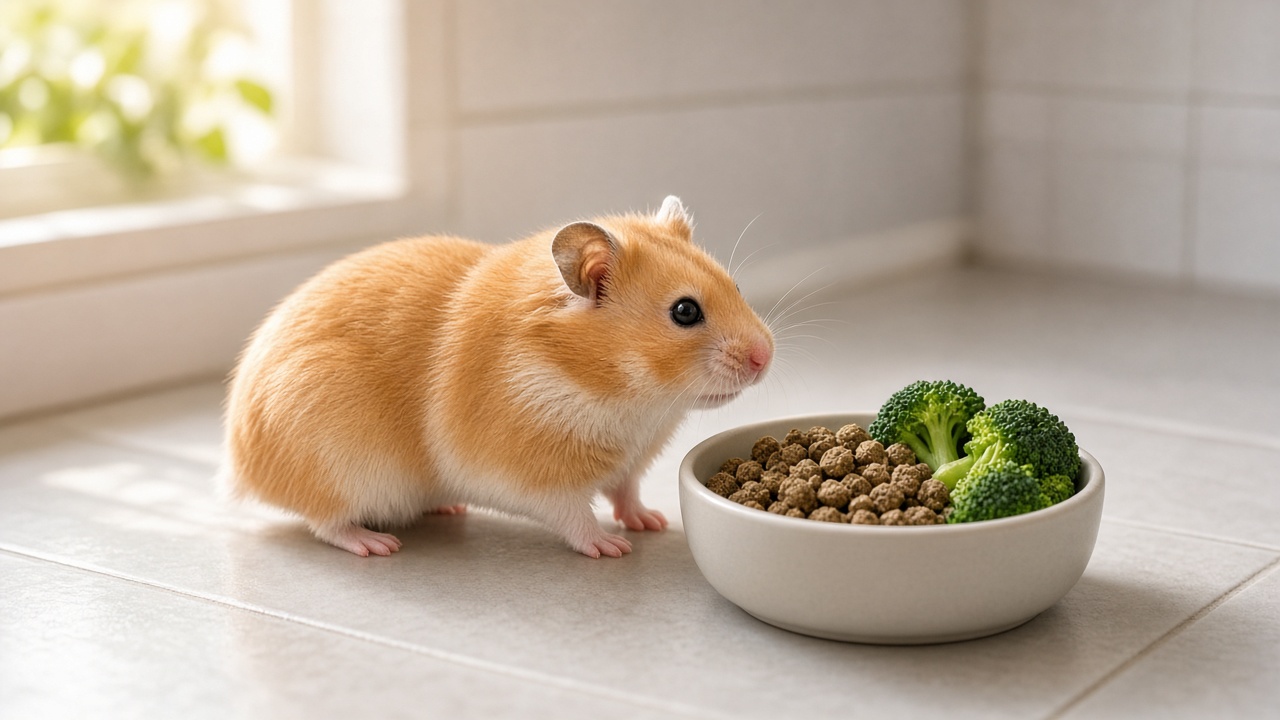
Mazuri sets a hard cap on extras. Grasses, vegetables, and seeds should not make more than 20% of an adult diet.
That 20% figure is the only numeric extra-food cap on the five maker pages we read. Use it as the ceiling when you add produce.
Keep produce pieces small. Remove what is not eaten before it wilts in bedding.
Oxbow says hamsters do not need hay as a staple. It still tells owners to offer free-choice hay for burrowing and hiding.
Hay in this use is furniture, not dinner. It does not replace the pellet.
Supreme’s U.S. Science Selective page warns that molasses, syrup, and other sugars can push overeating. That is a maker claim about added sugar, not a fruit ban.
The NRC chapter recorded a lab result on extreme sugar loads. Diets with 65% lactose or fructose had a 22% mortality rate. Diets with 71% glucose had a 6% mortality rate.
Those were purified lab diets, not a grape. They still argue against a sweet bowl.
Meat is part of the wild menu in the Merck chapter. It is not a listed daily item on these five bags.
Five complete foods, compared by label
The table below uses attributes the makers print. There is no rank column. There is no price column.
Format is the first split. A uniform pellet or extruded nugget makes every piece the same meal. A seed-and-fruit mix lets a hamster build a high-fat snack.
| Product | Format | Crude protein (min) | Crude fat (min) | Crude fiber | Listed adult serving |
|---|---|---|---|---|---|
| Oxbow Essentials Hamster & Gerbil Food | Uniform pellet | 15.00% | 4.50% | 10.00–15.00% | Small 1/8 cup; large 1/3 cup |
| Mazuri Hamster & Gerbil Diet (5M7V) | Mixed pellet shapes | 17.00% | 4.00% | 10.00–15.00% | Syrian 20–25 g; dwarf 5–7 g |
| Supreme Science Selective Hamster | Extruded nugget | 17.0% | 3.0% | 8.0% max | 5–10 g per day |
| Kaytee Forti-Diet Pro Health Nourish+Protect Hamster and Gerbil Food | Seed-and-pellet blend | 12.0% | 6.0% | 12.0% max | 2 Tbsp (about 20 g) |
| Higgins Sunburst Gourmet Blend Hamster & Gerbil | Gourmet seed-and-fruit mix | 15.0% | 7.0% | 9.5% max | 2–3 Tbsp per day |
Crude-fat minima on those pages run from 3.0% to 7.0%. Higgins sits at the high end. Science Selective sits at the low end.
Crude-fiber maxima run from 8.0% on Science Selective to 15.00% on Oxbow and Mazuri. That is the widest nutrient spread after protein.
Oxbow lists calcium at 0.60% to 1.00%, with phosphorus at 0.40% minimum. Science Selective’s U.S. guaranteed analysis lists calcium at 0.6% to 1.2% and phosphorus at 0.4% minimum.
Mazuri lists calcium at 1.00% minimum and phosphorus at 0.60% minimum. Vitamin E is listed at 200 IU/kg on Mazuri and 190 IU/kg on Oxbow. Science Selective lists 50 IU/kg.
Bag size is a freshness issue, not a value score. Kaytee sells 3 lb and 8 lb bags. It tells owners to use an opened bag in 30 to 45 days.
Oxbow sells 1 lb and 15 lb bags. Mazuri’s listed bag is 1.25 lb, Science Selective’s U.S. pack is 12 oz, and Higgins lists 2.5 lb and 25 lb.
Kaytee lists omega-3 fatty acids at 0.6% minimum and Bacillus species at 80,000 CFU/g. Mazuri lists omega-3 fatty acids at 0.40% and total microorganisms at 270,000 CFU/g.
Higgins lists omega-3 fatty acids at 0.40% and DHA at 0.03%. Lactic acid bacteria are listed at 200,000 CFU/g.
Switch foods slowly. Oxbow uses a four-week mix: one-quarter new, then half, then three-quarters, then all new. Kaytee and Higgins both list a 7 to 10 day mix of old and new food.
Water, hoarding, and a clean cage
The NRC chapter reports average golden-hamster water intake of 8.5 mL per 100 g each day. Males averaged 5 mL per 100 g. Females averaged 14 mL per 100 g.
A 125 g Syrian at that 8.5 mL rate drinks about 11 mL of water a day. The female rate on the same body would be about 18 mL.
The Merck chapter says glass water tubes are a poor fit for Syrian hamsters. They bite through glass. Stainless steel sipper tubes, set low, are the listed hardware.
Place pellets on the cage floor if a hopper does not fit a broad muzzle. The Merck chapter makes that floor-feeding point for Syrians.
Hoarding is normal. Oxbow notes that hamsters hide food, especially females and animals housed together. Check the caches and cut the next scoop if a pile is growing.
Fresh food in a nest spoils faster than dry pellets. That is why diet and how to clean a hamster cage belong in the same routine.
If you feed daily vegetables, the wet corners need a shorter interval. Our cage-interval guide on how often to clean a hamster cage is the matching chore list.
A homemade habitat still needs a floor dish and a steel sipper. If you are building one, the layout notes in our DIY hamster cage guide should include both.
Keep the room above hibernation cold. The Merck chapter says hamsters often hibernate below 5°C, or 41°F.
Syrian hamsters do not fatten first. They starve if they do not wake to eat.
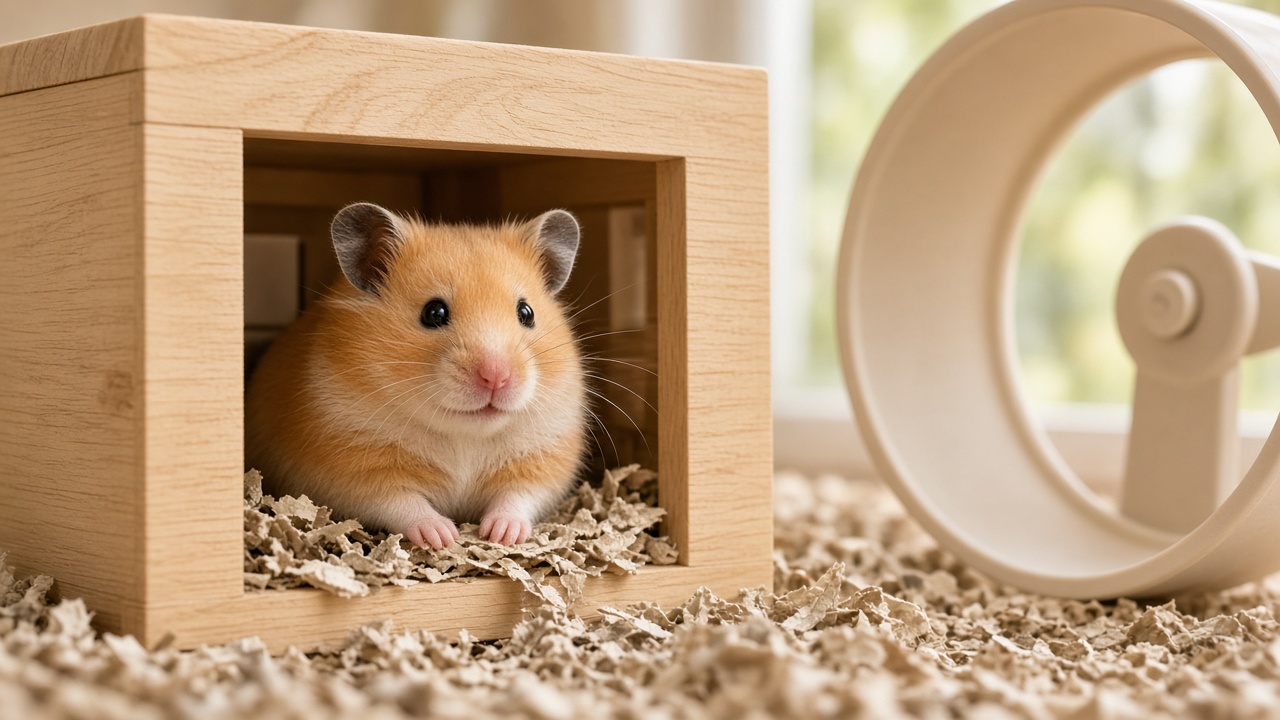
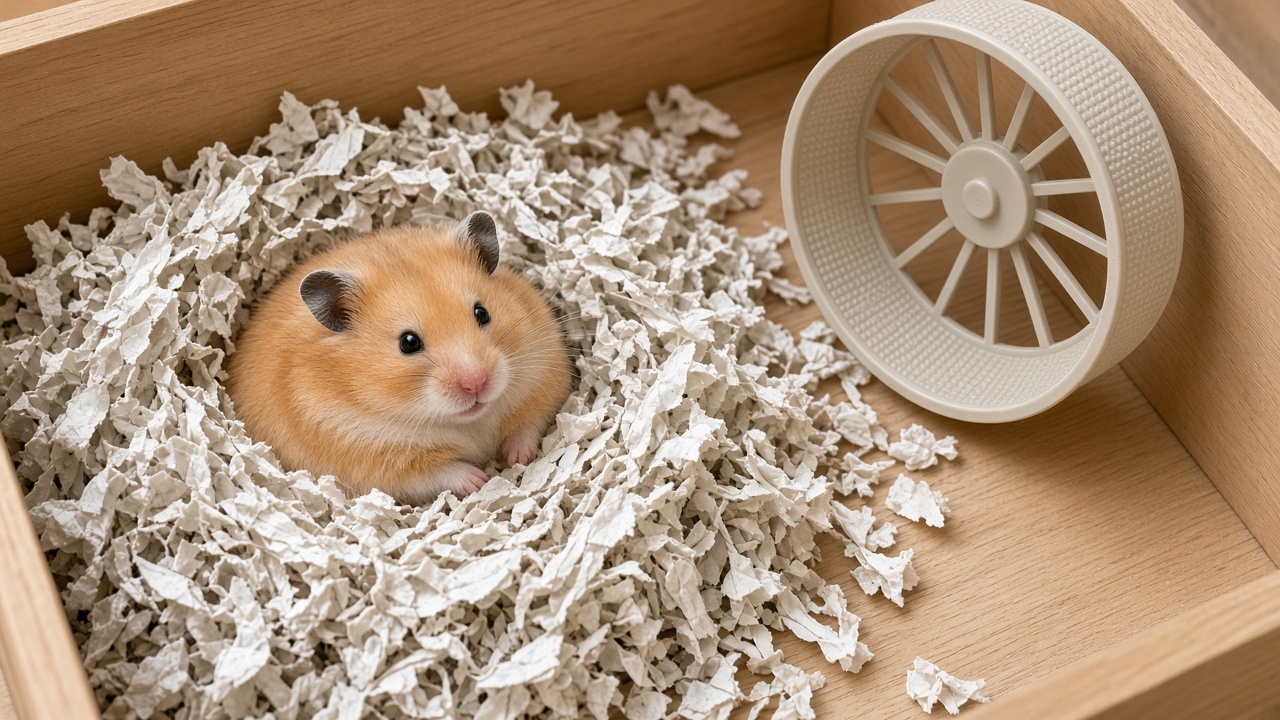
Deep bedding supports that night work. The Merck chapter recommends 40 to 80 cm, about 15 to 30 inches, of burrowing bedding for Syrians.
Age, teeth, and species notes
Newborn golden hamsters weigh 2 to 4 g in the NRC chapter. Incisors are already erupted.
Solid food starts at 7 to 10 days. Weaning is listed at 21 days, at about 40 g.
Oxbow’s unlimited ration for animals under six months matches that growth window. A weanling is not an adult scoop plus leftovers.
Syrian lifespan in the Merck chapter is 2 to 3 years. That is a short adult phase. Weight drift shows up fast.
Hamsters are coprophagic, per the Merck chapter. Do not treat pellet-looking feces as wasted food.
Cheek pouches can more than double head-and-shoulder width when full. A stuffed face is storage, not proof the daily scoop was small.
If two foods share a protein line, pick the format that leaves fewer uneaten pieces.
FAQ
Can a hamster live on a seed mix alone?
The Merck Veterinary Manual says generic seed mixes should be avoided. Hamsters pick seeds and skip pellets. A mix can sit in the bowl as an extra under a maker cap such as Mazuri’s 20% rule.
How many grams should I feed each day?
Mazuri lists 20 to 25 g for an adult Syrian and 5 to 7 g for an adult dwarf. Science Selective lists 5 to 10 g for an average adult. Kaytee lists about 20 g as 2 tablespoons. Use the line that names your species, then adjust for leftover hoards.
Do dwarf hamsters eat the same food as Syrians?
The five bags we compared are sold for hamsters as a group. The servings are not the same. A 20 g Kaytee scoop is roughly three to four times Mazuri’s 5 to 7 g dwarf band.
Do hamsters need hay?
Oxbow says hay is not a required staple. Offer it free choice for burrowing and hiding. The pellet or nugget remains the measured meal.
Why does my hamster hide food?
Hoarding is a species habit. The NRC chapter notes that wild hamsters store grain in burrows. Oxbow tells owners to find the stockpiles and change the next ration.
Can I add vegetables every day?
Yes, as a small extra, not as the base. Mazuri’s page keeps grasses, vegetables, and seeds at or under 20% of the adult diet. Wash the produce. Take out uneaten pieces before they wet the nest.
How long can an opened bag sit?
Kaytee tells owners to use food within 30 to 45 days after opening. Mazuri says to reseal the bag and store it at 75°F or colder. Stay inside the printed best-if-used-by date.