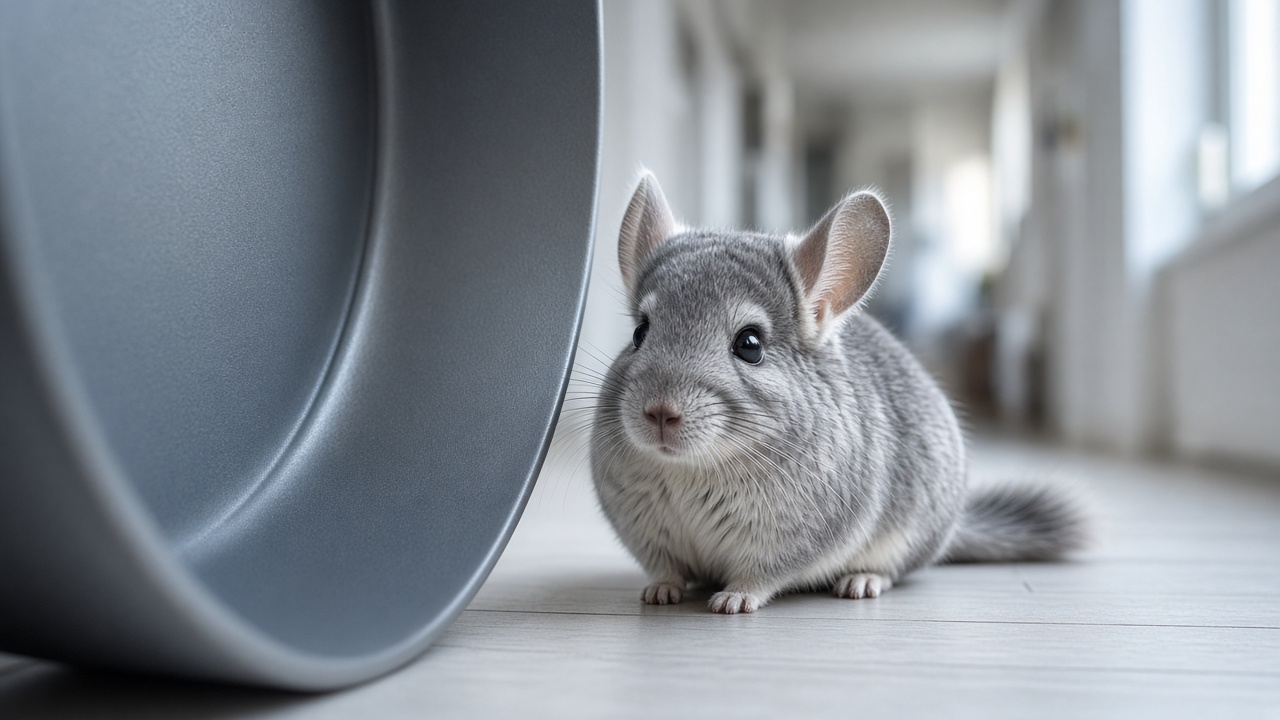
Quick answer: Pet chinchillas often live 15 to 20 years. Smithsonian’s National Zoo reports about 10 years in the wild and over 20 years in human care. Cool rooms and a high-fiber diet are the levers tied to that longer span.
Smithsonian’s National Zoo states wild chinchillas live about 10 years and can live over 20 years in human care.
This page is a research-desk synthesis of published zoo, manual, and maker numbers.
What this desk counted, and what it left out
Our selection rule is simple. A fact entered only if a named organization published it with a number on its own page.
A product entered the table only if it is a currently sold daily diet or grass-hay staple. The maker also had to list a guaranteed analysis.
We left out oldest-pet stories with no named record keeper. We also left out color-mutation rankings and treats with no nutrient analysis.
Our research team analyzed those published specs.
We call the three published levers the Cool-Fiber-Space Rule. Cool air, abrasive fiber, and a cage that does not trap a hind leg are the variables the sources quantify.
Wild years versus home years
Smithsonian’s National Zoo states a wild long-tailed chinchilla lives about 10 years. The same page states the species can live over 20 years in human care.
The Merck Veterinary Manual, in its May 2026 chinchilla review, states a long lifespan, up to 20 years.
Those two figures answer the query. Wild years cluster near a decade. Managed years can reach the late teens or pass 20.
The gap is not a mystery gene. Wild animals face predators, weather, and hunting. Home animals face heat, soft diets, and cage injuries instead.
Smithsonian’s National Zoo places the species in the Andes of northern Chile. The elevation range on that page is 9,800 to 16,400 feet.
That highland origin is why a warm living room is a lifespan risk. Dense fur that works at altitude holds heat at sea level.
Smithsonian’s National Zoo also states each follicle can hold up to 60 hairs. That density is a cooling problem, not only a coat fact.
The same zoo page lists female weight up to 1.76 pounds, or 800 grams. Males weigh about 1 pound, or 0.5 kilogram. We found no zoo page that printed a male-versus-female life table.
Heat, humidity, and the 150 rule
The Merck Veterinary Manual states chinchillas tolerate cold and are sensitive to heat. The ambient range it lists is 18.3 to 26.7°C, or 65 to 80°F.
Exposure above that range can result in heatstroke. High humidity makes the risk worse.
The manual’s own rule is to add Fahrenheit temperature to relative humidity. Any sum over 150 is called dangerous.
An example on that page is 85°F plus 65 percent humidity. That pair equals 150.
A humid 78°F room can still fail the sum. The check is more useful than a vague “keep them cool” line.
The same manual states fur mats above 26.7°C, or 80°F, in humid air. Matted fur is a husbandry signal, not a breed trait.
This is the Cool leg of the Cool-Fiber-Space Rule. A room that stays in the mid-60s sits closer to the published range.
Place the cage away from radiators, south windows, and dryer vents. Those are placement choices, not equipment tests.
Fiber, teeth, and the long-life diet
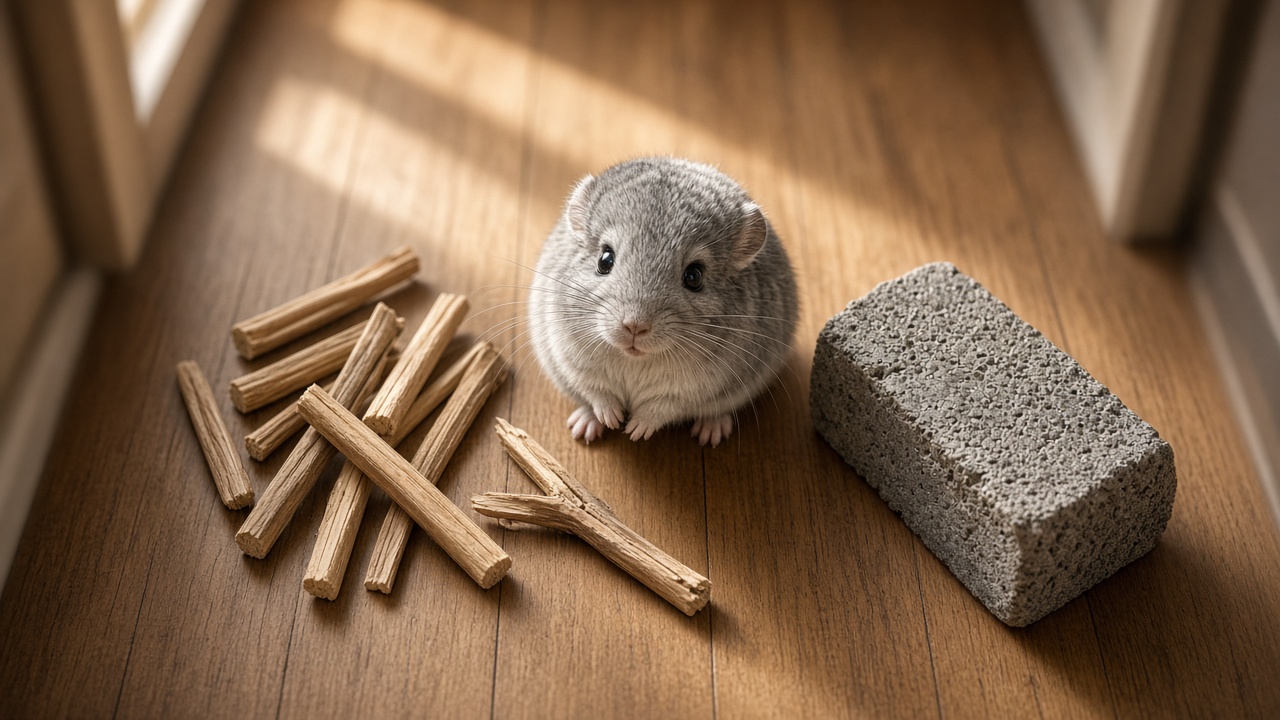
A 20-year rodent keeps growing teeth. The Merck Veterinary Manual states cheek-tooth crown and root problems are common.
Abnormalities tied to subclinical dental disease were reported in one-third of apparently healthy chinchillas at routine exams.
That one-third figure is the strongest published warning we found. An animal that still eats can already have hidden dental change.
The same manual states 50 percent of intraoral lesions can be missed in a conscious exam.
A less abrasive captive diet is listed as a proposed factor. Genetic causes are listed as well.
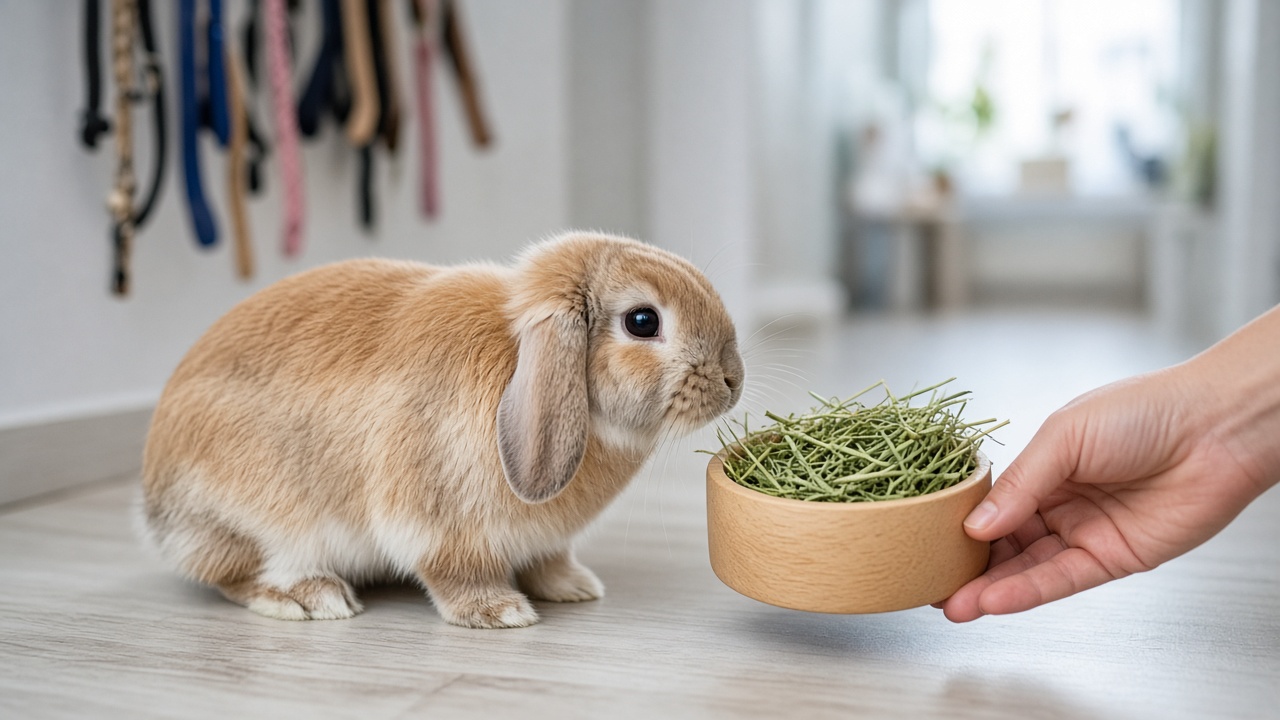
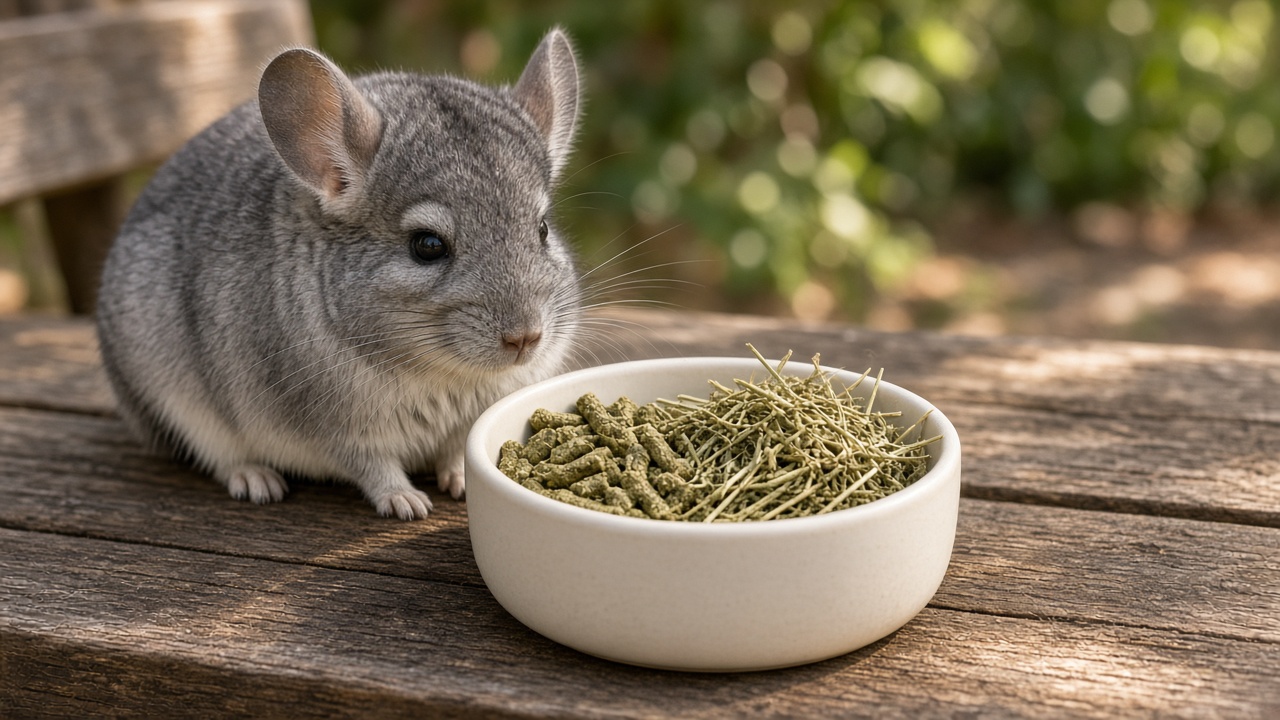
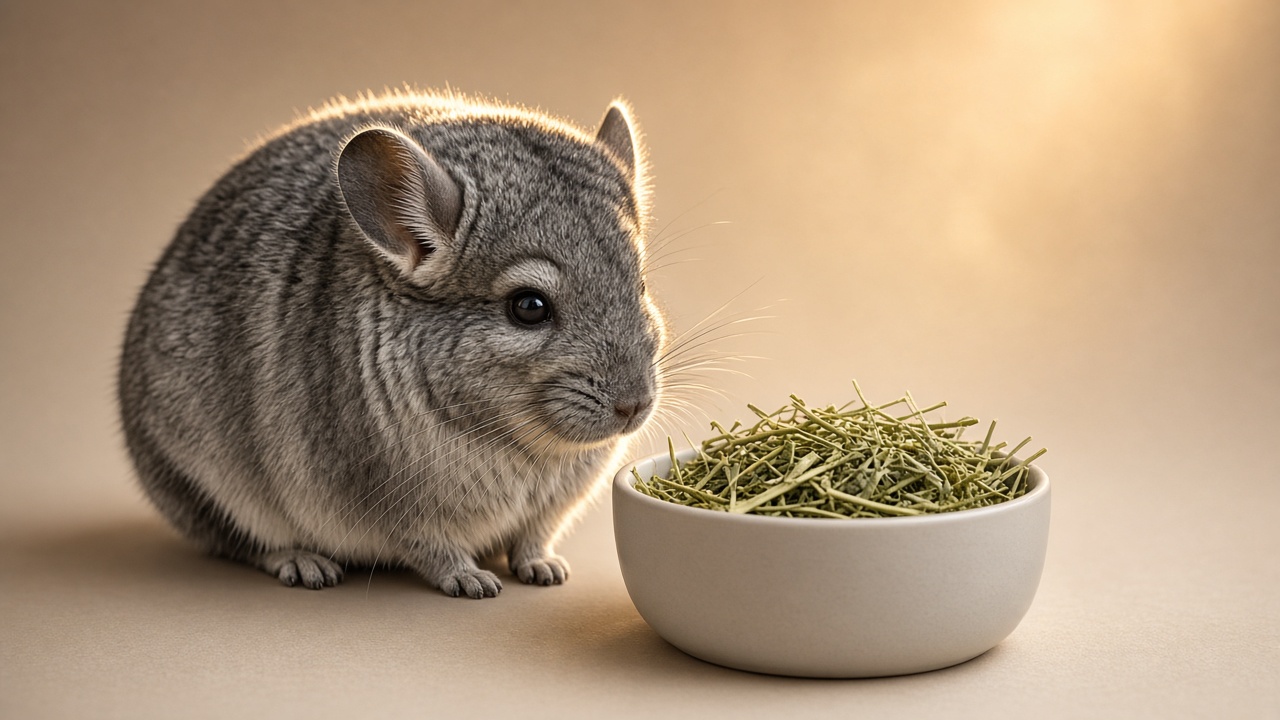
The diet the manual describes should consist mainly of high-quality grass hay. Pelleted chinchilla diets should supplement that hay.
Oxbow Animal Health, on its Essentials Chinchilla Food page, pairs pellets with free-choice grass hay. Adults older than one year get 1/8 to 1/4 cup of that food.
Younger animals get that food free-choice, plus grass hay and alfalfa. After one year, Oxbow Animal Health limits alfalfa hay to an occasional treat.
Oxbow Western Timothy lists crude fiber at a maximum of 32.00 percent. Crude protein is a minimum of 7.00 percent.
Moisture on that hay label is a maximum of 15.00 percent. High fiber is the Fiber leg of the rule.
Mazuri’s Chinchilla Diet page states adults eat about 20 grams, or 2 tablespoons, of pellets a day. Unlimited grass or hay sits beside that ration.
The same Mazuri page limits vegetables and fruits to less than 10 percent of the diet. Treats stay under 2 percent.
Kaytee’s Forti-Diet Pro Health Chinchilla Food page lists a starting portion of 2 tablespoons, about 20 grams.
Those maker portions cluster near two tablespoons a day. Hay volume is the larger, less numbered part of the bowl.
Sudden diet changes are a GI risk in the Merck Veterinary Manual. Oxbow Animal Health publishes a four-week mix-in for its pellets.
The first week is three parts old food to one part new. Equal parts come next, then the ratio flips, and week four is the new food alone.
Kaytee’s Forti-Diet page uses a 7 to 10 day mix-in window instead. Comparing those published schedules is not a feeding trial.
Daily diets compared by published specs
The table below is an attribute sheet, not a ranking. No column assigns a place, a score, or a price.
We included four currently sold items with a maker-published guaranteed analysis. Three are chinchilla-labeled pellet diets. One is the grass-hay staple Oxbow Animal Health names for chinchillas.
We kept uniform pellets in the table. Oxbow Animal Health states uniform food reduces selective eating.
| Product | Form | Crude protein (min) | Crude fat (min) | Crude fiber | Moisture (max) | Maker feeding note |
|---|---|---|---|---|---|---|
| Oxbow Essentials Chinchilla Food | Uniform pellet | 18.00% | 2.50% | 18.00% min, 23.00% max | 10.00% | Adults: 1/8–1/4 cup plus free-choice grass hay |
| Kaytee Forti-Diet Pro Health Chinchilla Food | Pellet with larger crunchy pieces | 17.0% | 3.0% | 17.0% max | 12.0% | About 2 tablespoons (20 g) as a starting portion |
| Mazuri Chinchilla Diet | Pellet, 5/32 in diameter × 3/8 in long | 20.00% | 3.00% | 18.00% max | 12.00% | About 20 g (2 tablespoons) plus unlimited grass or hay |
| Oxbow Western Timothy | Loose timothy grass hay | 7.00% | 1.50% | 32.00% max | 15.00% | Large handfuls in the habitat daily |
Mazuri’s page also lists calcium not less than 0.75 percent and phosphorus not less than 0.60 percent. Total microorganisms are not less than 270,000 CFU/g.
Those micronutrient lines are label facts. They are not proof that one bag adds years.
A keeper comparing published specs should match the cup to body condition. The Merck Veterinary Manual notes constipation is more common than diarrhea when fiber is short.
Space, dust, and injury risk
The Space leg of the rule is about legs, hides, and dust. It is not about floor-area bragging.
The Merck Veterinary Manual states tibial fractures commonly occur in young animals. The typical cause is a hind leg caught in wide floor-mesh grating.
Wire-mesh spacing should be narrow. Solid-bottom cages are recommended for females about to have young.
The same manual states chinchillas need places to hide. PVC plumbing pipes in elbow, Y, and T shapes are listed as hides.
Those pipes should be 10.2 to 12.7 cm, or 4 to 5 inches, in diameter. That is a published dimension, not a home build log.
Chinchillas require dust baths for skin and fur. The Merck Veterinary Manual states most commercial dusts are powdered pumice or aluminum silicate.
The published method is a box with about 2.5 cm, or 1 inch, of dust. Offer it 2 to 3 times a week for up to 15 minutes.
A box left in all day becomes a litter pan. The manual states excess dust bathing can irritate eyes.
Handle the animal by supporting the body. The Merck Veterinary Manual describes fur slip as a large patch of fur released under stress.
Fur can take several months to regrow. That coat loss is a handling cost, not aging.
Age stages that change the risk picture
The Merck Veterinary Manual states young chinchillas become sexually mature at 8 months. Gestation averages 111 days.
The estrous cycle is 38 days. Females generally have two litters a year, with 1 to 6 young and an average of 2.
Those numbers explain why this is a two-decade housing decision. An 8-month-old animal is already adult in reproductive terms.
Smithsonian’s National Zoo states kits nurse until 6 to 8 weeks old. They are born developed, not naked and blind.
Breeding is a lifespan variable. Dystocia, fur ring in males, and cage aggression are all described in that manual. Skip breeding if the goal is a long pet life.
Despite a lifespan up to 20 years, the Merck Veterinary Manual states chinchillas rarely develop neoplasia in published series.
Between 1994 and 2003, 325 chinchillas were presented to a major university hospital. Tumors were diagnosed in only 3 animals, or 1 percent.
Long life in this species is not a tumor story. It is a teeth, gut, heat, and fracture story.
Aging animals can develop posterior cortical cataracts, according to the same manual. Heart murmurs in young animals are described as common.
A survey cited there found echo abnormalities about 29 times as likely at murmur grade 3 or higher. That figure is a clinic statistic, not a home diagnosis.
A clinician who treats exotic rodents can sort those signs. This desk is reporting published rates, not examining patients.
If the Cool-Fiber-Space Rule holds, the late teens become a plausible target. Heat, a seed bowl, or wide mesh makes the wild-type decade the more honest forecast.
FAQ
How long do pet chinchillas live?
Smithsonian’s National Zoo states they can live over 20 years in human care. The Merck Veterinary Manual states a long lifespan, up to 20 years. Many well-kept pets land in the 15-to-20-year band those sources describe.
How long do chinchillas live in the wild?
Smithsonian’s National Zoo states about 10 years in the wild. That shorter span tracks predation, weather, and historic hunting. It is not a different species clock.
What shortens a chinchilla’s life most often in homes?
Published risks cluster around heat above 80°F. Humid air that fails the 150 sum is next. Low-fiber diets and legs caught in wide mesh complete the list.
The Merck Veterinary Manual also flags hidden dental disease in one-third of apparently healthy animals at routine exams.
How much should a chinchilla eat each day?
Mazuri’s Chinchilla Diet page and Kaytee’s Forti-Diet page both start adults near 20 grams, or 2 tablespoons, of pellets. Oxbow Essentials uses 1/8 to 1/4 cup for animals older than one year. All three pair pellets with free-choice grass hay.
When is a chinchilla a senior?
The sources we read do not publish a single senior birthday. Sexual maturity at 8 months, from the Merck Veterinary Manual, only marks adulthood. Eye changes and slower chewing in the mid-teens are the late-life flags that same manual describes.
Do chinchillas need dust baths to live a long life?
They need dust to keep skin and fur healthy. The Merck Veterinary Manual’s schedule is 2 to 3 short baths a week. Each bath is about 15 minutes in 1 inch of dust.
Daily open trays are not the method that page describes.
Can two chinchillas share a cage for more years?
Chinchillas are social in the wild. The Merck Veterinary Manual still describes female aggression, bite wounds, and older females killing young males in the same cage. Pairing is a temperament decision, not a published longevity bonus.