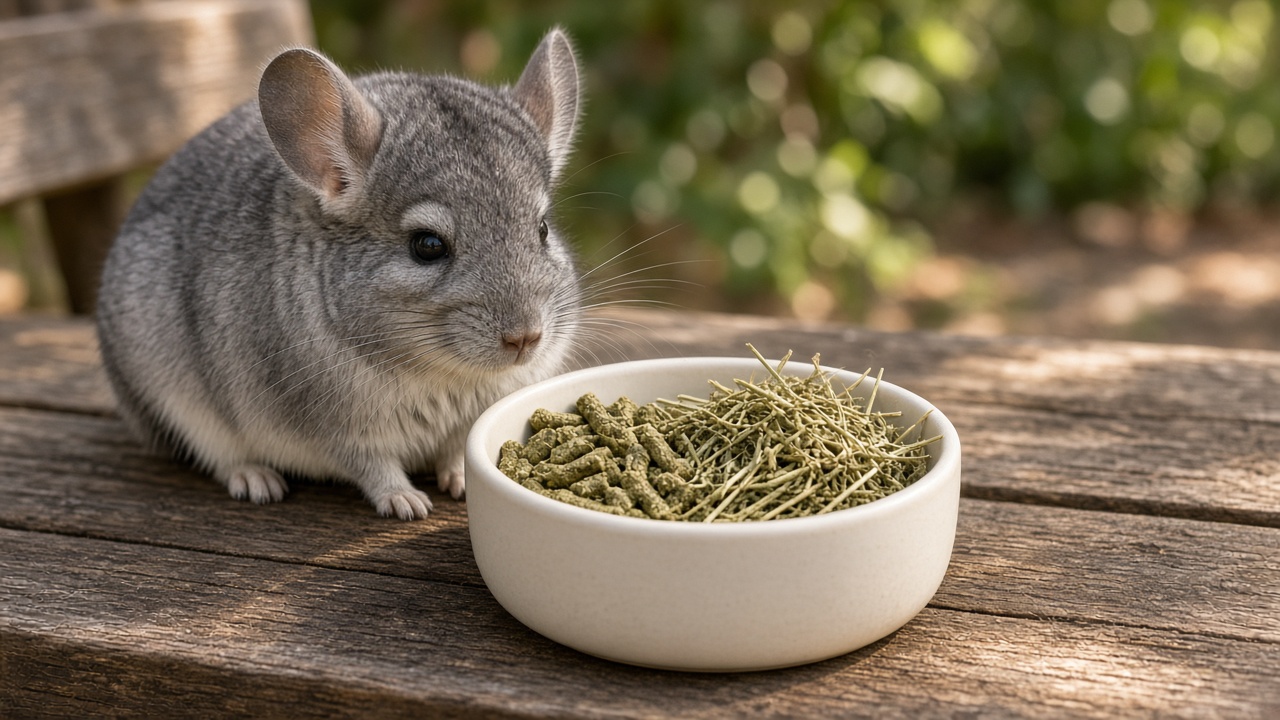
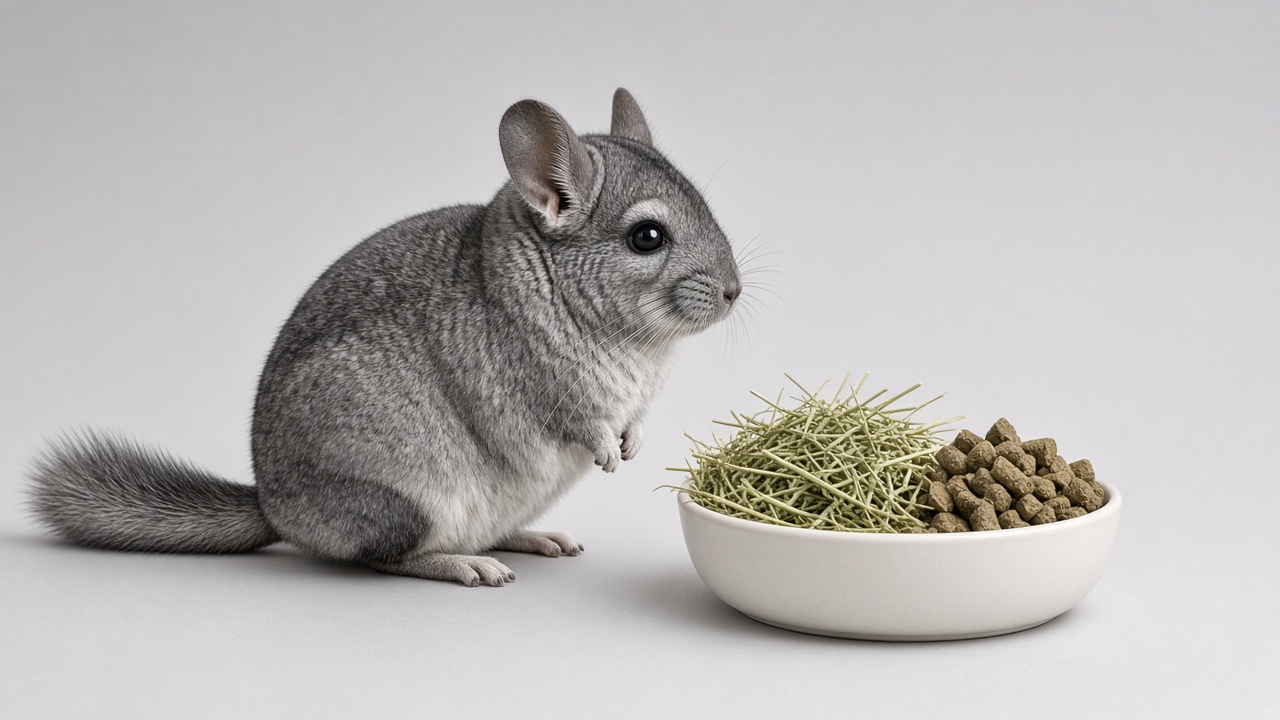
Quick answer: Keep grass hay in front of an adult chinchilla all day, then add a measured scoop of plain chinchilla pellets. The Merck Veterinary Manual puts that pellet scoop at 1–2 tablespoons. Skip seed mixes, dried fruit, and nuts.
An adult chinchilla diet is unlimited grass hay plus 1–2 tablespoons of plain pellets a day. This page is a label-and-manual briefing from a pet research desk.
What this article covers, and what it leaves out
Our selection rule is simple. We cover foods whose maker publishes a guaranteed analysis on its own site, and whose page names chinchillas.
Our research team analyzed those published specs side by side.
The working name for the daily plan is the Hay-First Plate. Hay stays out all day. Pellets stay measured.
The Hay-First Plate
Chinchillas eat plants. The Merck Veterinary Manual says wild forage is high in fiber. Pet pellets add nutrients, but they can also add calories.
That same Merck page says pellets crumble easily. They do not wear the teeth the way long-strand hay does. Teeth keep growing, so chewing time matters.
Hay is the main bowl. The Merck Veterinary Manual names timothy as the grass to keep on offer. Put out fresh hay each day, and store it dry.
Oxbow Animal Health sells Western Timothy Hay in bags from 15 oz to 50 lb. Its guaranteed analysis lists crude protein at 7.00% minimum and crude fat at 1.50% minimum.
Crude fiber on that Oxbow hay page is 32.00% maximum. Moisture is 15.00% maximum. Feeding is “large handfuls,” not a gram weight.
The Merck Veterinary Manual warns against alfalfa hay for typical adults. It ties alfalfa and high-calcium greens to bladder stones.
Oxbow’s pellet page still lists alfalfa meal first. That is a pellet recipe fact. It is not a reason to fill the hay rack with alfalfa.
Adults get grass hay first. Oxbow’s pellet bag makes one age exception. Animals under one year get free-choice pellets plus grass hay and alfalfa.
What four pellet labels actually list
Pellets are the second bowl, not the first. Maker pages do not agree on the daily weight.
Mazuri’s Chinchilla Diet page says adults eat about 20 grams, or 2 tablespoons, with unlimited hay. Kaytee’s Forti-Diet Pro Health Chinchilla Food page says the same 2 tablespoons, about 20 g.
Supreme Petfoods’ U.S. Science Selective Chinchilla page says 30–40 g, or 1–1.4 oz, per day. Oxbow Essentials Chinchilla Food tells owners to feed 1/8–1/4 cup after age one.
Those four adult directions are the spread we found. Twenty grams is not the same instruction as 30–40 grams. Use the line on the bag you bought.
Our research team compared the guaranteed analyses next. Crude protein minimums run from 14.0% on Science Selective to 20.00% on Mazuri.
Oxbow lists 18.00% protein minimum. Kaytee lists 17.0% protein minimum. Fat minimums run from 1.0% on Science Selective to 3.00% on Mazuri.
Kaytee also lists 3.0% fat minimum. Oxbow sits at 2.50% fat minimum.
Fiber is printed in different styles. Oxbow gives a band of 18.00% minimum and 23.00% maximum. Mazuri lists fiber at 18.00% maximum.
Kaytee lists 17.0% fiber maximum. Science Selective lists 22.0% maximum.
First ingredients line up. Oxbow, Mazuri, Kaytee, and Science Selective all start with an alfalfa meal form. Hay still has to do the long-stem work.
| Product | Form | Protein (min) | Fat (min) | Fiber on the label | First ingredient | Adult amount on the maker page |
|---|---|---|---|---|---|---|
| Oxbow Essentials Chinchilla Food | Uniform pellet | 18.00% | 2.50% | 18.00% min, 23.00% max | Alfalfa meal | 1/8–1/4 cup plus free-choice grass hay |
| Mazuri Chinchilla Diet | Pellet, 5/32 in × 3/8 in | 20.00% | 3.00% | 18.00% max | Dehydrated alfalfa meal | 20 g (2 tablespoons) plus unlimited hay |
| Kaytee Forti-Diet Pro Health Chinchilla Food | Pellet with larger pieces | 17.0% | 3.0% | 17.0% max | Sun-cured alfalfa meal | 2 tablespoons (about 20 g) |
| Science Selective Chinchilla | Extruded nugget | 14.0% | 1.0% | 22.0% max | Alfalfa meal pellets | 30–40 g per day plus hay |
| Oxbow Western Timothy Hay | Loose grass hay | 7.00% | 1.50% | 32.00% max | Timothy grass hay | Large handfuls, daily |
Mazuri prints a pellet size of 5/32 inch by 3/8 inch and formula number 5M01. Bag sizes on that page are 2.5 lb and 25 lb.
Kaytee lists 3 lb and 25 lb bags. The 3 lb carton is 3.75 in by 5.5 in by 8.5 in.
Science Selective’s U.S. page lists one pack size, 4.4 lb. Oxbow Essentials lists 3 lb, 10 lb, and 25 lb.
Vitamin lines diverge. Oxbow lists vitamin E at 190 IU/kg minimum. Science Selective lists vitamin E at 50 IU/kg minimum.
Both list vitamin A at 10,000 IU/kg minimum. Science Selective adds vitamin D3 at 1,000 IU/kg.
Calcium bands differ too. Oxbow lists calcium at 0.60% minimum and 1.10% maximum. Science Selective lists calcium at 0.5% minimum and 1.4% maximum.
The same Supreme page also prints calcium 0.8% and phosphorus 0.4% as a marketing pair.
Mazuri lists calcium at 0.75% minimum and phosphorus at 0.60% minimum. It also lists omega-3 fatty acids at 0.50% minimum.
Mazuri’s probiotic line is 270,000 CFU/g. Kaytee lists omega-3 fatty acids at 0.4% minimum and 60,000 CFU/g of Bacillus species.
Those flax and linseed fats are plant oils. They are not a dog fish-oil skin and coat supplement. Do not pour a canine capsule into this bowl.
Color claims are label facts, not ranks. Oxbow and Mazuri say no artificial colors. Science Selective says no added sugars.
Kaytee’s ingredient list includes titanium dioxide, FD&C Yellow #5, FD&C Blue #1, and FD&C Red #40.
How a chinchilla bag differs from a cat bag
The Association of American Feed Control Officials explains complete-and-balanced wording on its Reading Labels page. That page is written for dog and cat food.
AAFCO says its model rules recognize only dog and cat nutrient profiles. They also recognize the AAFCO Dog and Cat Food Feeding Protocols.
The four chinchilla pellet pages we opened do not use that dog-or-cat profile sentence. A complete cat food diet can lean on those AAFCO profiles. A chinchilla pellet cannot.
AAFCO also says ingredients must appear in descending order by weight. Alfalfa meal at the top means alfalfa led the recipe.
AAFCO says feeding directions are required for most complete-and-balanced claims. The pellet pages above do print adult amounts. They still point back to hay.
Treats are a different label class on that AAFCO page. Snacks need not meet the complete-and-balanced bar if the pack says snack or treat.
Treats, greens, and the 10 percent fruit cap
The Merck Veterinary Manual allows a slice of fresh apple or pear as an occasional treat. Fruit should stay under 10% of the diet.
That same page says to avoid dried fruits, grains, seeds, and nuts. It says those items can upset the stomach.
Mazuri writes two tighter numbers. Vegetables and fruits, if offered, should stay under 10% of the total diet. Treats should stay under 2%.
Mazuri also says produce is not required. The Merck Veterinary Manual still lists a daily handful of dark green lettuce. It names romaine and green leaf lettuce.
It also names bell peppers, carrot tops, and celery. It tells owners to skip kale, parsley, and dandelion greens because of calcium.
Carrots stay rare on that Merck page because of sugar. Throw out uneaten produce the same day. Mold is the reason.
Yogurt drops and seed cups fail our selection rule. They are treats, not daily rations.
Hay is still the chew that wears teeth. Cats need a different dental plan, which we cover in our cat dental care guide. A chinchilla’s teeth need long-strand fiber.
Young animals, nursing females, and food switches
Age changes the pellet bowl. Oxbow says animals younger than one year get Essentials Chinchilla Food free-choice. Adults over one year drop to 1/8–1/4 cup.
Mazuri says juveniles and lactating females should have unlimited pellets. Adults stay at about 20 grams.
The Merck Veterinary Manual says new foods should come in slowly over several days. Fast changes can bring wet droppings and gas.
Maker calendars are longer than “several days.” Oxbow prints a four-week mix. Week 1 is three parts old food and one part new.
Week 2 is even parts. Week 3 is one part old and three parts new. Week 4 is the new food alone.
Kaytee prints a 7 to 10 day mix of old and new food. That is shorter than Oxbow’s four weeks. Follow the bag you are opening.
Storage windows differ too. Kaytee says to use an opened bag within 30–45 days. Reseal it, and keep it cool and dry.
Mazuri says to store at 75°F, or 24°C, or colder. It names about 50% relative humidity. Use the diet within 1 year of the bag date.
Water is part of the plate. The Merck Veterinary Manual prefers a bottle because it stays cleaner. Clean the bottle every day.
That page also says some animals never learn the spout. Some with dental pain drink more easily from a bowl.
Cecotrophy is normal on that Merck page. Animals eat some of their own droppings. That is not a reason to cut hay.
We left out rabbit-only pellets as daily staples. Our rule required a maker page that names chinchillas.
We left out salt licks and extra mineral blocks. No maker page we opened required them on top of a fortified pellet and grass hay.
We left out dog supplements, including fish oil. Plant omega-3 figures on the Mazuri and Kaytee labels are not a canine dose.
We left out any claim that a bag is a full diet without hay. Every pellet page above still points back to grass hay.
If an animal stops eating, that is a clinic problem, not a recipe tweak. The Merck Veterinary Manual flags sensitive stomachs for a reason.
FAQ
How much hay should a chinchilla eat each day?
Hay should be available at all times. The Merck Veterinary Manual calls for unlimited timothy hay plus a small pellet scoop. Oxbow Western Timothy Hay tells owners to put large handfuls in the habitat daily.
How many pellets does an adult need?
The Merck Veterinary Manual gives 1–2 tablespoons a day. Mazuri and Kaytee both print about 20 grams, or 2 tablespoons. Science Selective prints 30–40 grams, and Oxbow prints 1/8–1/4 cup after age one.
Can I feed rabbit pellets instead?
Our selection rule kept rabbit-only bags out of the table. A product enters this page only if the maker’s own site names chinchillas and prints a guaranteed analysis. If a bag does not name chinchillas, it did not qualify here.
Are apple slices or raisins safe treats?
The Merck Veterinary Manual allows a slice of fresh apple or pear and keeps fruit under 10% of the diet. It tells owners to avoid dried fruit. Mazuri’s page keeps treats under 2% of the total diet.
How long should a pellet switch take?
The Merck Veterinary Manual says several days. Oxbow prints four weeks of stepped mixing. Kaytee prints 7 to 10 days.
Do chinchillas need a salt lick or extra vitamins?
None of the five maker pages in our table require a salt lick on top of the listed food. Oxbow and Mazuri both describe their pellets as covering daily vitamins and minerals. Extra drops sat outside our selection rule.
Is alfalfa hay all right for an adult?
The Merck Veterinary Manual tells owners to avoid alfalfa hay because of bladder stones. Oxbow’s adult pellet directions allow alfalfa hay only as an occasional treat. Young animals under one year are the group Oxbow pairs with free-choice pellets plus alfalfa.