
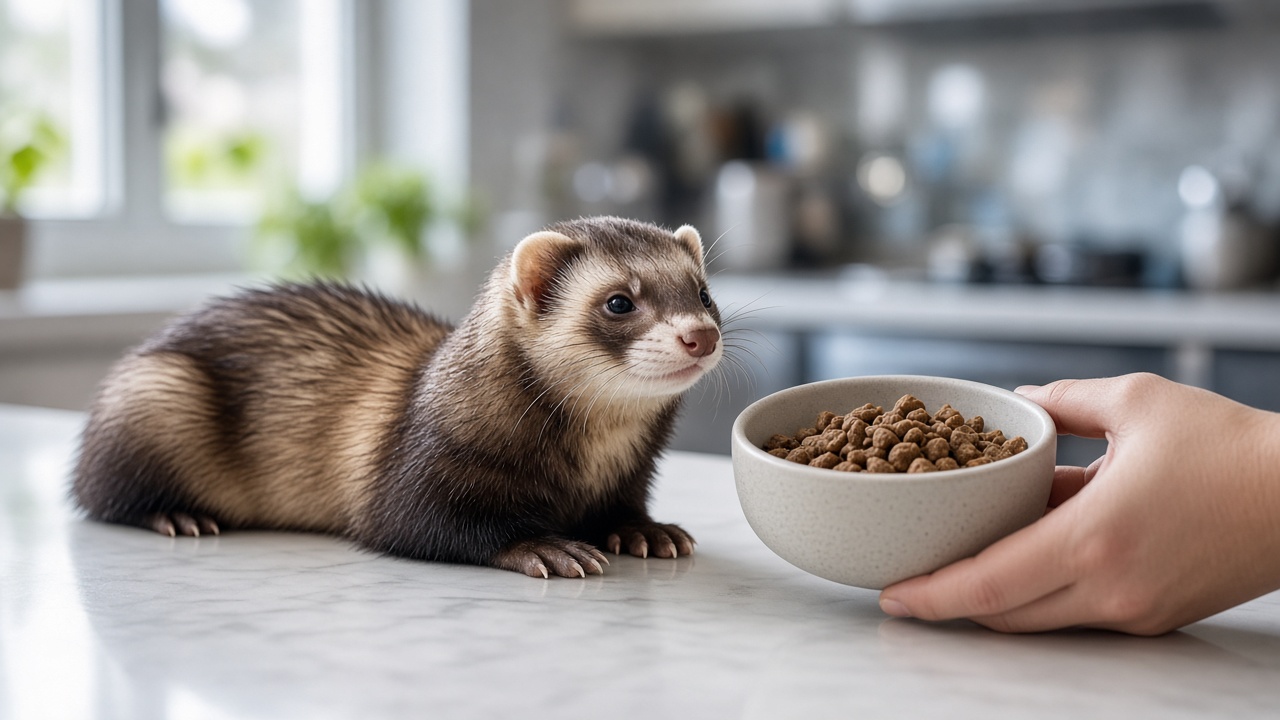
Quick answer: Plan on 5 to 8 years for a typical pet ferret. Auburn University College of Veterinary Medicine and Marshall Pet Products both publish that window. Diet, housing, and early disease checks shape the odds more than coat color.
A typical pet ferret lives 5 to 8 years, the same window Auburn and Marshall Pet Products both publish. This page is a desk comparison of published lifespan ranges and current diet labels, and
We used one rule for every product here. A dry ferret diet had to be on sale now, and its maker had to list a guaranteed analysis on its own site. We left out cat food, treats, raw mixes, and any recipe that exists only on a retailer card.
That is the Label-or-Leave Rule. It keeps this page on foods owners can buy and compare. It also keeps us from ranking bags we never fed.
The 5-to-8-year window, in print
Search pages often stretch ferret life toward a decade and a half. Printed ranges from the groups we read do not.
Marshall Pet Products tells new owners the average life span is 5 to 8 years. Auburn University College of Veterinary Medicine, writing about a five-year-old patient, says the common lifespan is between five and eight years.
A 2016 Veterinary Pathology review from the Massachusetts Institute of Technology Division of Comparative Medicine gives a wider band. That paper places the average life span at about 5 to 11 years.
Fox and colleagues, in Biology and Diseases of Ferrets, put the approximate life span at 6 to 8 years. They add that an animal may, on rare occasions, live as long as 11 years. Their table still lists average life span as 5 to 11 years.
Our research team lined those four printed ranges side by side. The shared floor is 5 years. The shared working ceiling for most pets is 8 years.
The 11-year figure appears only as a rare tail. That spread is the public record we could read. It is not a promise for one animal in one house.
Marshall Pet Products also lists adult weights on the same education page. It puts adult females at 1 to 3 pounds and adult males at 3 to 5 pounds.
Fox and colleagues put many gonadectomized, nonobese adults between 0.8 and 1.2 kilograms. Fox and Bell, cited in that chapter, say body weight can fluctuate by 30 to 40 percent. A heavy winter coat is not extra years.
Why year four is already a late chapter
The MIT review does not wait until year eight to talk about old age. It places the onset of geriatric disease between 3 and 4 years.
Endocrinopathies lead that list. The same paper calls them the most common noninfectious disease in middle-aged and older ferrets.
Two older tumor surveys cited there put the endocrine share at about 40 percent and 53 percent of ferret tumors. Simultaneous multiple tumors showed up in 12 to 20 percent of affected animals in those retrospective sets.
The MIT table of onset ages is blunt. Insulinoma clusters at 4 to 5 years. Adrenocortical neoplasms cluster at 4 to 6 years.
Those ages do not prove your ferret has a tumor. They do show why a four-year-old ferret is not a young adult in the published record.
The MIT authors also cite a United States pet count of about 7 to 10 million ferrets. That is a household figure, not a longevity study.
Auburn’s case note matches the middle of that aging curve. The college described a five-year-old ferret that already had adrenal disease plus a cancer of the paw.
Multiple problems in the waning years are the pattern Auburn’s clinician named. That is one service’s observation, not a census. Owners who wait for old-ferret signs at year nine are reading the wrong clock.
The Label-or-Leave Rule
Diet is the main non-clinical lever a household controls across a 5-to-8-year span. So we compared foods, not cages or toys.
The Association of American Feed Control Officials does not treat ferrets as pets in the dog-and-cat sense. AAFCO’s Model Bill Section 3(q) defines pets as dogs and cats.
Section 3(u) lists ferrets as specialty pets, with rodents, ornamental birds, and similar household species. AAFCO also states that it does not regulate, test, approve, or certify pet food.
Under AAFCO’s 2025 purpose-statement guidance, a Daily specialty-pet food is the daily diet for a species with no AAFCO-recognized nutritional authority. A Complete Food claim for a specialty pet is not allowed unless such a profile exists.
AAFCO accepted its Pet Food Label Modernization model in August 2023. Those model rules took effect on January 1, 2024.
We used them to explain why ferret bags lack the dog-food “complete and balanced” sentence. If a maker will not print protein, fat, fiber, and moisture on its own page, we leave the bag out.
What current ferret diet labels actually list
Our research team analyzed four currently sold dry diets on their maker pages. We compared only the numbers those pages print.
Marshall Premium Ferret Diet lists crude protein at 38.0 percent minimum. It lists crude fat at 18.0 percent minimum, crude fiber at 3.5 percent maximum, and moisture at 10.0 percent maximum.
Oxbow Essentials Ferret Food lists crude protein at 42.00 percent minimum and crude fat at 20.00 percent minimum. Fiber and moisture sit at 3.00 percent and 10.00 percent maximum.
Oxbow also prints taurine at 0.50 percent minimum and calcium at 1.20 percent minimum. Vitamin A is 20,000 IU per kilogram minimum. The bag size on Oxbow’s product page is 4 pounds.
ZuPreem Premium Ferret Diet lists crude protein at 40.0 percent minimum and crude fat at 20.0 percent minimum. Fiber and moisture match the 3.0 and 10.0 percent caps.
ZuPreem prints taurine at 0.15 percent minimum. That is less than one-third of Oxbow’s 0.50 percent taurine floor. ZuPreem tells owners to keep other foods and treats at or below 10 percent of the diet.
Bag sizes on ZuPreem’s page are 4.0, 8.0, and 30.0 pounds. Wysong Ferret Epigen 90 lists crude protein at 62 percent minimum and crude fat at 18 percent minimum.
Wysong’s fiber is 3 percent maximum, moisture is 10 percent maximum, and taurine is 0.2 percent minimum. Wysong tells owners to switch over 15 days, starting the new food at about 10 percent of the mix.
Marshall Pet Products says food passes a ferret’s gut in about 2 hours. It puts a cat’s digestion closer to 5 hours. That is Marshall’s comparison, not a trial we ran.
Marshall also publishes a four-year-and-up recipe with 10 percent less fat and protein than its flagship bag. That shift lines up with the MIT geriatric window. It is not an 11-year birthday plan.
We calculated one extra column from those printed floors. It is a protein-to-fat ratio, nothing more.
| Product | Crude protein min | Crude fat min | Crude fiber max | Moisture max | Taurine min | Protein-to-fat ratio |
|---|---|---|---|---|---|---|
| Marshall Premium Ferret Diet | 38.0% | 18.0% | 3.5% | 10.0% | not listed | 2.11 |
| Oxbow Essentials Ferret Food | 42.00% | 20.00% | 3.00% | 10.00% | 0.50% | 2.10 |
| ZuPreem Premium Ferret Diet | 40.0% | 20.0% | 3.0% | 10.0% | 0.15% | 2.00 |
| Wysong Ferret Epigen 90 | 62% | 18% | 3% | 10% | 0.2% | 3.44 |
Three of the four bags cluster near a 2-to-1 protein-to-fat ratio. Wysong Ferret Epigen 90 sits at 3.44 because its protein floor is 62 percent. That ratio is a label comparison, not a ranking.
Marshall Pet Products describes a good ferret diet as 30 to 40 percent animal-based protein and 15 to 20 percent fat. Three of the four bags sit inside or just above that protein band. A higher protein print does not prove a longer life.
Heat, gut speed, and daily clocks
Fox and colleagues warn that ferrets tolerate heat poorly. They recommend 4 to 18 degrees Celsius for juveniles and adults.
They say temperatures above 30 degrees Celsius cannot be tolerated well. Ferrets have poorly developed sweat glands and can slide into heat prostration.
Kits under 6 weeks need housing above 15 degrees Celsius if they are off the dam. Those numbers come from laboratory husbandry. They still give a hard ceiling for summer rooms.
Marshall Pet Products tells owners to moisten food for kits 6 to 11 weeks old. The mix is three parts warm water to one part Marshall Premium Ferret Diet.
Marshall wants a fully dry diet by 12 to 13 weeks of age.
Fox and colleagues put birth weight at 6 to 12 grams. They put weaning weight near 400 grams at 6 to 8 weeks.
A kit that size is not a small cat. It is a short-gut carnivore that Marshall says empties a meal in about 2 hours. Long gaps between bowls matter more in that gut than they do in a dog.
Vaccines Marshall lists beside a one-year guarantee
Marshall Pet Products states that every Marshall ferret leaves the farm with two distemper vaccines. The first is at 7 weeks. The second is at 9 weeks.
Marshall then recommends another distemper vaccine after 11 weeks of age. It recommends a rabies vaccine after 12 weeks of age, then both vaccines each year.
The Marshall guarantee runs one year from the purchase date. It covers neuter, descent, and congenital defects. It does not cover colds, influenza, tumors, cancers, or parasite-driven loss.
The guarantee also requires that the ferret stay on Marshall Premium Ferret Diet. That is a commercial condition, not a lifespan law.
The 2011 CDC MMWR Compendium of Animal Rabies Prevention and Control treats dogs, cats, and ferrets as one public-health group. A healthy ferret that bites a person is to be confined and watched daily for 10 days.
That same 2011 table lists a 1 milliliter subcutaneous ferret dose from 3 months of age, then annually. We are repeating a published schedule, not writing a clinic protocol.
A ferret that keeps every appointment can still die at six. The published window is a range, not a bargain.
FAQ
How long do ferrets live?
Most pet ferrets live 5 to 8 years. Marshall Pet Products and Auburn University College of Veterinary Medicine both print that range. A 2016 MIT review stretches the average to about 5 to 11 years, and Fox and colleagues call 11 years rare.
Do male and female ferrets live different lengths?
The lifespan pages we read do not split years by sex. They do split weight. Marshall Pet Products lists females at 1 to 3 pounds and males at 3 to 5 pounds.
When is a ferret considered old?
The MIT review places geriatric disease between 3 and 4 years. Insulinoma in its table clusters at 4 to 5 years. Adrenal tumors cluster at 4 to 6 years.
Does diet change how long a ferret lives?
No maker page we read publishes a survival curve for its kibble. The labels do publish protein, fat, fiber, moisture, and, on three bags, taurine. Our research team compared those printed floors and did not measure extra months.
Can a ferret live 10 years?
Fox and colleagues say an 11-year life happens on rare occasions. The MIT review’s upper average is 11 years. Auburn and Marshall both stop their common window at 8.
How much should a ferret weigh?
Marshall Pet Products puts adult females at 1 to 3 pounds and adult males at 3 to 5 pounds. Fox and colleagues put many gonadectomized adults between 0.8 and 1.2 kilograms. They also warn that body weight can swing 30 to 40 percent with the seasons.
What vaccines do Marshall kits leave the farm with?
Marshall Pet Products says kits receive distemper vaccines at 7 weeks and 9 weeks. It then recommends another distemper dose after 11 weeks and a rabies dose after 12 weeks. Both are yearly after that.
The printed lifespan for a pet ferret is short. Plan the house, the bowl, and the calendar around 5 to 8 years. Treat anything past that as a bonus the papers call uncommon, not as the default.