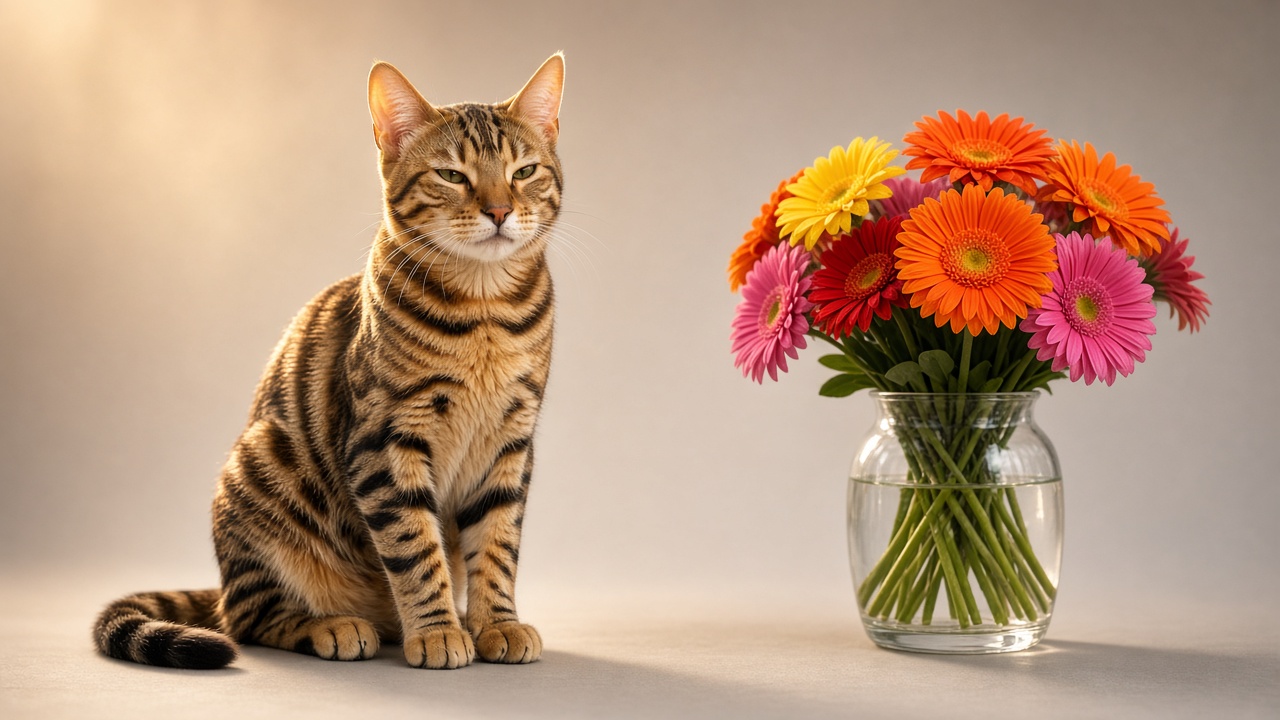
Quick answer: Gerbera daisies are not a cat poison. The ASPCA lists Gerbera jamesonii as non-toxic to cats. A mixed bouquet is a different problem if a true lily shares the vase.
The ASPCA lists Gerbera jamesonii as non-toxic to cats. That sentence still answers the search if you quote it alone. This page is a research-desk species check of florist names against published plant lists.
Our research team analyzed the ASPCA cats plant list and grower spec sheets. We compared published heights and bloom sizes.
How we chose what belongs here
A plant makes this page only if two things are true. First, the scientific name appears on the ASPCA cats plant list. Second, a maker page we read lists a height, pot size, or bloom width.
We skip unlabeled “daisy” bunches. We skip Shasta and oxeye stems with no ASPCA species entry. We skip any SKU whose maker page hid the measurements.
That’s the PetBench Label Rule. No Latin name, no safety claim.
Costa Farms prints a hard limit on its gerbera plant-finder page. The company says gerbera daisy is not recommended for human or animal consumption. Non-toxic is not a snack invitation.
What the ASPCA listing actually says
The ASPCA’s Gerber Daisy page uses one species. Gerbera jamesonii. Extra names on that same card are Transvaal daisy, African daisy, Veldt daisy, gerbera daisy, and Barberton daisy.
The card marks the plant non-toxic to dogs, cats, and horses. It does not list a toxin. It does not list clinical signs.
The ASPCA Daisy page is a different plant. That entry is Chrysanthemum species.
Extra names there are chrysanthemum and mum. The ASPCA marks that group toxic to dogs and cats.
Toxic principles on the chrysanthemum card are sesquiterpene, lactones, pyrethrins, and other irritants. Clinical signs listed there are vomiting, diarrhea, hypersalivation, incoordination, and dermatitis.
If the tag says only “daisy,” you don’t have a gerbera answer. You have a name collision.
The Daisy-Name Census
Our research team counted every ASPCA cats-list line that uses the word daisy. The count is from the September 2026 pull of that list.
Thirteen listing lines include daisy in a common name. After we collapsed aliases of the same species, ten taxa remain.
Five of those taxa sit in the toxic section. They include Chrysanthemum species and Achillea millefolium, sold as Dog daisy.
The other toxic daisy names are Erigeron speciosus, Anthemis cotula, and Anthemis nobilis. Those last two show up as Poison daisy and Barnyard daisy.
Five sit in the non-toxic section. They include Felicia amelloides, or Blue daisy, and Gerbera jamesonii.
The other non-toxic daisy names are Arctotis stoechadifolia, Townsendia sericea, and Dimorphotheca pluvialis. Florists also sell that last one as African daisy.
African daisy is the trap name. The ASPCA uses it for gerbera and for Cape marigold.
A florist card that says African daisy is not finished work. Ask for Gerbera jamesonii.
The Bouquet Fork
Use the PetBench Bouquet Fork. Fork A is a labeled gerbera with no lily in the mix. Fork B is any unlabeled bunch, or any stem in Lilium or Hemerocallis.
Fork A is the ASPCA non-toxic gerbera case. Fiber can still upset a stomach. That is volume, not a listed toxin.
Fork B is not a gerbera question. The FDA warns that true lilies and daylilies can kill a cat. Stem, leaf, flower, pollen, and vase water all count.
The FDA says a small bite can be enough. So can a few pollen grains or a sip of vase water. Fatal kidney failure can follow in less than 3 days.
Early signs start 0 to 12 hours after ingestion. Kidney-damage signs start about 12 to 24 hours later.
Kidney failure, the FDA says, occurs within 24 to 72 hours if the cat is not treated. The same page says a delay of 18 hours or more generally means irreversible kidney failure.
That’s why a pretty mixed vase is not a gerbera problem. It is a lily-ID problem.
ASPCA Poison Control logged calls about over 376,000 items pets met in 2025. Plants and fungi were 7.5% of those exposures.
Chocolate was 13.6%. Over-the-counter medicines and supplements led the year at 16.9%.
Plant calls are not rare background noise. They are also not the top household class. The FDA still treats lily contact as an immediate clinic call.
If a cat already chewed a gerbera
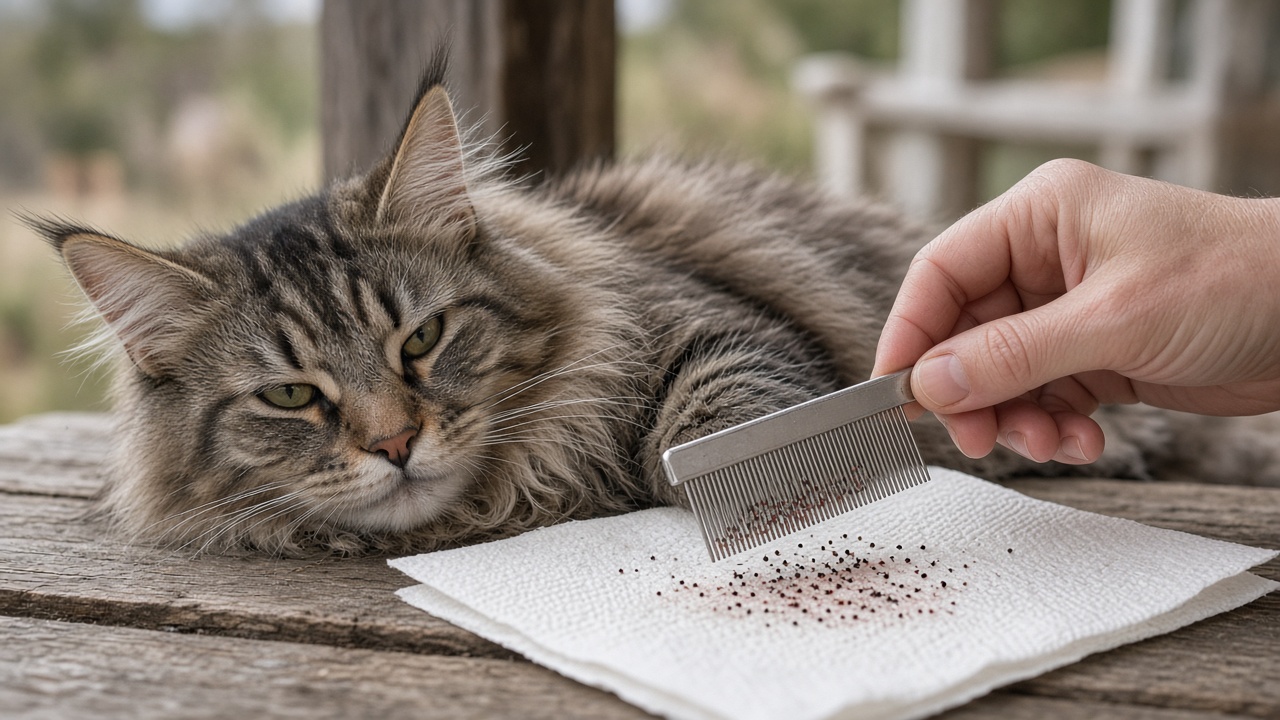
A nibble of labeled Gerbera jamesonii is not the lily pathway. Watch for drooling, vomiting, or a skipped meal. Those signs can follow any fibrous plant in a cat’s mouth.
The ASPCA plant list notes a gut-upset caveat. Eating any plant material may cause vomiting in dogs and cats.
Non-toxic on that list still means “not expected to be life-threatening.” It does not mean “feed freely.”
If appetite drops, scale the next meal with a cat feeding chart by weight. Do not add a new food while you wait on a clinic call.
Offer water. A pet water fountain for multiple cats helps a household keep drinking after a messy chew.
It does not treat poisoning.
If the stem might have been a mum, a “field daisy,” or a lily, stop guessing. Photograph the plant.
Bag a sample if you can do that safely. Call your clinic or ASPCA Poison Control at (888) 426-4435.
The FDA also lists Pet Poison Helpline at (855) 764-7661. A consult fee may apply. That is still cheaper than waiting on a lily.
Don’t induce vomiting from a video. Don’t wait for a second pretty flower to “confirm” the ID.
Currently sold plants we compared
The table is an attribute grid, not a ranking. We included four Costa Farms gerbera cultivars from the company’s plant-finder page. We added two in-stock The Sill houseplants whose species the ASPCA also lists as non-toxic to cats.
Costa Farms states gerberas grow 6 to 18 inches tall. The page lists them as hardy in Zones 8–11.
The same page claims some flowers can reach 12 to 15 inches across. Every named cultivar with a listed bloom width sits between 2.5 and 5 inches.
That gap is why we use the cultivar line, not the intro boast.
| Product | ASPCA species match | Maker-listed height | Maker-listed bloom or growth | Role in a cat home |
|---|---|---|---|---|
| Costa Farms Jaguar Pink | Gerbera jamesonii | 10–12 inches | 3-inch-wide pink flowers | Labeled gerbera, Bouquet Fork A |
| Costa Farms Volcanoes | Gerbera jamesonii | 18 inches tall and wide | 4.5-inch-wide orange flowers | Labeled gerbera, Bouquet Fork A |
| Costa Farms Mega Revolution Orange Dark Eye | Gerbera jamesonii | 12 inches tall, 8 inches wide | 5-inch-wide orange flowers | Labeled gerbera, Bouquet Fork A |
| Costa Farms Flori Line Maxi Lilac | Gerbera | 12 inches tall | Flowers to 4 inches across | Labeled gerbera, Bouquet Fork A |
| The Sill Spider Plant Variegated | Chlorophytum comosum (ASPCA listing) | Small ships 4–6 inches | Maker lists 3–6 inches of growth per year | ASPCA non-toxic foliage, not a flower stand-in |
| The Sill Parlor Palm | Chamaedorea elegans (ASPCA listing) | Small 6–11 inches; medium 12–18 inches; large 3–4 feet | Maker lists 2–3 inches of growth per year | ASPCA non-toxic palm for indoor shelves |
The Sill marks both houseplants safe for homes with pets. Watering on those two pages is every 1–2 weeks.
Soil should dry between drinks. The Parlor Palm page asks for humidity above 40% when you can provide it.
A labeled gerbera is the color pick. A spider plant or parlor palm is the long-term indoor pick. Neither is cat food.
Cats chew because the leaves move. Give them a designated toy instead of a vase.
Our interactive cat toys for indoor cats page is that redirect. It is not a second plant.
What a gerbera will not do
Gerbera jamesonii will not match the FDA lily timeline. It will not put pyrethrins on the ASPCA gerbera card. Those compounds belong to the chrysanthemum daisy card.
It will not make a mixed funeral bunch safe. Pollen from a hidden Lilium still counts.
It will not replace a clinic if the cat is already sick. Collapse, nonstop vomiting, or no urine is an emergency path, not a reread.
Keep fertilizer, insecticidal soap, and neem off the chew zone. Costa Farms and other growers treat ornamentals as display plants. The soil and spray can be the real problem after a “safe” nibble.
FAQ
Are gerbera daisies poisonous to cats?
No. The ASPCA lists Gerbera jamesonii as non-toxic to cats, dogs, and horses.
That listing is the species answer to this query. A tag that says only daisy is not the same listing.
What should I do if my cat ate a gerbera daisy?
Confirm the Latin name if you still have the tag. If it is Gerbera jamesonii, watch for mild gut upset. Keep water available.
If the plant might be a mum, a field daisy, or a lily, call your clinic now. ASPCA Poison Control is the backup line.
Are all daisies safe for cats?
No. Our Daisy-Name Census found ten daisy-named taxa on the ASPCA cats list.
Five are toxic. Five are not. Chrysanthemum “daisy” is the common toxic mix-up.
Can cats eat gerbera leaves, or only the flower?
Neither part is a listed toxin on the ASPCA gerbera card. Costa Farms still says the plant is not for animal consumption. A large fibrous chew can still cause vomiting.
Are gerbera daisies safe in a mixed bouquet?
Only if every other stem is identified. The FDA treats true lily pollen and vase water as a kidney emergency. One unlabeled white trumpet can erase the gerbera answer.
What indoor plant can I buy if I want color without a lily risk?
Start with a labeled Costa Farms gerbera cultivar from the table. Or skip flowers and use The Sill Spider Plant Variegated or The Sill Parlor Palm.
The ASPCA lists both of those species as non-toxic to cats.
Is African daisy the same plant as gerbera daisy?
Sometimes. The ASPCA gerbera card uses African daisy as an alias for Gerbera jamesonii.
The same list also uses African daisy for Dimorphotheca pluvialis. Ask for the Latin name.
A labeled gerbera is not a cat poison on the ASPCA list. A mystery daisy still is a phone call.
Keep the tag. Keep lilies out of the house.