Quick answer: Comb the coat, then wet the specks. If they bleed rust-red, treat the cat and wash the bedding. Pair a labeled adulticide with vacuuming so new fleas cannot replace the ones you just killed.
Flea dirt on cats is digested-blood feces that turns reddish-brown on a wet white paper towel.
This page is a research-desk brief that compares published labels and parasite-council numbers. We did not examine clinic cats, run a kill-rate trial, or open product packages.
Our selection rule was narrow. We included only currently sold US cat products whose official maker page listed both a named active ingredient and a minimum age. We left out dog-only labels, home remedies, and yard sprays.
Confirm flea dirt with a wet white towel
Flea dirt is not soil. The Companion Animal Parasite Council describes it as blood that dries into reddish-black pellets in the coat.
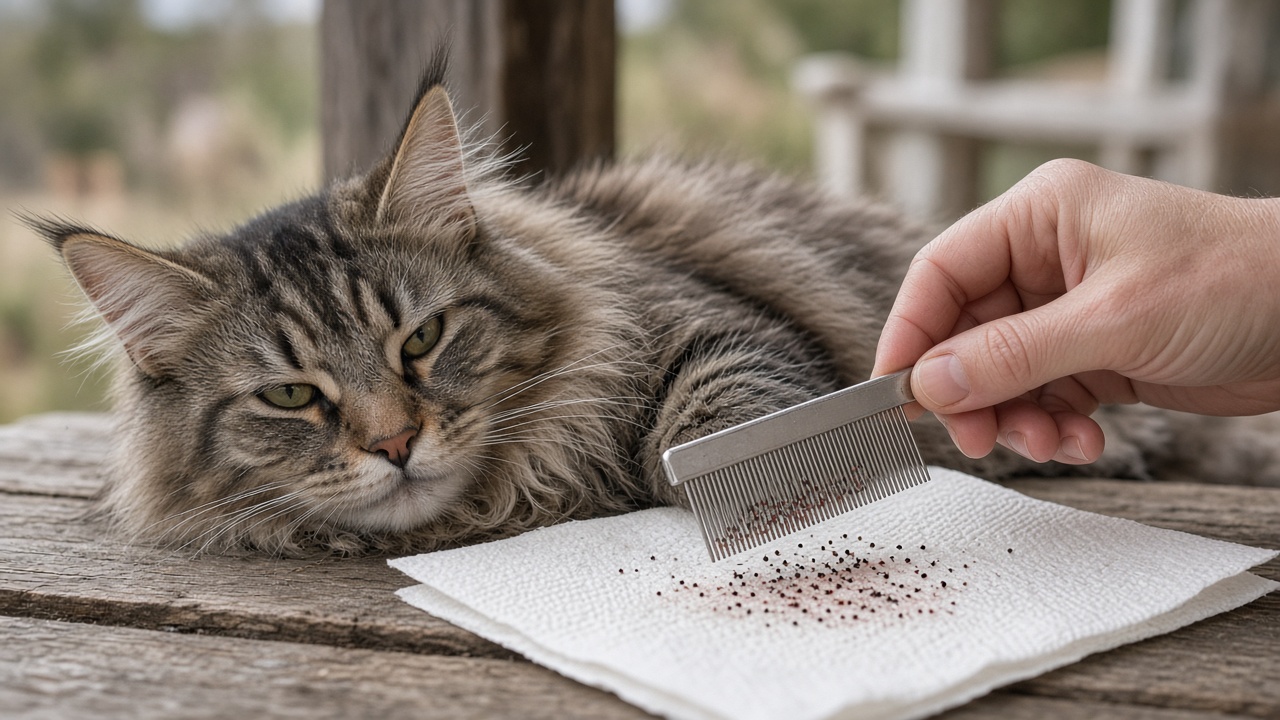
The same council’s diagnosis step is the home test. Comb out the specks and set them on a wet towel. The feces dissolve and turn red.
Work in bright light. Sit the cat on a pale sheet so fallen specks stay visible.
Use a fine-tooth flea comb, not a wide brush. Start at the tail base, then the lower back, belly, and neck.
Tap the comb onto white paper after each pass. Move a few dark grains onto a damp paper towel.
Wait and watch. A rust-red halo is a positive result. Specks that stay gray or sandy are ordinary debris.
Long coats hide pellets against the skin. A grooming glove made for long-hair cats can lift loose hair first. Then the comb can reach the skin.
Wash your hands after you handle the debris. The Merck Veterinary Manual notes that flea fecal pellets can carry Bartonella henselae into a scratch or bite wound.
Why flea dirt means fleas are feeding now
Those pellets exist only after an adult flea has taken a blood meal. Finding them means feeding has already happened, even if you never see a live insect.
The Companion Animal Parasite Council says egg production begins within 20 to 24 hours of a female’s first blood meal. Females can lay 40 to 50 eggs each day.
Those eggs are tiny. The same council lists them as pearly white ovals about 0.5 mm long. They fall off the cat within a few hours.
Dirt on the cat and eggs in the carpet arrive as a pair. The cat is the feeding station.
The Merck Veterinary Manual puts the typical household life cycle at 3 to 8 weeks. Under ideal heat and humidity it can finish in 12 to 14 days. In cold or dry rooms the same manual says the cycle can stretch as long as 350 days.
The Companion Animal Parasite Council says most adult fleas survive 2 to 3 months under normal conditions.
Cocoons stall the cleanup. At 11°C and 75% humidity, that council reports adult Ctenocephalides felis may stay in the cocoon for up to 30 weeks.
That number is why a one-bath plan fails. You can wipe every speck off the cat today. Pre-adult fleas can still emerge weeks later.
The DailyMed CAPSTAR label adds a useful scale for egg output. A single female flea may produce up to 2,000 eggs over her lifetime.
Larvae then eat the dirt you just combed off. The Companion Animal Parasite Council states that larvae feed on blood in adult flea feces.
Leave those specks in the carpet and you feed the next wave.
Get the specks off the coat
Removal and treatment are different jobs. Combing clears the evidence. A labeled product is what stops new pellets from forming.
Comb daily for the first week after you confirm dirt. Drop each pass into a bowl of soapy water so caught fleas cannot hop back.
A lukewarm bath with a gentle cat shampoo can loosen dried pellets. Rinse well. Dry the cat before any topical goes on.
Elanco’s Advantage II for Cats page says the cat should be dry before application and stay dry for 24 hours after. Bath first. Treat second.
Do not scrape the skin raw. Red skin plus dirt is a reason for a clinic visit.
Kittens and thin cats lose blood faster. The Companion Animal Parasite Council warns that heavy infestations may lead to iron deficiency anemia, especially in the young.
If the cat is lethargic or pale at the gums, skip the home-only plan. A kitten coated in specks needs a clinic visit.
Compare labeled cat products by attribute
Our research team analyzed six official maker pages that met the selection rule: four monthly topicals, one same-day oral tablet, and one eight-month collar.
We did not rank them. We compared listed form, actives, age or weight floors, and labeled windows.
Minimum listed weights run from 1.5 pounds on FRONTLINE Plus for Cats to 2.8 pounds on Zoetis Revolution Plus. Listed minimum ages run from 4 weeks on CAPSTAR to 10 weeks on Seresto for Cats. Only Elanco’s Advantage II for Cats page names an insect growth regulator, pyriproxyfen, among this set.
| Product | Form | Actives listed by the maker | Minimum age / weight | Labeled window | Extra targets listed |
|---|---|---|---|---|---|
| FRONTLINE Plus for Cats | Topical pipette | Fipronil and (S)-methoprene (EPA label) | 8 weeks / 1.5 lb | 30 days | Ticks, chewing lice, flea eggs and larvae |
| Advantage II for Cats | Topical pipette | Imidacloprid and pyriproxyfen | 8 weeks / 2 lb | 30 days | Flea eggs and larvae |
| Revolution Plus | Topical pipette, prescription | Selamectin and sarolaner | 8 weeks / 2.8 lb | One month | Heartworm, four tick species, ear mites, roundworm, hookworm |
| CAPSTAR for Cats | Oral tablet | Nitenpyram 11.4 mg | 4 weeks / 2 lb | Starts in 30 minutes | Adult fleas only |
| Cheristin for Cats | Topical pipette | Spinetoram | 8 weeks / 1.8 lb | Monthly; up to 6 weeks on the page | Adult fleas |
| Seresto for Cats | Collar | Imidacloprid and flumethrin | 10 weeks | 8 months | Ticks |
Boehringer Ingelheim’s FRONTLINE Plus for Cats page says one pipette lasts 30 days. It lists a floor of 8 weeks of age and 1.5 pounds.
Elanco’s Advantage II for Cats page says it starts killing fleas within 12 hours. It is waterproof after 24 hours and keeps working for 30 days.
Zoetis lists Revolution Plus for cats 8 weeks and older weighing 2.8 pounds or more. The Zoetis insert sets a minimum of 2.7 mg of selamectin and 0.45 mg of sarolaner per pound. DailyMed’s October 2024 monograph records it as FDA NADA 141-502.
CAPSTAR is the speed option in this set. The DailyMed CAPSTAR label says tablets begin working within 30 minutes. The same label reports greater than 90% effectiveness against adult fleas on cats within 6 hours.
The cat tablet is 11.4 mg of nitenpyram for animals 2 to 25 pounds. DailyMed allows another dose as often as once per day if fleas return. It does not treat eggs in the carpet.
Elanco’s Cheristin for Cats page says it starts killing fleas in 30 minutes. The page cites a controlled study with 98 to 100% of fleas killed within 12 hours. Elanco still recommends monthly use, even while listing up to 6 weeks of adult kill.
Elanco’s Seresto for Cats page lists 8 continuous months of flea and tick prevention. The EPA Seresto Cat label sets the floor at 10 weeks and lists 10.0% imidacloprid with 4.5% flumethrin.
Leave room for two fingers at the neck. Elanco says to trim excess to no more than one inch beyond the loops unless the kitten is still growing.
Match the label to the cat in front of you. A 6-week-old kitten is too young for five of these six products. Elanco’s Advantage II and Cheristin pages both say each cat needs its own full dose.
If you need a same-day knockdown, CAPSTAR is the listed oral option here. The DailyMed directions allow hiding the pill in food. See whether cats can eat tuna before you turn fish into a daily pill pocket.
Talk with your cat’s veterinarian before you stack products. Revolution Plus carries an isoxazoline caution on the Zoetis page for cats with a neurologic history.
Stop the rebound in bedding and furniture
Killing adults on the cat is half the job. The Companion Animal Parasite Council says a comprehensive plan must also clear the environment and prevent reinfestation.
The same council says moderate to severe infestations may take several months to control. Every pet in the home must be treated, or untreated animals restock the house.
Wash beds, blankets, and removable tree hammocks in hot water. Dry on high heat when the fabric allows it.
Vacuum carpets, baseboards, sofa cracks, and the pad under a modern cat tree. Empty the canister into a sealed bag.
Eggs fall where the cat rests. Do not skip the car seat or the guest-room quilt.
Larvae hide from light. The Companion Animal Parasite Council notes indoor development in carpets, under furniture, and along baseboards. Vacuum those edges, not just the open rug.
Cocoons resist many sprays. Pressure and warmth also trigger emergence, per the same council, so vacuuming still helps.
After you vacuum, keep the labeled product on the cat. New adults that hatch will feed, then die, instead of restarting egg lay.
FRONTLINE’s cat page notes that indoor cats still pick up fleas from other animals, clothing, and new rooms.
When a paper test is not enough
A positive towel test answers the search query. It does not grade the cat’s blood loss or name every parasite a flea can carry.
The Merck Veterinary Manual names Dipylidium caninum as a tapeworm that develops inside the cat flea. Cats swallow the flea while grooming.
Rice-like segments on the rear or in the litter box need a clinic stool check. Clearing dirt alone does not clear that worm.
The same manual links flea fecal pellets to Bartonella henselae and cat scratch disease in people. Wash scratches. Keep flea numbers down.
Pale gums, collapse, or a kitten coated in pellets is an emergency pattern. The Companion Animal Parasite Council lists anemia and death as risks in heavy infestations of the young.
If the towel stays gray, look for other grit. Litter dust, potting soil, and dander do not bloom rust-red. If the cat still itches after the specks are gone, that is a skin exam, not another comb pass.
FAQ
Can a cat have flea dirt if I never see a live flea?
Yes. Adults are fast and spend time in the coat, not on the comb. The Companion Animal Parasite Council treats flea feces on a wet towel as a standard diagnostic step. Pellets mean a blood meal already occurred.
How long after treatment should flea dirt stop showing up?
Adults on the cat should drop within the window on the label you used. Elanco lists 12 hours for Advantage II and 30 minutes for Cheristin. New specks after a week usually mean new adults arriving from the room, not a failed first dose.
Does a bath get rid of flea dirt for good?
A bath can wash pellets off the hair. It does not kill eggs in the carpet or fleas in cocoons. The Merck Veterinary Manual’s 3-to-8-week household cycle is why dirt returns after a single wash.
Can an indoor-only cat get flea dirt?
Yes. FRONTLINE’s cat education notes that fleas ride in on other pets, clothing, and shoes. The Companion Animal Parasite Council says newly emerged fleas in the home are the usual start of an infestation. Indoor status is not a test result.
Is flea dirt dangerous to people?
The pellets themselves are dried blood, not house soil. The Merck Veterinary Manual says humans can be infected with Bartonella henselae when flea fecal pellets contact a scratch or bite. Wash hands after combing, and clean any scratch with soap and water.
Why does flea dirt keep returning on one cat in a two-cat home?
Untreated animals keep the breeding population alive. The Companion Animal Parasite Council says every pet in the home must be treated. Elanco also tells multi-cat homes not to let cats groom each other until a topical has dried.
Can I use a dog flea pipette on a cat?
No. Elanco’s Cheristin page states the product is not for dogs, and Advantage II for Cats says not to use the cat product on dogs. If the box says dog only, leave it on the shelf.