
Quick answer: Do not put a hamster in an exercise ball. Blue Cross says balls must not be used. Use a solid upright wheel sized to the species, plus supervised time in a secure pen.
Hamster balls are not a safe exercise tool: a 7-inch ball is 9.2 cm below Blue Cross’s Syrian wheel floor.
This page compares published specs;
Selection rule: We included only currently sold, solid-surface upright wheels whose maker pages list a diameter. We matched those listed sizes to Blue Cross and PDSA published bands. We left out enclosed balls, mesh wheels, and any SKU we could not confirm on a maker HTML page.
Why welfare groups reject hamster balls
A hamster ball is a clear plastic sphere. The animal is locked inside. The sphere rolls as the hamster runs.
Blue Cross states that hamster exercise balls must not be used. The group cites exhaustion, poor ventilation, and no way to escape. It also notes that food, water, and a hide are out of reach.
The RSPCA’s hamster behavior page says wild hamsters can run up to five miles a day. That distance needs open space and a proper wheel. It does not need a sealed sphere.
Hamsters rely on smell, hearing, and whiskers. Sight is poor. A closed ball blocks those cues.
The RSPCA flags that loss of sensory information as a stress risk.
A hamster inside a ball cannot stop the roll. Furniture hits are likely. The RSPCA also flags paw or leg pinches at air holes.
Blue Cross’s replacement is plain. Give a safe, secure run, such as a hamster playpen, when the animal is awake.
The size gap, in numbers
Our research team compared listed diameters with published wheel floors. The gap is large.
PDSA asks for a solid wheel at least 20 cm (8 inches) for dwarf hamsters. It asks for at least 30 cm (12 inches) for Syrian hamsters. A lot of shop wheels, PDSA notes, force a curved back.
Blue Cross publishes tighter species bands. Syrian hamsters need 27 to 32 cm. Campbell’s and winter white dwarfs need 22 to 25 cm.
Roborovski hamsters need 20 to 22 cm. Chinese dwarfs need 25 to 27 cm.
A typical 7-inch plastic ball is 17.8 cm across. That sits 9.2 cm under Blue Cross’s 27 cm Syrian floor. It sits 12.2 cm under PDSA’s 30 cm Syrian floor.
Comparing published specs, 17.8 cm is 41 percent smaller than PDSA’s 12-inch Syrian mark. The ball also sits 2.2 cm under PDSA’s 20 cm dwarf floor.
Blue Cross says a hamster must run with a straight back and without a raised head. A 17.8 cm dome cannot meet that posture test for a Syrian.
The Stop-Hide-Drink rule
We used one check on every product. Call it the Stop-Hide-Drink rule.
A hamster must be able to stop running under its own power. It must reach a hide. It must reach water.
No human should have to unscrew a lid first.
An enclosed ball fails all three. The animal cannot park the sphere. It cannot duck into a nest.
It cannot drink.
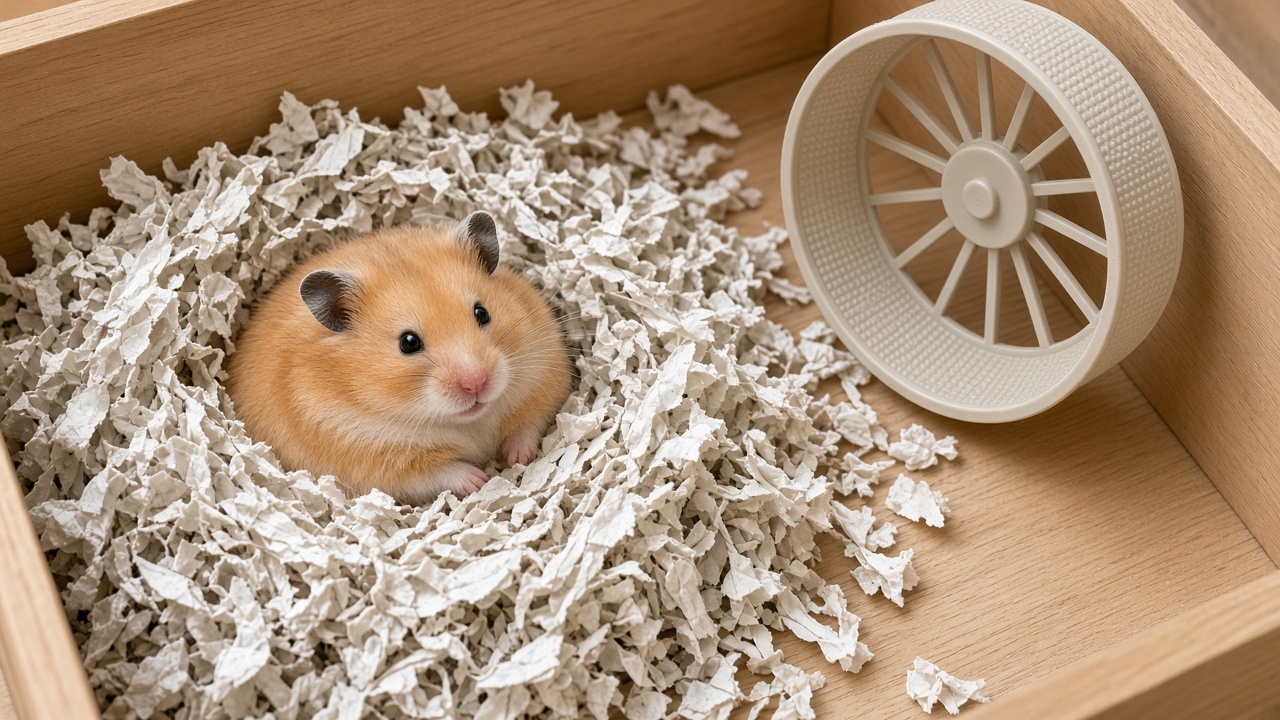
A solid upright wheel passes the first check. The hamster steps off when it wants. A stocked cage or pen then covers hide and water.
Blue Cross also rejects spoke and mesh wheels. Feet can catch. That is why mesh models stayed out of our table, even when a maker listed an 11-inch diameter.
PDSA agrees on the surface. The running face must be solid, not slats or bars.
Solid wheels that meet published size bands
Start with species, then pick a listed diameter. Do not buy by the word “hamster” on the box.
Niteangel Pet lists its Super-Silent Hamster Exercise Wheel in four drum sizes. Those sizes are 8.2-inch Small, 10-inch Medium, 11-inch Large, and 12.6-inch Extra Large.
The maker lists a PS plastic drum and an acrylic base. It also lists dual ball bearings and 1 to 4 inches of adjustable bottom height.
Convert those listed drums. 8.2 inches is 20.8 cm. That meets PDSA’s 20 cm dwarf floor and Blue Cross’s Roborovski 20 to 22 cm band.
The 10-inch drum is 25.4 cm. That covers Blue Cross’s Campbell’s and winter white 22 to 25 cm band. It also meets the Chinese dwarf 25 to 27 cm band at the low end.
The 11-inch drum is 27.9 cm. That enters Blue Cross’s Syrian 27 to 32 cm band. It still sits 2.1 cm under PDSA’s 30 cm Syrian floor.
The 12.6-inch drum is 32.0 cm. That hits the top of Blue Cross’s Syrian band. It also clears PDSA’s 30 cm Syrian floor by 2.0 cm.
Kaytee lists its Comfort Exercise Wheel Large at 8.5 inches across. The maker page lists a solid running surface and a 0.7 pound weight.
It also lists a heavy-duty wire stand and a two-way cage clip. Unit size is 8.5 by 5 by 9.5 inches.
8.5 inches is 21.6 cm. That clears PDSA’s 20 cm dwarf floor. It misses PDSA’s 30 cm Syrian floor by 8.4 cm.
It also sits 5.4 cm under Blue Cross’s 27 cm Syrian floor. Treat the Kaytee Large as a dwarf-sized wheel. It is not a Syrian wheel.
Prevue Pet Products lists the Quiet Wheel 8 inch, model 90017, as an all-plastic wheel with ball bearings. The maker page lists unit size 8 inches long, 4 5/8 inches wide, and 9 inches high. The wheel can sit on its stand or clip to cage wire.
8 inches is 20.3 cm. That meets PDSA’s dwarf floor and Blue Cross’s Roborovski band. It is not a Syrian wheel.
Attribute comparison of current solid wheels
No rank column. These rows report maker-listed attributes only.
| Product | Listed diameter | Maker-listed build | Mount | Species band the listed size can meet |
|---|---|---|---|---|
| Niteangel Super-Silent Extra Large | 12.6 in (32.0 cm) | PS drum, acrylic base, dual ball bearings | Freestanding; 1–4 in bottom height | Syrian (Blue Cross 27–32 cm; PDSA ≥30 cm) |
| Niteangel Super-Silent Large | 11 in (27.9 cm) | PS drum, acrylic base, dual ball bearings | Freestanding; 1–4 in bottom height | Syrian at Blue Cross’s 27 cm floor; short of PDSA’s 30 cm |
| Niteangel Super-Silent Medium | 10 in (25.4 cm) | PS drum, acrylic base, dual ball bearings | Freestanding; 1–4 in bottom height | Campbell’s, winter white, Chinese dwarf (Blue Cross) |
| Niteangel Super-Silent Small | 8.2 in (20.8 cm) | PS drum, acrylic base, dual ball bearings | Freestanding; 1–4 in bottom height | Roborovski (Blue Cross 20–22 cm); PDSA dwarf floor |
| Kaytee Comfort Exercise Wheel Large | 8.5 in (21.6 cm) | Solid plastic surface; 0.7 lb; 8.5 × 5 × 9.5 in | Wire stand or two-way cage clip | Dwarf floor (PDSA 20 cm); not Syrian |
| Prevue Quiet Wheel 8" (90017) | 8 in unit (20.3 cm) | All-plastic drum and base; ball bearings | Stand or cage-wire mount | Roborovski / PDSA dwarf floor; not Syrian |
A Syrian needs the Niteangel Extra Large to clear both published floors. The 11-inch Large meets only the Blue Cross floor.
A Roborovski can use the Niteangel Small, the Kaytee Large, or the Prevue Quiet Wheel 8 inch. Watch posture. If the back curves, step up one listed size.
Supervised floor time instead of a rolling ball
A wheel is not the only exercise. Blue Cross tells owners to use a playpen for out-of-cage time.
Keep the first pen small. Blue Cross says a large new space can stress a cautious hamster.
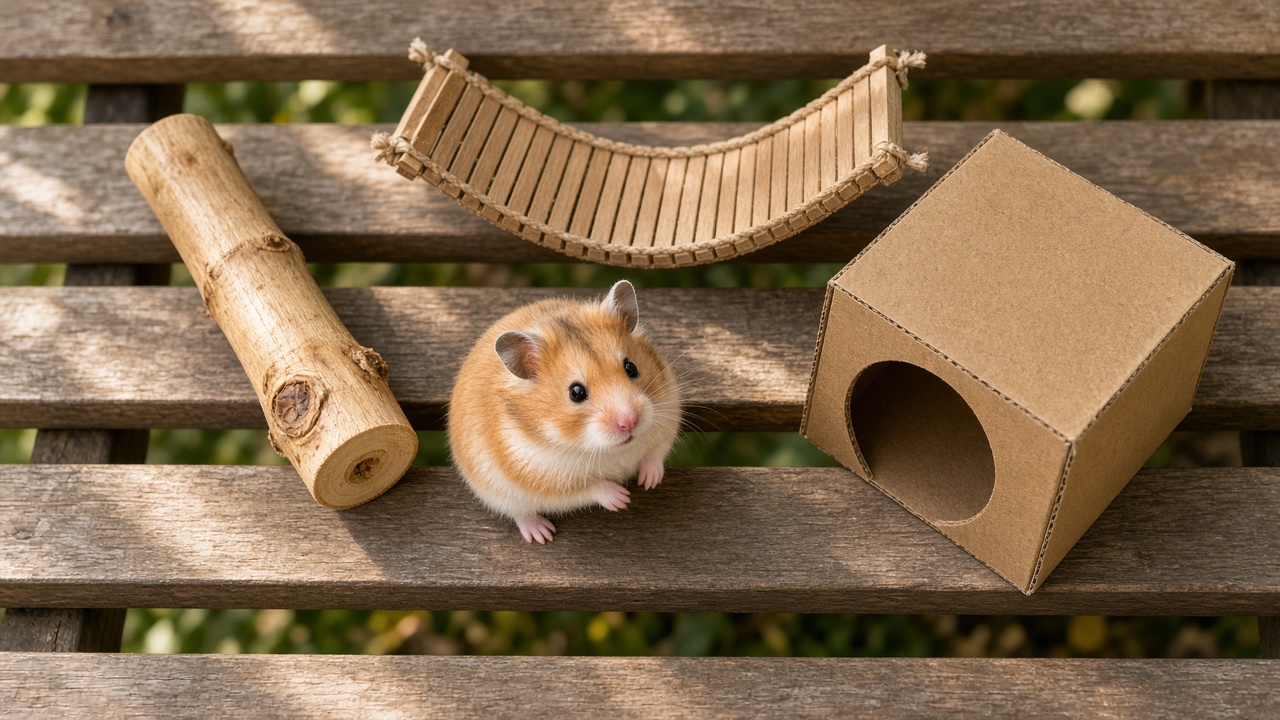
Add toys, food, water, and hides. Widen the area only as the animal settles.
Supervise the whole session. Never wake a sleeping hamster to put it in a pen. Blue Cross is explicit on that point.
The RSPCA says never leave a hamster out of its cage unattended or overnight. Keep dogs and cats out of the room.
Bar gaps matter. Blue Cross wants cage bar or mesh gaps under 1 cm.
For a wire playpen, Blue Cross wants vertical bars. It says dwarf hamsters need bars no less than 9 mm wide so they cannot climb out.
A hamster-proofed bathroom floor can work. Block gaps, remove cords, and stay in the room. Put a hide and a water bottle in reach.
Need a holding spot while you clean? Use that pen, not a ball.
Our guide on how to clean a hamster cage walks through a full clean. Pair it with how often to clean a hamster cage.
PDSA says small cages often need a full clean weekly. Larger set-ups may wait a few weeks. Blue Cross says a full clean is often once or twice a month, with spot cleaning every few days.
A bigger cage does more than any gadget
Exercise gear cannot fix a tiny tank. PDSA cites the German Veterinary Association for Animal Welfare.
That group states a minimum floor of 100 by 50 cm. PDSA calls that a minimum. Bigger is better.
Blue Cross lists the same floor: 100 cm by 50 cm, and 50 cm tall. Tanks beat tall multi-level cages. Hamsters have poor sight and fall from heights.
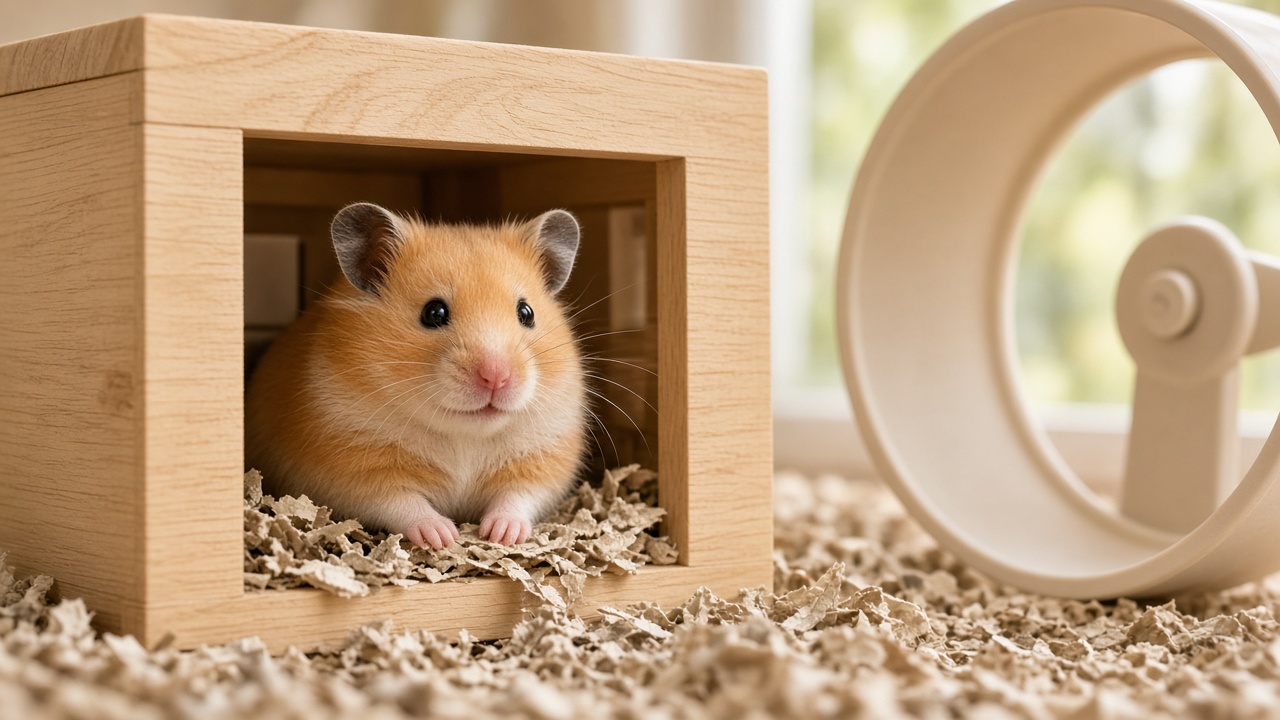
Bedding depth is not optional. PDSA wants at least 25 cm (10 inches) of bedding that holds a burrow.
Blue Cross sets a 20 cm digging minimum. Use the larger PDSA figure when the two differ.
PDSA lists paper-based bedding, aspen, spruce, hemp, cheap unscented toilet paper, soft hay, and pet-safe organic soil. It rejects dusty wood shavings, cotton wool, kapok, bamboo fluff, scented bedding, and inked newspaper.
Shop cages often fall short. A DIY hamster cage can hit that 100 by 50 cm floor.
Leave room for a 12.6-inch wheel. Leave 25 cm of bedding.
PDSA wants the room at 18 to 21°C. Blue Cross warns that cold can trigger torpor. Heat can cause heatstroke.
Keep the home off drafts and out of sun.
PDSA says hamsters typically live two to three years. Daily open exercise in a large cage matters more than a short roll in a ball.
FAQ
Are hamster balls safe for dwarf hamsters?
No. A 7-inch ball is 17.8 cm wide. That is 2.2 cm under PDSA’s 20 cm dwarf wheel floor.
Toes also catch in air holes. Use a solid 8.2-inch or 8.5-inch wheel, then check that the back stays straight.
How long can a hamster stay in a ball?
Do not put the hamster in a ball at all. Blue Cross says balls must not be used. There is no safe time limit on a device that blocks water, a hide, and an exit.
What size wheel does a Syrian hamster need?
PDSA sets a 30 cm (12 inch) floor. Blue Cross sets 27 to 32 cm.
Comparing published specs, only the Niteangel Super-Silent Extra Large clears both. That drum is 12.6 inches, or 32.0 cm.
Can I use a hamster ball while I clean the cage?
No. Blue Cross says to use a playpen or carrier. Put water and a hide in that holding space.
Then follow a calm clean. Put some familiar, unsoiled bedding back in.
Do hamsters need a wheel if the cage is large?
Yes, as one tool, not the only one. The RSPCA says wild hamsters can run up to five miles a day. It still wants a large, solid, axle-free wheel plus deep litter and other enrichment.
What should go in a playpen besides open floor?
Blue Cross wants toys, food, water, hides, and tunnels. Start small.
Add cardboard tubes and a sand bath. Stay in the room for the whole session.
Is a mesh wheel safer than a ball?
A mesh wheel still fails PDSA’s solid-surface rule. Blue Cross says replace spoke or mesh wheels because feet catch. Pick a solid drum that matches the species band.