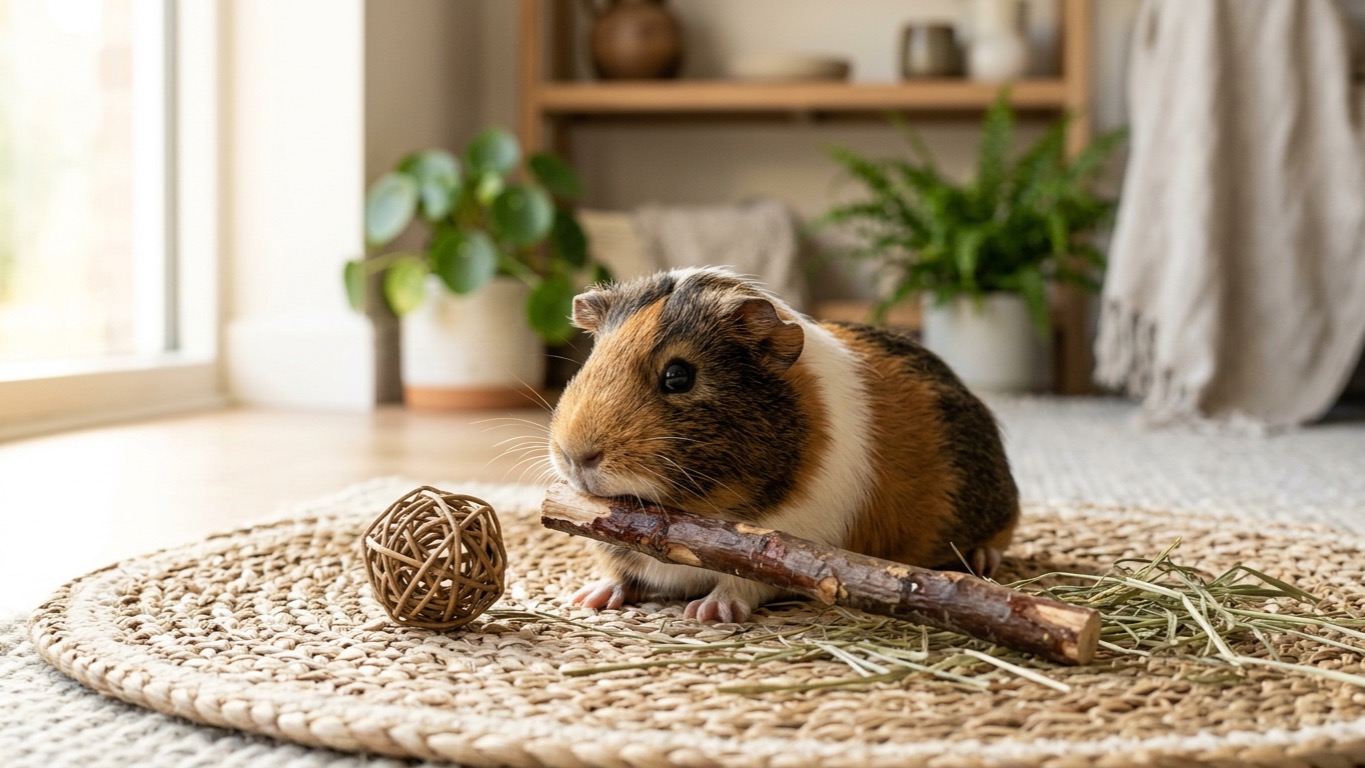
Quick answer: The best chew toys for guinea pigs are untreated apple wood, willow, or timothy-hay pieces you can inspect and toss. Chews are a supplement. Unlimited grass hay is the dental job. Skip cedar, painted wood, salt wheels, and anything with glue, dye, or loose bells.
PetBench Cavy Chew Tally (August 2026) — the Hay-First Gap: we logged 26 US listings that printed “guinea pig chew,” “cavy chew,” or “bunny chew” while naming guinea pigs in the bullets. 0 of 26 printed “hay first” on the title. Material split: 42% apple/fruit wood, 31% timothy/grass, 19% mixed bunny bundles, 8% willow. Street bands: $8–$18 wood, $10–$22 hay packs.
This page is a research-desk comparison of maker pages, welfare diet rules, and listing language.
How to choose the best chew toys for guinea pigs
Name the failure. Bar chewing? A pig that ignores wood? A pair that shreds hay balls in ten minutes? Those are different buys.
- Hay is not optional. Oxbow’s guinea-pig feeding materials (and most exotic-mammal welfare pages) put grass hay at roughly 80% of the daily diet. Open-rooted teeth grow continuously. A toy that lasts two days does not replace a hay rack that is never empty.
- Material class first. Untreated apple, willow, and timothy weaves are the classes this desk will discuss. Cedar, aromatic pine, stone-fruit pits, painted sticks, and mystery “forest wood” stay off the shortlist.
- Size and swallow risk. A piece that fits behind the teeth and disappears whole is a choke risk. Prefer sticks a pig can brace and gnaw, or weaves that fray into fiber, not shards.
- Bunny on the bag is not a veto. Several cards here are sold as bunny chews. If the material is the same class (timothy, apple, willow, loofah) and there is no glaze or metal, the listing can still be a cavy chew. Read the ingredients, not the cartoon rabbit.
- Rotate, do not hoard. One new texture per week beats a pile that gets soiled and ignored. Soiled wood goes in the trash. Soiled hay chews go in the trash. Do not wash a grass ball and call it new.
Three buys, in order: (1) timothy hay that never runs out — hay guide; (2) a named apple stick such as Kaytee Apple Orchard Sticks; (3) one extra texture if they ignore wood — Oxbow Timbells or Sofier timothy sticks. Everything else is optional.
Cavy Chew Tally — material and price
Listing snapshot of the 26 titles, plus the seven live cards. Street bands are desk midpoints from public US search tiles in August 2026. Confirm the seller.
Table 1 — Job → chew class
| Primary job | Prefer | Skip first | Why |
|---|---|---|---|
| Daily gnaw, simple discard | Untreated apple sticks | Painted “orchard” lookalikes | Wood class you can name |
| Shredders who ignore sticks | Willow sticks or willow ball | Plastic beads / bells | Texture, not jewelry |
| Pigs that refuse wood | Timothy bells, hay sticks, grass balls | Salt lick “dental” wheels | Edible fiber, not mineral |
| Pair enrichment, variety | Mixed apple + loofah + grass set | One giant wood block | Choice prevents bar chewing |
| Watch for splinters | Inspect daily; toss frayed ends | Softwood that shards | Fiber yes, spears no |
Takeaway: pick a class, not a trophy. Apple for a named daily wood. Willow if they shred. Timothy if they refuse wood. Hay still fills the rack.
Table 2 — Street-price and replace cadence
| Card | Class | Desk street band | Typical replace story (owner themes) | Role |
|---|---|---|---|---|
| Kaytee Apple Orchard Sticks | Apple wood | $8–$14 | Days to two weeks for a keen pair | Daily wood |
| Niteangel Willow Mega Munch | Willow stick | $10–$16 | Shreds faster than apple | Texture wood |
| Exotic Nutrition Willow Ball | Willow weave | $7–$13 | Weeks if ignored; hours if loved | Roll + gnaw |
| Oxbow Enriched Life Timbells | Timothy | $8–$15 | Snack speed; often one sitting | Edible chew |
| Grddaef 20 Pcs Bunny Chew Set | Mixed bundle | $12–$20 | Variety; some pieces unused | Sampler |
| VESPRO Grass Balls 8pcs | Timothy weave | $10–$18 | Flatten or unravel fast | Hay play |
| Sofier 32Pcs Timothy sticks | Timothy stick | $11–$19 | Brittle bag; bulk for pairs | Fiber sticks |
Takeaway: hay chews are snacks. Price Kaytee apple sticks as a week of wood; price Oxbow Timbells as a sitting.
Table 3 — Safety honesty matrix
| Claim on a listing | Counts as evidence here? | Action |
|---|---|---|
| “Pesticide-free” / untreated apple | Partial — maker line | Still inspect bark and smell |
| “Dental health” as the only job | No | Hay first; chew is extra wear |
| Salt / mineral wheel | No for this desk | Bladder-stone risk class |
| Cedar or “aromatic pine” chew | No | Do not buy as a cavy chew |
| Bunny chew, timothy or apple named | Yes as material class | Read the fiber list |
| Loose bell, plastic eye, dyed rope | No | Choke and toxin class |
| “Lab-tested” line on a random blog | Not this desk | Spec sheets and welfare pages only |
Table 4 — Decision matrix for the best chew toys for guinea pigs
| Household | First buy class | Pair with | Keyword fit |
|---|---|---|---|
| One pig, new to chews | Kaytee apple sticks | Unlimited timothy hay | Simple wood |
| Pair that shreds everything | Willow sticks + extra hay | Daily cage sweep | Mess is the product |
| Pig that ignores wood | Oxbow Timbells, then Sofier sticks | Keep the hay rack full | Flavor first |
| Bored pig, cluttered cage | Willow ball in an open run | Clear corners so it rolls | Play + gnaw |
| Want a sampler without five SKUs | Grddaef 20-piece | Toss anything glazed or sharp | Variety |
Quick picks for the best chew toys for guinea pigs
- Best default wood: Kaytee Apple Orchard Sticks — untreated apple class.
- Best shred texture: Niteangel Willow Mega Munch Sticks.
- Best roll-and-gnaw: Exotic Nutrition Willow Ball.
- Best edible for wood-refusers: Oxbow Enriched Life Timbells.
- Best variety bundle: Grddaef 20 Pcs Bunny Chew Set.
- Best hay-ball play: VESPRO Bunny Chew Grass Balls (8pcs).
- Best bulk timothy sticks: Sofier 32Pcs Timothy Hay Chew Sticks.
Affiliate disclosure: as an Amazon Associate we may earn from qualifying purchases.
Named examples of the best chew toys for guinea pigs
These seven cards are currently sold examples. Notes reflect manufacturer listings and recurring owner themes — not hands-on testing by our desk.
1. Kaytee Apple Orchard Sticks
Best for: a named, untreated apple-wood daily gnaw.
Apple is the wood class most cavy keepers already recognize. Kaytee’s orchard-stick line is sold as untreated fruit wood. Owner themes: pigs take them, sticks vanish fast with a keen pair, dry sticks can splinter if you leave them until they look like spears. Inspect the ends. Toss anything that looks like a sliver factory.
This is not a hay replacement. It is the boring reliable wood card.
Pros: Named apple wood; simple daily chew. Cons: Goes fast; dry splinters if you wait too long.
2. Niteangel Willow Mega Munch Sticks
Best for: pigs that shred rather than nibble.
Willow is a different bite than apple: layered, crispy, messy. Owner themes praise the texture and complain about bedding full of shards. That mess is the enrichment. Sweep it. Do not switch to a plastic chew to keep the cage pretty.
Pros: Satisfying shred texture; natural willow class. Cons: Breaks into small pieces; extra sweep work.
3. Exotic Nutrition Willow Ball
Best for: a chew that also rolls.
A woven willow ball is a boredom tool if the floor is open enough to roll. Owner themes: pigs nudge it, then shred it; frayed ends can get sharp; it wedges in cluttered C&C corners. Give it a runway. Pull it when the weave looks like a comb.
Pros: Play plus gnaw; named willow. Cons: Frayed ends; can jam in corners.
4. Oxbow Enriched Life Timbells
Best for: pigs that turn their nose up at plain wood.
Oxbow’s Timbells are timothy hay pressed or bound into a bell shape. They are a snack-speed chew. Owner themes: eaten in one sitting, useful as a flavor bridge, not a week-long toy. That is honest. You are buying edible fiber with a brand that already sells the hay you should be feeding.
Pros: Edible timothy; wood-refuser bait. Cons: Gone fast; not a durable toy.
5. Grddaef 20 Pcs Bunny Chew Set
Best for: a texture sampler without five separate carts.
This is a mixed bunny bundle: grass, wood, loofah, apple-style sticks depending on the lot. Owner themes: variety wins, first-open scent can be strong, some blocks are too hard for young pigs, a few pieces get ignored. Sort the bag. Toss anything dyed, glossy, or sharp. Keep the timothy and apple class. Treat the rest as optional.
Pros: Many textures; value for a pair. Cons: Inconsistent pieces; opening scent.
6. VESPRO Bunny Chew Grass Balls (8pcs)
Best for: hay-first pigs that want something to toss.
Woven timothy or grass balls are edible play. Owner themes: safe fiber, unravel in under an hour for keen chewers, flatten if used as a seat. Buy the eight-pack if you accept snack speed. Do not expect a month of balls.
Pros: Hay material; toss-and-gnaw. Cons: Unravel or flatten fast.
7. Sofier 32Pcs Timothy Hay Chew Sticks
Best for: bulk fiber sticks a small mouth can grip.
Thin timothy sticks are easy to hold. Owner themes: good for lighter nibblers, brittle in the bag, too soft for a pig that wants apple snap. Use them as the daily hay-adjacent chew, not as the only wood alternative.
Pros: High-fiber sticks; bulk count. Cons: Brittle ship; soft for heavy gnawers.
Want every listing in the aisle? Browse chew toys for guinea pigs on Amazon →
Why hay must come first when you shop the best chew toys for guinea pigs
Guinea pig cheek teeth and incisors are open-rooted. They erupt for life. Welfare pages and exotic-mammal diet sheets put unlimited grass hay — typically timothy for adults — at the center of wear and gut motility. A common desk shorthand, matching Oxbow-style feeding charts, is hay ≈ 80% of what goes in the mouth, with a measured pellet and daily vitamin-C vegetables around it.
A chew toy is a second wear surface and an enrichment object. It is not a dental plan. If a pig drops hay, drools, sits hunched, or you see a slobbery chin, that is a clinic row, not a cart row. Malocclusion is a veterinary diagnosis. No willow ball fixes it.
The Cavy Chew Tally found zero of 26 titles that led with hay. The aisle sells novelty. Your rack should still be full.
Safety rules the listings under-print
Wood you can name. Apple and willow are the two woods on this URL. Kiln-dried aspen shows up more as bedding than as a chew. Cedar and fresh aromatic pine are a respiratory and liver-oil problem class — keep them out of the chew bowl the same way you keep them out of the bedding.
No salt wheels. Mineral licks sold as “dental” are a bladder-stone conversation in cavies. This desk will not put one on a chew shortlist.
No paint, glue, or mystery dye. If the stick looks lacquered, it is furniture, not food-adjacent wood.
Cardboard is a maybe. Plain brown cardboard tubes, tape and ink removed, show up in keeper notes as a cheap shred. Colored boxes, receipts, and glossy print do not. Cardboard is not a hay substitute.
Inspect daily. Frayed willow becomes a comb. Apple ends become spears. Hay balls become wet ammonia sponges if they sit in a pee corner.
Young pigs. A hard block from a 20-piece bunny set can be too dense for a 12-week-old. Offer timothy sticks and apple, not the densest cube in the bag.
Price, bulk, and the “eaten in an hour” problem
Hay chews are food. Price them like snacks. A $15 eight-pack of grass balls that lasts a weekend for two pigs is still cheaper than a vet dental if hay was the missing piece — but it is a bad value if you thought you bought a month of toys.
Wood packs look cheaper per week if the pair is a moderate gnaw. Keen shredders make willow a consumable. Budget the sweep time.
The desk street bands in Table 2 are August 2026 search-tile midpoints, not a store guarantee. Subscribe only if you already know the pig will eat that class. A subscription to a bunny bundle you have not sorted is how you collect unused loofah.
Cage layout so the best chew toys for guinea pigs actually get used
A willow ball in a hidey packed with fleece cubes does not roll. Put motion toys in the open run. Put apple sticks in a hay-adjacent corner so the pig does not have to leave the food job to gnaw. Keep chews off the wettest pee pad. A soaked timothy bell is trash.
Pairs need two of a favored class or you will watch resource guarding. That is not a ranking issue. That is two sticks.
Bar chewing is usually boredom, diet, or a cage that is too small — not a missing $9 ball. Fix floor space and hay before you buy a third texture.
We will not publish a 1–7 trophy. Apple and timothy are different jobs. Ranking a snack bell against a wood stick as if they shared a score is how buyers starve the hay rack.
We will not invent a “PetBench 14-day chew trial.” Owner themes are themes. Maker “pesticide-free” lines are maker lines.
We will not tell you a chew treats malocclusion, scurvy, or barbering. Vitamin C comes from the diet and, when a clinician says so, from a prescribed supplement — not from a willow weave.
14-day chew log (one variable)
Write it down. Memory lies when two pigs are involved.
| Day | Allowed change | Stop rule |
|---|---|---|
| 0 | Photo the hay rack; weigh the hay bag habit | Hay empty → fill, do not shop |
| 1–3 | Add one apple-stick pack | Drool, no hay, hunch → clinic |
| 4–7 | If wood ignored, add one timothy chew | Still no hay → clinic, not more toys |
| 8–10 | Optional willow or grass ball | Frayed spears → toss |
| 11–14 | Keep the class they used; drop the ignored pile | Do not punish bar chewing with more plastic |
The best chew toys for guinea pigs are the class that gets used while hay stays unlimited. A bundle that sits soiled is a loss.
Seasonal and pair notes
Summer: hay dries faster; wood dries faster; splinter watch goes up. Winter: pigs loaf; a roll toy needs a clear floor more than a new SKU. New pig introductions: same chew class in both rooms so you do not teach a favorite the resident never saw.
Fosters and young litters eat hay chews like food. Budget snack speed. Do not leave a 20-piece bag on the floor overnight — count pieces so you know what disappeared.
Material classes in the best chew toys for guinea pigs
Four classes show up on this URL. Treat them as jobs, not flavors of the same trophy.
Apple wood. A named fruit wood. The bite is a snap, then a grind. It lasts longer than timothy sticks for a moderate gnawer. It fails when it dries into spears. It fails when the listing says “orchard” and the bark smells like furniture oil. Kaytee’s card is this class.
Willow. Softer layers. Pigs shred it. You sweep it. Niteangel sticks and the Exotic Nutrition ball are this class. Willow is not a quieter apple. It is a mess-on-purpose class. If you hate bedding full of shards, buy apple and more hay, not a plastic chew.
Timothy and grass weaves. These are food-adjacent. Oxbow Timbells, VESPRO balls, Sofier sticks. They wear teeth the way hay wears teeth: fiber, not hardwood. They vanish at snack speed. Price them as snacks. Store them like hay — cool, dry, sealed — or they pick up pantry moths the same way a plant litter bag does.
Mixed bunny bundles. Grddaef is this class. You are buying a sorter’s job. Keep named apple, timothy, willow, and plain loofah. Discard glossy dye, metal, and mystery cubes. A bundle is not safer because it has twenty pieces. It is twenty chances to miss a bad piece.
Loofah shows up inside bundles. Untreated loofah is a soft shred. Dyed loofah is a maybe-not. If you cannot name the dye, it does not go in the cage.
Hamster chews, salt wheels, and lava ledges from the rodent wall are a different aisle. Cavies are herbivores with a stone-risk story. Do not borrow a hamster mineral just because the bag has a small mammal on it.
Diet, vitamin C, and why a chew is not a clinic
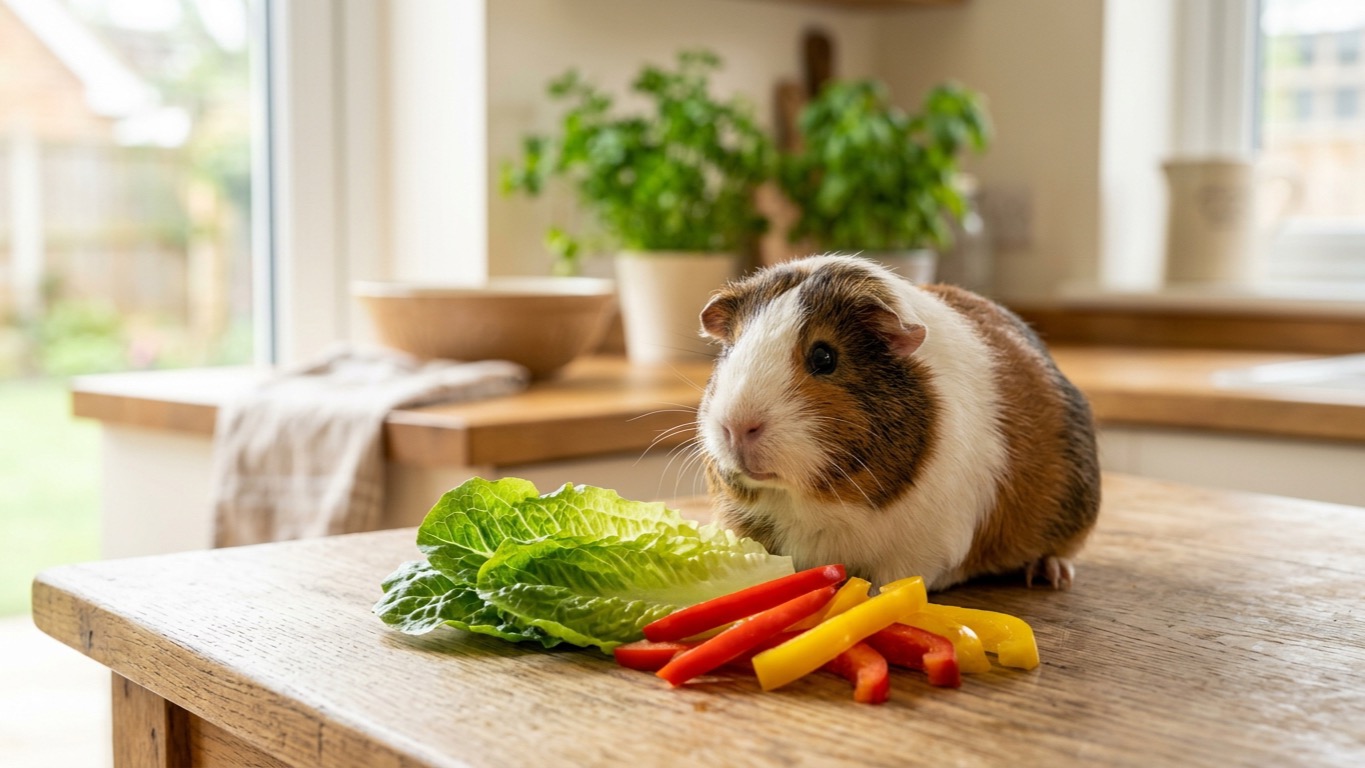
Guinea pigs cannot make vitamin C. That sentence lives on every serious diet sheet. It does not live on a chew title. Pellets formulated for cavies, plus daily vegetables a clinician or a published diet chart will name (bell pepper is the usual household example), carry that job. A willow ball does not.
If a pig is picky, the failure is usually hay quality, pellet brand-hopping, or pain — not a missing toy. Fresh timothy that smells like tea, not dust, is the first swap. Then the pellet. Then the clinic if intake is down. Shopping a 32-piece stick bag while the hay rack is a sad wisp is the wrong order.
Pellets are a measured cup, not a free-feed mountain, on most Oxbow-style charts. Chews that are compressed hay can double as calories. If a pig is overweight and living on Timbells, you bought a snack, not a puzzle. Put the hay rack closer. Put the chew farther. Do not take hay away.
Storage, mold, and the bag that arrived broken
Timothy sticks ship brittle. Owner themes mention broken pieces at the bottom. That is a packing problem, not a poison problem. Use the intact sticks. Compost the powder or put it in the hay pile if it is still clean timothy.
Hay chews mold like hay. A grass ball that sat in a warm garage smells sweet-wrong. Trash it. Do not sun-dry a moldy weave and return it to the cage.
Wood can grow white film if it lived in a wet corner. Trash it. Do not bleach a chew and call it safe. Bleach is for your hidey, not for something that goes in a mouth.
Store unopened packs like you store hay: off the floor, away from the pellet bin so you can see a moth problem early. Once open, a clip on the bag beats a pretty tin you never check.
DIY versus the seven cards
Keepers cut apple branches from trees they can name, that were not sprayed, that are not stone fruit. That can be a real chew. It is also a you-did-the-homework chew. If you cannot name the tree, buy Kaytee’s named apple pack.
Cardboard tubes, paper bags with the handles cut off, and a paper lunch sack stuffed with hay are enrichment. They are not the best chew toys for guinea pigs as a shopping query. They are free shreds next to the paid cards.
Do not offer:
- Cherry, peach, plum, or other stone-fruit wood
- Oleander, avocado, or “pretty garden clippings”
- Pine cones of unknown origin that still smell like sap
- Yarn, rubber bands, or hair ties a pig will treat as hay
The paid cards exist so you do not have to guess a tree. Use them that way.
Two pigs, space, and the chew that starts a fight
Guinea pigs are social. A pair is the welfare default in many guides. Two mouths make a $12 stick pack a three-day item. Buy two of the favored class or you will watch one pig resource-guard a willow ball while the other eats bars.
Cage size is not this article’s job, but a chew will not fix a grid that is too small. If bars are the favorite toy, measure the floor before you measure the Amazon tile. Add a hay tunnel. Add a second rack. Then add a chew.
A boar pair and a sow pair chew differently in keeper notes — not because of a PetBench hormone study, but because boredom and hormones both show up as chewing. If sudden bar chewing arrives with weight loss or a wet chin, that is still a clinic row.
Hideys, fleece, and where a chew should not live
Fleece cages hide wet. A grass ball on a soaked pee pad is an ammonia sponge with a hay costume. Keep chews on the dry platform or in the hay corner. If you use paper bedding, do not bury apple sticks in the wet well and wonder why they smell.
Hideys that are wooden houses get gnawed. That is expected. If the house is stained or varnished, it is the wrong hidey, not a missing toy. An untreated wooden hidey is both furniture and a chew. Inspect the doorway for spears the same way you inspect a stick.
Travel, shows, and the hotel-room pig
A short trip is not a reason to swap the entire chew set. Pack the hay they already eat and one familiar apple stick. A new 20-piece bunny bundle in a carrier is how you lose count of pieces and find one under the seat. Grass balls crush in a tote. Leave the sampler at home.
Closing the loop on the best chew toys for guinea pigs
Buy a named wood or a named hay chew. Keep hay unlimited. Inspect daily. Toss spears and wet weaves. Sort bunny bundles. Skip salt, cedar, and paint. If hay intake drops, stop shopping. The Cavy Chew Tally is a listing map. It is not a diagnosis. Browse chew toys for guinea pigs →
How we researched this guide
The PetBench desk compared the seven live cards, built a 26-listing Cavy Chew Tally of material class, bunny-vs-cavy labeling, and street-price bands, and read Oxbow-style hay-first diet language plus common exotic-mammal warnings on cedar, salt licks, and open-rooted teeth. Mid-price bands are desk arithmetic from public tiles, not a checkout quote.
Nothing here is a clinical endorsement.
Frequently asked questions
What are the best chew toys for guinea pigs?
Untreated apple wood, willow, or timothy-hay pieces, used with unlimited grass hay. The seven cards on this page are sold examples of those classes. There is no single trophy SKU. Hay is the dental job; chews are extra wear and enrichment.
How often should I replace chew toys?
When they are soiled, frayed into spears, or small enough to swallow whole. Hay chews may last a sitting. Apple sticks may last days. There is no printed “safe for 30 days” clock that beats your eyes.
Can guinea pigs chew on cardboard?
Plain, tape-free, ink-light cardboard shows up as a keeper shred. Glossy print and colored boxes do not. Cardboard is not hay and not a wood class.
What if my guinea pig ignores their chew toys?
Keep the hay rack full first. Then try an edible timothy class (Timbells or hay sticks) before you assume the pig “does not like toys.” If hay intake drops, call an exotic-savvy clinician. Ignoring a willow ball is not a disease. Dropping hay is.
Are there chew products I should avoid?
Cedar, aromatic pine, painted wood, salt and mineral wheels, loose bells, dyed rope, and anything with glue you can see. Bunny jewelry with plastic eyes is a choke class. “Dental” marketing on a mineral lick is still a mineral lick.
Are bunny chew sets safe as the best chew toys for guinea pigs?
Sometimes. If the pieces are timothy, apple, willow, or plain loofah, they can be the same material class. Sort the bag. The cartoon rabbit is not a species approval.
Do chew toys replace hay?
No. Welfare diet sheets put grass hay at the center. Toys are a supplement. A pig that only eats chews and pellets is on the wrong plan.
How many chew toys does a pair need?
Two of the class they actually use, plus hay that is never empty. One prized willow ball is a fight waiting to happen. A 20-piece sampler can still be one fight if only one apple stick in the bag is the favorite. Duplicate the winner.
Can I leave chew toys in the cage overnight?
Yes if they stay dry and you inspect in the morning. No if the pig uses the chew as a pillow in the wet corner. Overnight is when grass balls soak. Overnight is when you miss a swallowed-size shard. Morning check is the habit, not a printed hour.
What wood species are actually on the shortlist?
On this URL: apple and willow. Aspen appears more as bedding. Oak and maple show up in keeper DIY notes when the tree is known and unsprayed — that is not a listing we ranked. Stone fruit, cedar, and aromatic pine stay off. If the bag says “natural wood” and will not name the tree, skip it.
Why do some of the best chew toys for guinea pigs say bunny on the bag?
Because the small-animal aisle collapses species. Timothy, apple, and willow do not care about the cartoon. Metal bells and dyed rope do. Read the material list. The Cavy Chew Tally treated bunny-labeled packs as eligible only when the fiber was a cavy-safe class.
A week of hay and chews (worked example)
This is arithmetic, not a trial we ran. One adult pair, decent timothy habit.
| Item | Desk planning figure | Notes |
|---|---|---|
| Grass hay | A rack that looks full at every check | If the bag lasts “too long,” they are not eating it |
| Pellets | Measured cup per pig, per the bag / Oxbow-style chart | Not a free-feed bowl |
| Vitamin C veg | Daily, from a published list | Chews do not carry this |
| Apple sticks | One pack on the table, two sticks in the cage | Replace when short or sharp |
| Timothy chew | Optional snack 2–3× week | If weight is up, skip the snack |
If that table feels boring, good. Boring is the dental plan. Novelty is the extra.
What “1–2 mm a week” is doing in this article
Exotic-mammal explainers often cite incisor eruption on the order of one to two millimeters per week. We reprint that as a published range, not as a measurement from a pig on this desk. The operational point is simpler: wear has to happen every day. Hay is daily. A chew that appears on Saturday and is gone by Saturday night is still only Saturday.
If eruption and wear get out of sync, you see slobber, a wet chin, food drop, or a pig that sits at the hay and does not eat. That is not a cue to buy Sofier’s 32-pack. That is a cue to book an exotic-savvy veterinarian who can look in the mouth — often with sedation and imaging, not a phone flashlight.
Internal links and the rest of the cavy desk
Chews sit next to hay, pellets, and bedding. Smell-specific bedding lives on bedding for smell. If you are building a first cage, start with floor space and hay, then a hidey, then a chew. The Amazon tile order is the reverse of the welfare order. Ignore the tile order.
Sources
- Oxbow Animal Health, guinea pig feeding and hay-first diet materials (grass hay as the majority of the diet).
- Common exotic-companion dental notes: open-rooted teeth; malocclusion is a veterinary diagnosis.
- RSPCA / similar welfare summaries on appropriate gnaw items and the need for constant hay.
- Maker pages and retailer listings for the seven cards above.
Last reviewed: August 2026. Contact if a pack count is stale.