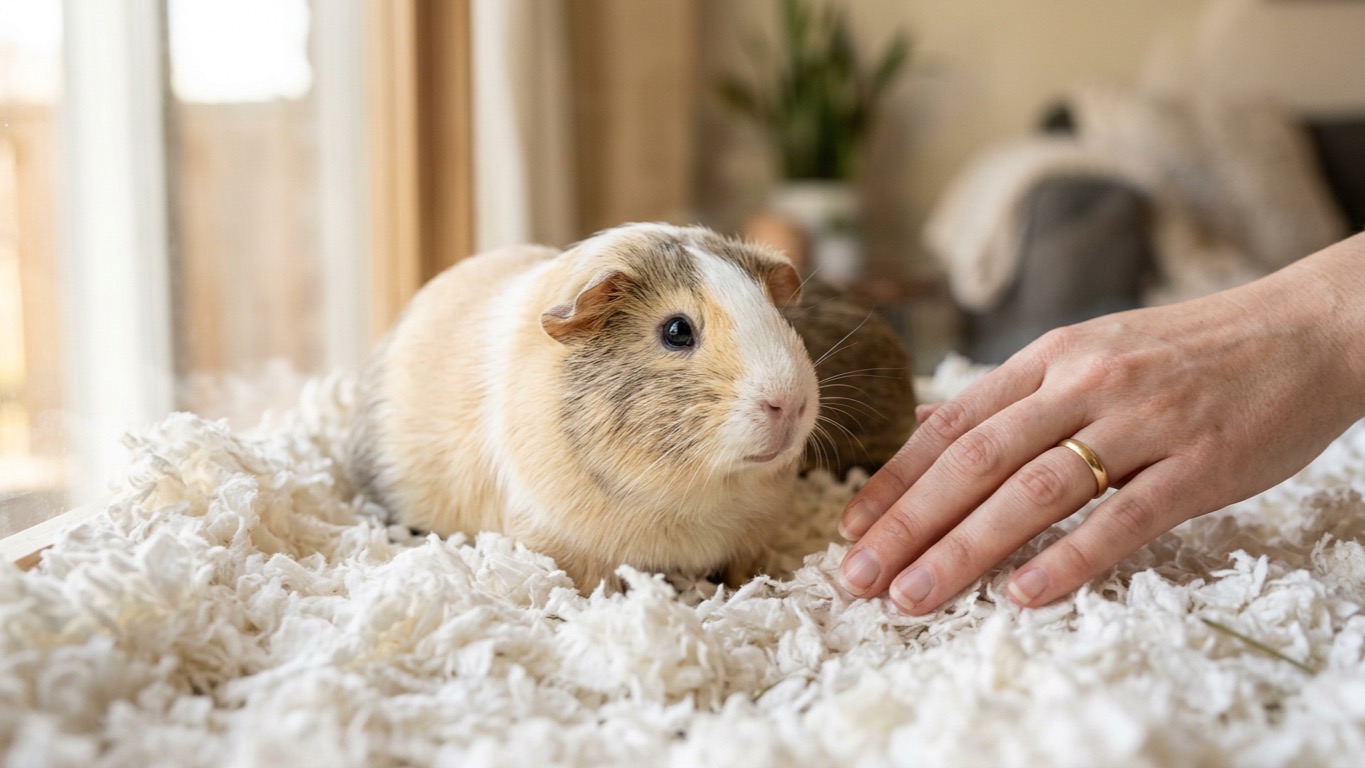
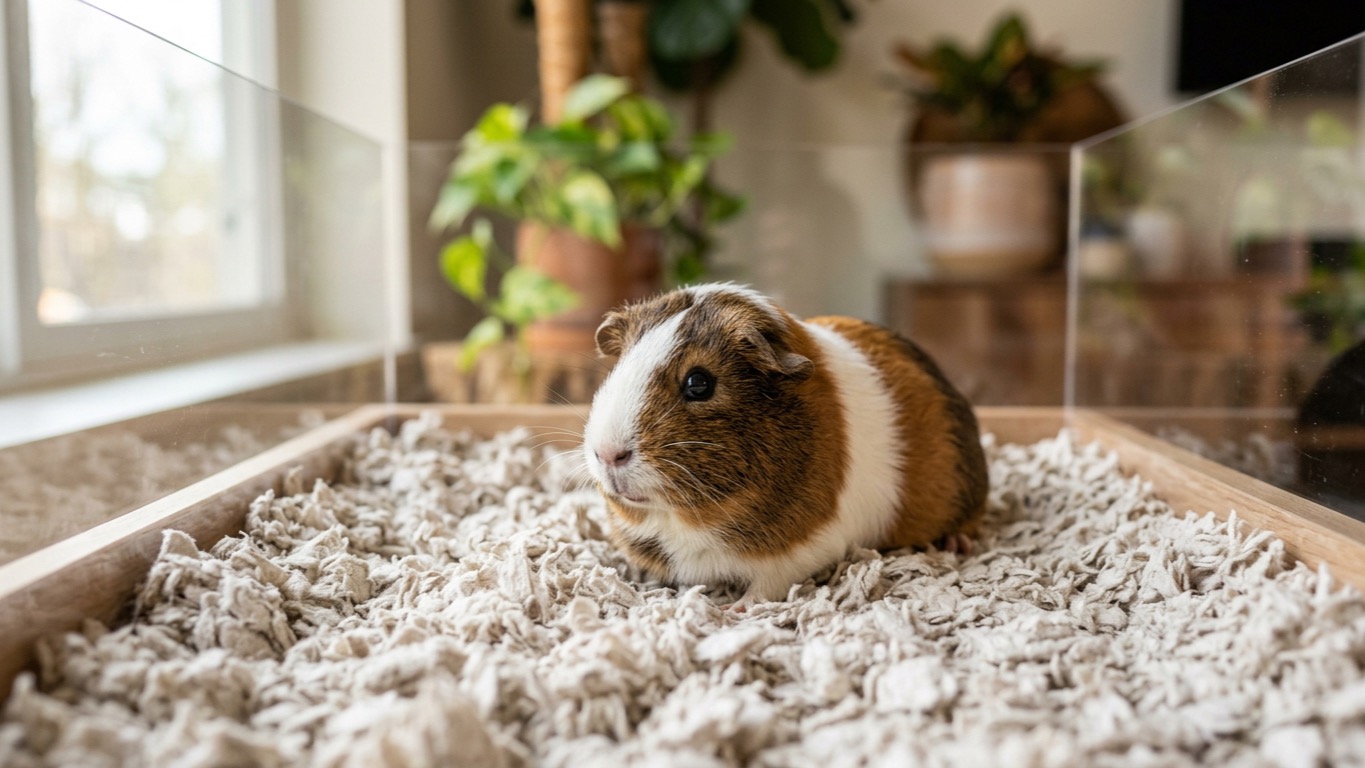
The best bedding for guinea pigs for smell is whatever stays dry underfoot and that you refresh on a calendar: usually unscented paper or wood-fiber, 2–3 inches in the wet third, or a fleece stack you wash. Perfume and pine scent mask ammonia; they do not delete it. Cedar stays off the list.
Buy unscented dye-free paper (Best Pet Supplies or Oxbow Pure Comfort class) if you will dump on a 5–7 day calendar. Buy a factory-mixed odor paper (Kaytee Extreme) only if you want baking soda in the fiber — do not fog the cage with kitchen soda. Do not buy cedar, “fresh pine,” or a lavender bag to hide a half-inch layer.
Nothing here has been reviewed by a veterinarian on our behalf. Specs are maker pages or published husbandry ranges as of August 2026. RSPCA guinea pig pages treat a dry, spacious floor as welfare. Aromatic softwood bedding is the class small-animal welfare writing has warned about for decades. We reprint that warning.
Affiliate disclosure: we may earn a commission from Amazon links.
The general bedding chooser (paper vs fleece vs aspen, without the odor keyword) lives on best bedding for guinea pigs. Hay and pellets are separate smell sources — wet hay smells like a barn for a reason: hay, pellets.
What the best bedding for guinea pigs for smell actually has to do
Guinea pigs are heavy floor animals (published adult ranges often sit near 1.5–2.5 lb). They void a lot of urine for their size. Wet, thin substrate is a pododermatitis / bumblefoot risk class in keeper and clinic writing. Smell control and foot safety are the same variable: a dry walking surface.
Published keeper notes often cite about 15–30 mL of urine per pig per day as the volume you are buying substrate to hold. Treat that as a planning range, not a lab result from this desk. If you treat 20 mL as a midpoint, one pig is about 140 mL/week into the wet zone — plus spilled water and wet veg. A thin 0.5 inch layer over two square feet cannot hold that and stay dry on top.
Three jobs get mashed into one shopping query:
- Cut ammonia, not add perfume — unscented paper, 2–3 inches in wet zones.
- Lower bag trash — fleece + absorbent middle + paper potty, washed on time.
- Wood look without cedar — kiln-dried aspen or named wood-fiber. Never cedar.
If you smell ammonia at standing height, you are already late. Depth or a wash day beats a louder bag tile.
How this desk compared odor cards
PetBench Cavy Smell Desk (August 2026) mapped seven currently attached Amazon cards to dryness, dust language, fragrance vs unscented, and whether the SKU is a full-cage fill or a novelty. We used published husbandry ranges for urine volume and the long-standing welfare warning on cedar and aromatic pine.
We did not weigh 26 mL/kg in a lab. Two pigs double output — size the wet zone or the change day; do not buy a louder perfume.
Named examples — odor jobs, not a medal table
These seven cards are the live attachments. Notes reflect manufacturer listings and owner themes.
1. Best Pet Supplies Natural Paper Bedding
Best for: overall odor control without adding a perfume story.
Recycled, dye-free, unscented paper is the class this desk will defend for the best bedding for guinea pigs for smell keyword: you are buying absorbency and a neutral bag, not a candle. Owner themes say a 5–7 day full change holds if depth is honest. Larger cages need more bags, not a stronger scent.
Pros: Neutral; low-dye; owner “locks moisture” theme. Cons: Needs fluffing; dust if you dump from high up indoors.
2. Oxbow Pure Comfort Bedding
Best for: wood-fiber ammonia language and a dust-control claim, if you will pay the bag price.
Reclaimed wood-fiber listings in this class print aggressive dust-control and odor language. That is a material story (surface area, dryness), not a license to skip the Sunday dump. Premium price is the honest con.
Pros: Ammonia-focused marketing; low-dust theme. Cons: Costs more per fill.
3. Kaytee Extreme Odor Control
Best for: a paper bag that already includes a baking-soda style odor formula.
If you want chemistry in the fiber, buy it factory-mixed. Do not fog the cage with kitchen soda. Owner notes mention remaining dust and a faint soda smell — that is the product. Highly absorbent paper still needs a dump day.
Pros: Targets ammonia language; absorbent paper. Cons: Can be dusty; soda scent is not “unscented.”
4. Kaytee Clean & Cozy Premium Small Animal Bedding
Best for: budget volume and a soft burrow, with honest mid-pack odor performance.
The 6× absorbency claim and TUV-style certification language show up on this line. It is a value paper, not the strongest odor SKU in owner themes. Use depth. Do not expect a cheap bag to out-smell a skipped change.
Pros: Volume for price; soft. Cons: Odor control mid-pack; initial dust.
5. Living World Pet Bedding Premium Natural Paper
Best for: cellulose plus baking-soda odor help with a low-dust theme.
Clumping when wet is the owner-noted mess: scooping can tear a wet mat. That is a handling quirk, not a reason to switch to cedar.
Pros: Low-dust theme; absorbent. Cons: Wet clumping.
6. Carefresh Natural Confetti Pet Bedding
Best for: soft burrow texture — not the longest odor hold in this set.
Confetti pieces scatter and get chewed. Fun is a real enrichment note. Odor fade faster than denser paper or wood-fiber is the honest con in owner themes. Use it if the pig’s comfort is the job and you will change sooner.
Pros: Soft; burrow-friendly. Cons: Odor control mid-to-short; extra scatter.
7. Vitakraft Fresh Bedding
Best for: keepers who already accepted a kiln-dried pine scent and will monitor airways — not this desk’s default smell pick.
The listing story is FSC-style wood and a “fresh” pine aroma. Aromatic softwoods are the class small-animal welfare writing has warned about for decades because of airway and liver-enzyme concerns with certain oils. Kiln-drying reduces some volatiles; it does not turn pine into paper. If you want wood, aspen is the cleaner class on the companion page. If a pig sneezes or avoids the bag, stop. Do not “get used to the forest smell.”
Pros: Wood absorbency; some owners like the scent. Cons: Scent may be too strong; pine remains a debated class.
Comparison: odor-control cards at a glance
| Product | Smell job | Snapshot price | Check |
|---|---|---|---|
| Best Pet Supplies paper | Neutral dye-free paper | — | Price |
| Oxbow Pure Comfort | Wood-fiber ammonia | — | Price |
| Kaytee Extreme | Baking-soda paper | $23 | Price |
| Clean & Cozy | Budget volume | $15 | Price |
| Living World paper | Low-dust + soda | — | Price |
| Carefresh Confetti | Soft, shorter odor hold | — | Price |
| Vitakraft pine | Scented wood — watch airways | — | Price |
Want the wider shelf? Browse guinea pig odor-control bedding on Amazon →
— smell job to material
| Smell job | Prefer | Skip first | Why |
|---|---|---|---|
| Cut ammonia, not add perfume | Unscented paper, 2–3 in wet zones | Lavender / “fresh pine” bags | Fragrance ≠ dry feet |
| Sensitive human or pig airways | Low-dust paper or wood-fiber with a dust claim | Loose baking soda you pour yourself | Dust is an airway load |
| Lower bag trash | Fleece + absorbent middle + paper potty | Fleece alone on bare plastic | Fleece wicks; it does not store a week of urine |
| Wood look without cedar | Kiln-dried aspen or named wood-fiber (Oxbow Pure Comfort class) | Cedar, fresh pine, mystery “forest shavings” | Aromatic oils are the risk class |
| Watch urine color | White / pale paper | Dark pine and confetti dye | Visibility is a health tool |
| Bottle drip / hidey corner | Washable pad under the leak | More scented paper | Fix plumbing, then the pad |
Cadence vs pig count (table 2)
| Household | Paper full change (typical owner theme) | Fleece wash | If the room smells at standing height |
|---|---|---|---|
| One pig, generous cage | About 5–7 days | Every 2–4 days + daily sweep | You are late; add depth or a day |
| Pair | 3–5 days often | Every 2–3 days | Split potty area or add a second litter tray |
| Three-plus | Do not “stretch the bag” | Laundry becomes the hobby | Enlarge cage; perfume will not scale |
Claim honesty matrix (table 3)
| Listing claim | Counts as evidence here? | Action |
|---|---|---|
| “Absorbs 6× its weight” | Maker claim — reprint only | Still change on a calendar |
| “99.9% dust-free” | Maker claim | Fluff outdoors; watch sneezing |
| Baking soda in the fiber | Partial | Prefer factory mix over loose powder |
| “Extreme odor control” | Marketing until cadence is printed | Read bag size vs cage size |
| Kiln-dried pine / “fresh bedding” | Debated class | This desk prefers aspen or paper for smell and airway |
| Cedar / aromatic pine | No | Do not use as primary bedding |
| Recycled, dye-free paper | Partial plus owner “neutral smell” theme | Strong default for this keyword |
Monthly cash vs chore (table 4)
| System | Typical monthly cash (one–two pigs, desk estimate) | Chore that actually kills smell | Failure mode |
|---|---|---|---|
| Unscented paper | $15–$30 | Depth + weekly (or sooner) dump | Thin pretty scatter |
| Odor-formula paper | $20–$35 | Same dump; formula is a helper | Stretching to day 12 |
| Wood-fiber (Pure Comfort class) | Mid–high per bag | Same as paper | Buying less volume than the cage needs |
| Aspen | $10–$20 | More frequent wet-wood scoop | Using it like paper and wondering why it sours |
| Fleece rotation | Detergent + power after year-one kits (~$150+ to start) | Daily hay sweep + real wash | Softener-coated non-wicking fleece |
| Hybrid | Mid | Paper potty mid-week, fleece lounge | Forgetting the potty corner |
These are planning bands, not invoices we issued.
Decision matrix for the best bedding for guinea pigs for smell (table 5)
| Home | First class | Pair with | Avoid |
|---|---|---|---|
| Apartment, one pig, hate laundry | Unscented or dye-free paper | White paper to see wet patches | Cedar; thin layers |
| Pair, willing to wash | Fleece stack + paper potty | Fragrance-free detergent, extra rinse | Fabric softener |
| Dust-sensitive | Low-dust paper or wood-fiber | No lavender bag | Loose baking soda |
| Tight budget, wood OK | Aspen + aggressive scoop | Extra change day | Pine-scent marketing as “the cheap fix” |
Why guinea pig smell is not hamster smell
Hamsters climb, hoard, and occupy vertical space. Guinea pigs live on the floor and void a lot of urine for their size. A thin pretty scatter that works in a dwarf-hamster bin sours in a C&C cage by Wednesday. Depth of 2–3 inches in the wet third is the product. Anything less pools on the coroplast, which is the ammonia factory you can smell from the doorway.
They also produce a lot of cecotropes and hay mess. Smell is not only urine. Soaked hay in a corner is a second substrate. Pull it daily. The hay page is not optional reading if you came here for odor.
Paper vs fleece vs wood vs pellets — odor edition
Paper — Default for most apartments. Soft, discard, typically a 5–7 day full change for one pig if depth is real. Dye-free unscented is the smell keyword winner in this desk’s job table. Scented paper is a human preference with an airway watch.
Fleece — Wins long-term trash and can win smell if the stack wicks (waterproof base + absorbent middle + fleece top) and you wash on time. Daily hay sweep is non-negotiable. Softener kills wicking. Up-front kit money is real.
Aspen — Safer wood class than cedar/pine. Cheaper bags, more scooping, heavier. Good if you accept labor.
Wood-fiber (Pure Comfort class) — Sits between paper and shavings: dust-control claims, ammonia language, higher price.
Pellets — Useful in a litter tray the pigs actually use, not as a whole-cage gravel. Hard on feet as a full floor. Great potty-corner absorber.
Pine/cedar shavings — Cedar is a no. Aromatic pine is a no for this desk’s default. Kiln-dried pine still carries a scent story (Vitakraft card). Prefer aspen or paper.
The chemistry you can smell — without a fake lab
Ammonia is the sharp note from stale urine. It rises when urine sits wet against plastic and air. Dry fiber plus a dump day lowers that note. Baking soda in a factory mix is a buffer story; loose powder you throw is a dust story. Essential-oil “pet sprays” on a dirty cage are a headache story.
If the cage smells hours after a full clean, check: (1) depth, (2) a wet hidey the liner missed, (3) a bottle drip, (4) hay sludge, (5) a plastic tray that never got washed, (6) a room with no airflow. Do not immediately buy a new brand.
Respiratory signs — repeated sneezing, discharge, open-mouth breathing — are a clinic, not a cue to add lavender. We will not diagnose.
Humane Society guinea pig care treats housing and daily checks as the floor. This URL’s job is the substrate class that keeps that floor from becoming an ammonia source.
Cage hygiene and bumblefoot (the smell page has to say this)
Dry feet are the prevention class keepers and clinics both name. Red, swollen, or scabbed pads are a same-week clinic. Do not treat with a different confetti color. Increase dry surface area and get the animal seen.
Place the cage where air moves gently — not in a closed closet, not on a booming speaker, not in a sun-baked window that cooks urine into a stronger note. Airflow is a smell product you already own.
Fleece stack that actually controls smell
- Waterproof base (coroplast, fitted liner).
- Absorbent middle (uhaul pads, puppy pads you accept, or washable absorbent cloth).
- Fleece top.
- Optional paper or pellet potty in the corner they already use.
- Daily: sweep hay and poops; swap the potty if soaked.
- Wash: 2–4 days, fragrance-free, extra rinse, no softener.
- Rotate at least two full tops so one is always dry.
If you press the lounge fleece and get a wet handprint after one night, the middle layer is missing or the wash is late. That wet handprint is the smell.
Paper-only SOP
- Measure the wet third. Fill to 2–3 inches there; lounge can be slightly thinner if they do not pee there.
- Fluff bags outdoors or in a tub.
- Spot wet corners daily into a compost or trash bag.
- Full dump on the calendar in Table 2 — earlier if you smell it standing.
- Wash the empty tray; biofilm on plastic smells like “the bedding failed.”
- Do not mix cedar “for freshness.”
Multi-pig math
Two pigs are not “one pig plus a little.” They are closer to 2× urine plus more hay waste plus more corner competition. If you refuse to change more often, you need more cage and a dedicated potty, not Extreme Odor Control as a personality. Three-plus without a giant grid cage is how people end up on fragrance forums.
Males vs females can differ in marking; that is a behavior note, not a substrate ranking. Neutered pairs still pee.
Other smell sources people blame on bedding
| Source | Fix |
|---|---|
| Wet hay | Rack, daily pull, dry storage |
| Dirty water bottle gasket | Soak, brush, replace the tube |
| Kitchen trash next to the cage | Move the cage or the bin |
| Fleece with fabric softener | Strip-wash, stop using softener |
| “Natural” wood litter that is cedar | Throw it out |
| A pig with a UTI or dental pain (less grooming) | Clinic — not a new bag |
| Poor ventilation | Move the cage |
Weight the pig weekly on a kitchen scale. Sudden loss plus a smell change is a health flag. This desk does not treat.
Listing literacy for the best bedding for guinea pigs for smell
Read bag weight and coverage square feet before stars. Confirm unscented if anyone in the home is airway-sensitive. Check whether “odor control” is baking soda, charcoal language, or just lavender. For fleece, demand an absorbent layer in the photo or the bullet list. Prices move.
PetBench discards “#1 bestseller” as a smell signal. A 500-review bag that you spread 0.5 inches thick will lose to an obscure bag used at 3 inches.
Ask the listing:
- Is the bag unscented, or is “fresh” a perfume?
- Is odor chemistry factory-mixed, or are you expected to add powder?
- What coverage number is printed — dusting or a 2-inch fill?
- Is the wood species named?
How we did not evaluate
We compared maker claims, material class, and owner-theme cadence. That is the honest method.
Decision checklist
- Write the job (“pair in a 2×4, I will dump Saturdays, no perfume”).
- Match Table 1 and Table 5.
- Confirm depth or fleece stack on the live listing.
- Confirm the chore you will keep.
- Only then compare $15 vs $23 bags.
If step 3 is a scented pine bag and a dusty room, pick another class.
Room setup that makes any bag work harder
A cage on the floor in a carpeted closet loses. A cage on a stand in a room you already air out wins. Put a washable runner under the cage for tracking. Keep the litter scoop in a lidded caddy so the scoop does not become a smell object. Wash hideys; fleece hideys hold urine in seams.
In summer, urine sours faster. Shorten the interval. In winter, closed windows raise the indoor note — that is ventilation, not a failed brand.
Transition week
Change one zone first (a corner pad or a half-cage paper swap). Watch eating, hiding, and whether they sit on the new texture. A full overnight swap of scent and texture is how you get a boycott plus accidents on the fleece lip. Seven to ten days is a humane pace when you can afford it.
Frequently Asked Questions
What should I prioritize when shopping for the best bedding for guinea pigs for smell?
Dry walking surface and a change cadence you will keep. The best bedding for guinea pigs for smell is usually unscented paper or a real fleece stack — not the loudest odor tile. Then dust, then price.
How often should I change bedding to keep smells down?
Paper: about 5–7 days for one pig with honest depth; sooner for a pair. Fleece: wash every 2–4 days plus daily sweep. If you smell ammonia at standing height, you are already late.
Is baking soda safe to add?
Prefer factory-mixed odor papers. Loose powder is dusty. Do not create a soda sandstorm.
Why does the cage smell after I just cleaned?
Thin layer, unwashed tray, wet hay, bottle drip, or no airflow. Depth and tray wash beat a brand swap.
Can I mix types?
Yes: paper potty + fleece lounge is the hybrid this desk sees work. Do not mix cedar into any stack.
Is wood safe?
Aspen and some wood-fiber products are the wood lane. Cedar is out. Kiln-dried pine is a watch-the-airways class, not this page’s default.
Does fleece smell less than paper?
Only if it wicks and you wash. A wet fleece smells worse than a dumped paper bag.
What if the pig has sore feet?
Dry the floor and call the clinic. Substrate color will not treat pododermatitis.
Daily keeper notes (smell-adjacent)
Hay always available, pellets measured, vegetables appropriate for the species, water bottle checked for clogs. Weekly weigh-in. Document which bag the herd accepts before you buy a 50-pack. Pair substrate with the hay you already know they eat — a new timothy that they shatter everywhere will look like a bedding failure.
Deep-clean day (the smell reset humans skip)
A bag swap on dirty plastic is a scented sandwich. Once every 2–4 weeks (weekly for a pair in a small tray), empty the cage fully:
- Relocate pigs to a safe, sided playpen with hay and water — not a high sofa.
- Dump substrate; scrape corners with a plastic scraper, not a metal blade that gouges coroplast.
- Wash the tray or wipe coroplast with a pet-safe cleaner the label allows; rinse until it does not smell like product.
- Dry completely. Wet plastic plus new paper = instant sour.
- Wash hideys, kitchen tiles, and the water bottle in the same session.
- Refill to Table 1 depth. Do not “save” the dry-looking lounge paper from a pair cage — it has aerosol and tracked urine you cannot see.
If you use a wooden hut, it is a porous smell battery. Bake-in-sun or replace when it stays sour after a wash. This is husbandry, not a woodworking review.
Male grease gland, senior pigs, and smells that are not the bag
Intact males have a grease gland above the rump that collects sebum. That is a grooming smell, not an ammonia smell. Clean per widely published keeper methods (mineral oil / gentle wipe — follow a clinic if the skin is raw). Buying Extreme Odor Control will not degrease a gland.
Senior pigs may sit in wet corners more. Shorten the interval; add a fleece pad they will actually use; get mobility and dental checks at the clinic. A 6-year-old who suddenly reeks is not a Kaytee problem first.
Boars vs sows: marking can differ. Neutering is a clinic decision with its own recovery smell (bedding will be messier for days). Plan extra paper, not a pine bag.
Hay, veggies, and the “I just changed it” complaint
Timothy and orchard grass that sat in a humid bin smell like a barn before they hit the cage. Store hay in a dry, ventilated container, not a sealed plastic tote that sweats. Wet cucumber ends and lettuce spines left overnight are a compost starter. Pull uneaten wet veg the same evening. Pellets that get peed on become mash — use a heavy bowl or a raised kitchen.
If you switch hay brands the same week you switch bedding, you will not know which variable soured the room. One variable.
Four desk scenarios (composite owner themes, not house trials)
Scenario A — Studio apartment, one pig, paper only. Job: Sunday dump, no washer. Class: dye-free paper at 3 inches in the wet corner, thinner lounge. Fail: lavender bag “so guests don’t notice.” Guests notice lavender-plus-ammonia, which is worse.
Scenario B — Pair in a 2×5 C&C, both work full-time. Job: smell on Thursday when you thought you had until Saturday. Class: hybrid — fleece lounge, paper or pellet potty, mid-week potty dump, full fleece wash twice a week. Fail: one fleece blanket on bare coroplast.
Scenario C — Child wanted “the forest bag.” Job: cheap wood at the pet store. Class: aspen if you must do wood; return cedar; treat kiln-dried pine as a watch. Fail: “it’s natural so it must be safer than paper.” Natural is not a safety class.
Scenario D — Rescue trio, small starter cage. Job: impossible. Three pigs in a pet-store rectangle will beat every odor SKU. Class: enlarge first (grid cage / Midwest-style expansion), then paper. Fail: stacking Extreme Odor bags as architecture.
These are decision stories. They are not medals and they are not patient case reports.
Travel, sitters, and boarding smell
Write the cadence on a card taped to the stand: “Spot daily; full paper Sunday; fleece in the washer Wednesday.” A sitter who “doesn’t want to waste bedding” is how you come home to a wall of ammonia. Leave pre-measured bags. For boarding, ask what substrate they use; a pine bin at a kennel is a 48-hour airway experiment you did not consent to. Bring your own paper if they allow it.
Car travel: a small carrier with a pee pad, not a full paper fill that dumps in a turn. Transfer back to the real depth at destination.
Coroplast, Midwest, and store cages — smell geometry
Store cages with a deep plastic tub hold urine in a bathtub. That can be good (walls) or bad (you never dump the soup). C&C on coroplast needs 5–6 inch walls or you will have waterfall pee on the floor, which you will blame on the bag. Midwest-style canvas bottoms soak; use a waterproof liner or you are smelling canvas, not Carefresh.
A second story / loft: pigs will pee up there. Fleece the loft or you have a drip onto the lower paper that sours both levels.
Laundry science in one page (fleece people)
- Fragrance-free detergent, measured — extra soap residue smells and coats fibers.
- Extra rinse is the wicking product.
- No fabric softener, no dryer sheets.
- Vinegar rinse is a keeper hack for odor in the washer itself; do not soak pigs in vinegar.
- High heat can damage waterproof backings — follow the liner maker.
- If fleece still smells after a wash, the middle pad was left in the cage or the washer has a mildew gasket. Clean the machine.
Strip-wash (hot, extra detergent once, then multiple rinses) is for fleece that has been softened to death. It is not a weekly religion.
What “15–30 mL/day” means in bag math
If you treat 20 mL as a midpoint, one pig is about 140 mL/week of urine into the wet zone — plus spilled water and wet veg. Two pigs are ~280 mL/week before drips. If your bag says it covers a giant cage and you still smell it on day three, you used the coverage number as a brag, not as a fill depth.
We are doing arithmetic on a published range so you stop buying perfume.
Air quality for people
If a human in the home has asthma, unscented low-dust paper or fleece is the first class, and the cage does not live in a bedroom with the door shut. Fluff bags on the balcony. This is not medical advice for humans either — it is a placement note.
When smell means clinic first
Blood in urine, straining, screaming when peeing, a pig who stops eating, or a sudden one-sided wet that looks like sludge — those are not “try Oxbow.” Go. Bring a sample if the clinic wants one. We will not interpret it.
Buying in bulk without creating a warehouse smell
Paper in a sealed bin in a garage will pick up gasoline and mold notes. Keep a week of bags in the house, the rest in a dry indoor closet. Check for pests. A 6-month pallet is only a bargain if the first bag still smells like paper, not like the shed.
Counterfeit and warehouse-damaged bags show up around popular SKUs. If the bag arrives wet or ripped, that is a smell you should not introduce. Use the return window.
What to do tomorrow
- Write pig count and cage footprint.
- Pick unscented paper or a three-layer fleece stack from Table 1.
- Fill the wet third to 2–3 inches, or build the stack.
- Put dump or wash day on a calendar.
- If ammonia is in the doorway, add inches or a wash day before you look at SKUs.
For the best bedding for guinea pigs for smell, shop in this order: cage size and pig count → unscented absorbent class → depth or fleece stack → calendar → only then brand tiles on Amazon. Internal link if you still need the general chooser: best bedding for guinea pigs.
A last placement check: if the cage shares a wall with a litter box or a cat’s automatic box, you are smelling two species. Separate the rooms if you can. If you also run a rabbit hutch indoors, do not reuse rabbit pine as cavy bedding — different species pages, different oil rules.
Keep a written log for two weeks after any bag change: dump date, pig count, whether you smelled ammonia at 5 p.m., and any sneeze notes. That log is more useful than a star average.
Sources
- RSPCA, Guinea pigs: https://www.rspca.org.uk/adviceandwelfare/pets/rodents/guineapigs
- Humane Society, Guinea pig care: https://www.humanesociety.org/resources/guinea-pig-care
- PDSA / welfare-org housing notes (dry floor, space — not a field trial notes)
- Maker listing language on the seven Amazon cards above (August 2026 snapshots)
- Published keeper-range urine volume (~15–30 mL/pig/day) used only as bag-math planning, not as a lab result from this desk