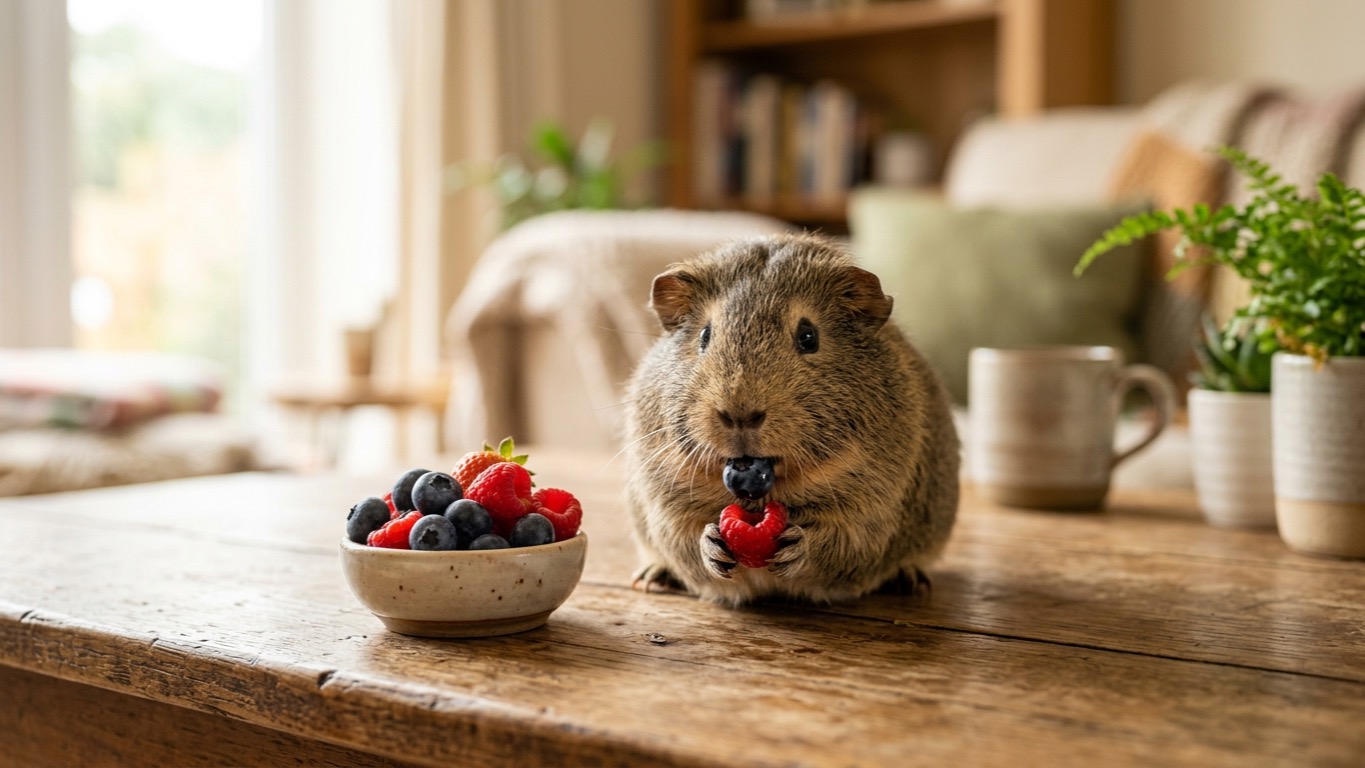

The best veggies for guinea pigs daily are a cup-class bowl built on high-C, lower-calcium produce — bell pepper as the C engine, leaf lettuce as the volume, cilantro as a rotate-in — on top of unlimited grass hay and a C-fortified pellet. Cucumber is water, not a vitamin. Iceberg is a no. Kale and parsley are high-calcium leftovers, not daily staples. The We read the titles and descriptions of 5 SKUs. Snapshot stickers run $1–$3 (median $2, a 3.0× spread). The five tiles sum to $9. 2 of 5 are lettuce (romaine $3, the most expensive tile; green leaf $2). 1 of 5 is the high-C class (pepper $2). 1 of 5 is an herb (cilantro $1). 1 of 5 is a hydration leftover (cucumber $1). 0 of 5 are hay. 0 of 5 are pellets. 0 of 5 are iceberg. A $3 romaine head is not a better C plan than a $2 pepper. That is USDA class math, not a feeding trial.
Hay first (hay, Timothy). Then a plain pellet (pellets). Then this bowl. Fruit is a teaspoon, not a meal (fruit). Floor and bedding still matter (cage, bedding).
Hero stat (August 2026): USDA-class vitamin C per 100 g of raw edible portion — red bell pepper ~128 mg, cilantro ~27 mg, green leaf lettuce ~9 mg, romaine ~4 mg, cucumber ~2.8 mg. Pepper’s C is ~46× cucumber’s at the same 100 g reference. Nobody feeds a pig 100 g of pepper. The ratio is why pepper is the daily engine and cucumber is a warm-day slice.
Our guides are reader-supported. This article may contain affiliate links. As an Amazon Associate we may earn a commission if you buy through links, at no extra cost to you.
Related: pellets, hay, fruit, cage. A pig who stops eating, sits hunched, or strains to pee is a clinic problem tonight. We are not that clinic.
What are the best veggies for guinea pigs daily?
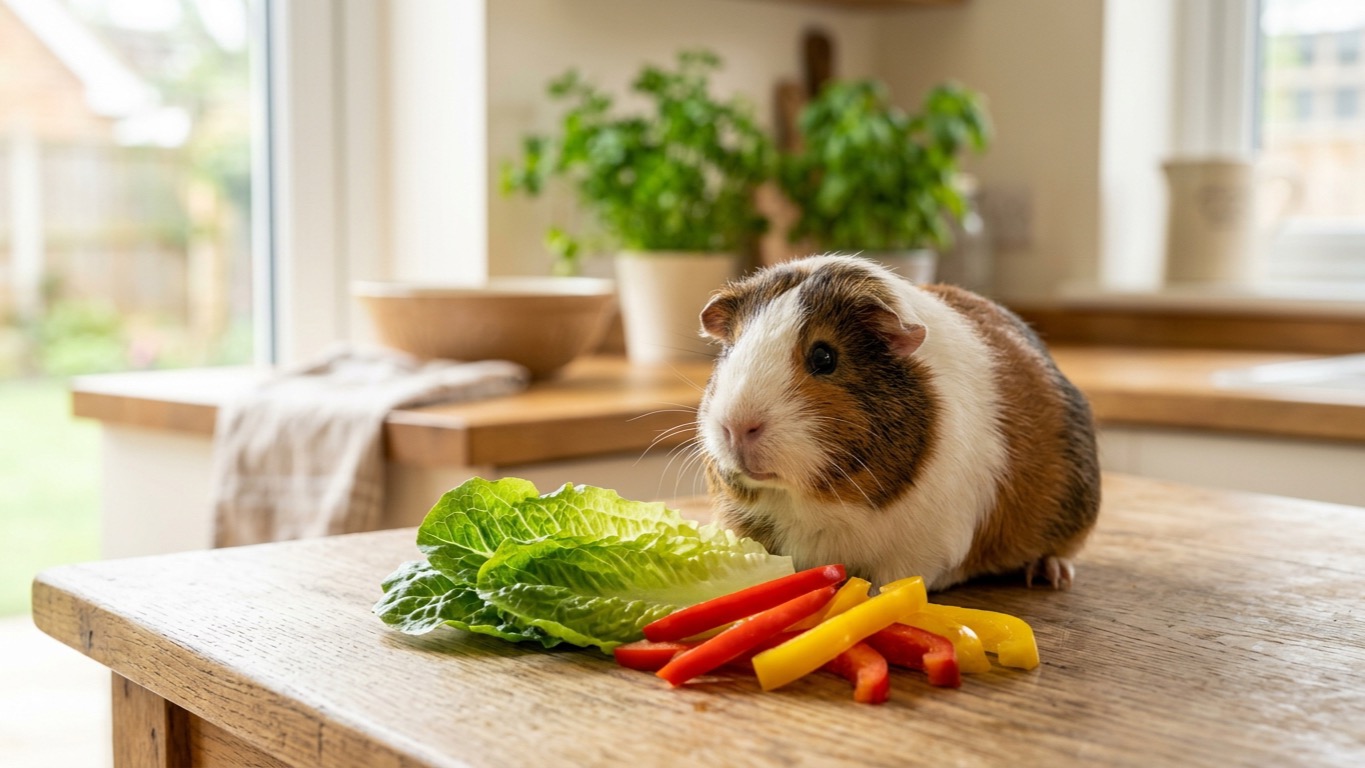
A rotated cup — commonly cited on rescue and GPCA-class pages as about one cup of fresh veg per pig per day — built from low-calcium, vitamin-C-useful plants, with hay still doing the fiber and teeth job. On this URL the five cards are a grocery shortlist, not a complete diet. Pepper is the C class. The two lettuces are volume and water. Cilantro is a flavor rotate-in with more calcium than pepper. Cucumber is almost no C.
Merck Veterinary Manual still treats guinea pigs as a vitamin C–dependent species. Published care pages commonly cite roughly 10–30 mg of ascorbic acid per day for a healthy adult, more for growing, pregnant, or sick animals — those are clinic doses, not a bowl we weighed. A C-fortified pellet covers a baseline. Fresh pepper covers a visible, washable boost.
Browse the keyword on Amazon →
Quick picks at a glance
- Best listed C engine: Bell peppers — $2 card. USDA-class ~128 mg C / 100 g (red). Low calcium class. Trim stem and seeds. Daily yes.
- Best listed cheap herb: Cilantro — $1. Moderate C, higher calcium than pepper. Rotate. Wilts fast.
- Best listed volume green (cheaper lettuce): Green leaf — $2. Daily salad base. Wash. Not a C plan by itself.
- Best listed volume green (expensive leftover): Romaine — $3. Most expensive tile on this URL. Hydrating. Weaker C class than pepper. Do not let it replace pepper because it costs more.
- Honest leftover (hydration, not daily C): Cucumber — $1. Water + almost no C. Thin slices, not the cup.
How cavy veg listings compare on labels
Four real diet jobs — then the five grocery tiles this URL actually lists.
| Job | What actually works | Category | Fail if you skip it |
|---|---|---|---|
| Teeth + gut motility | Unlimited grass hay | Off these five — hay | Veg as “the meal” |
| Baseline ascorbate in a complete feed | C-fortified uniform pellet | Off these five — pellets | Honey sticks as the C plan |
| Daily C engine | High-C, low-Ca produce | Bell pepper $2 | Iceberg or cucumber as the C plan |
| Cup volume / water | Leaf lettuce | Green leaf $2; romaine $3 | Romaine as the expensive “better” pepper |
| Rotate-in herb | Small handful, not the bowl | Cilantro $1 | Daily parsley / kale (high Ca) |
| Warm-day water slice | Cucumber | $1 leftover | A cup of cucumber |
| Teaspoon fruit | High-C fruit, rare | Off these five — fruit | Fruit as the daily veg |
Before you shop: (1) you can name hay first before you name a pepper, (2) iceberg is a no, (3) cucumber is not the C engine, (4) high-calcium greens (kale, parsley, spinach class) are rotate-or-skip if the pig has a stone history, (5) no eat / hunched / blood in urine / teeth that will not close is a clinic, not a new lettuce. Fail gate 5 and this checklist is how you shop past an emergency.
Why the best veggies for guinea pigs daily are a C-to-calcium worksheet
- They cannot make vitamin C. That is species physiology (Merck; standard cavy texts). Scurvy in a pig looks like reluctance to move, swollen joints, poor coat, and a pig who stops eating — clinic, not a new herb.
- Hay is still the diet. Veg is the wet vitamin layer. Pellets are the measured supplement. A beautiful salad next to an empty hay rack is a failed bowl.
- Calcium is the other lever. Rescue and clinic pages still treat bladder sludge and stones as a common cavy problem. High-Ca greens (parsley, kale, spinach class) are the tiles people overfeed because they look “healthy.” Pepper is the daily class because it is high C, low Ca on USDA tables.
- Sugar and starch are not daily. Carrot, corn, and fruit are treats. This URL’s five cards are mostly leaves and pepper. Keep them that way.
- Oxalates are a rotate rule, not a panic word. Spinach-class greens belong on an occasional list. They are not on these five cards. Do not add them because a blog said “dark leafy.”
- Iceberg is empty water plus little C. It is not on the card file. Keep it off the bowl.
- Frozen bags are a no for this job. Thaw texture plus “steamable” mixes with onion/garlic salt are how people poison a pig by accident. Fresh, washed, room-temp.
The five Amazon cards sit in a fifth bin: grocery search tiles. Useful as a produce shortlist. $0 of a hay bale.
How this desk scored the five cards (and refused to score “guinea pigs love them”)
We grouped listings by the five attached cards on class honesty:
- Is it a high-C class on USDA tables? 1 of 5 (pepper).
- Is it a lettuce volume class? 2 of 5 (romaine, green leaf).
- Is it the most expensive tile? 1 of 5 (romaine $3).
- Is it a hydration leftover? 1 of 5 (cucumber $1).
- Does any card replace hay? 0 of 5.
Want current produce shopping? browse the keyword on Amazon →
Produce — USDA-class C vs calcium
Numbers below are rounded FoodData Central / standard produce references for raw, edible portions. They are not assays we ran. Use them to compare classes, then cut the serving to a cavy cup, not 100 g.
| Produce (card or leftover) | Vitamin C (mg / 100 g) | Calcium (mg / 100 g) | Card sticker | Desk note |
|---|---|---|---|---|
| Red bell pepper | ~128 | ~7 | $2 | Daily C engine |
| Cilantro | ~27 | ~67 | $1 | Rotate; more Ca than pepper |
| Green leaf lettuce | ~9 | ~36 | $2 | Volume base |
| Romaine | ~4 | ~33 | $3 | Volume; weakest C of the two lettuces |
| Cucumber (with peel) | ~2.8 | ~16 | $1 | Water leftover |
| Parsley (not a card) | high C class | high Ca | — | Occasional, not daily |
| Kale (not a card) | high C class | high Ca | — | Occasional, not daily |
| Iceberg (not a card) | near-zero C | low | — | Skip |
Desk stat: pepper’s C is ~14× green leaf’s and ~32× romaine’s per 100 g, at ~0.2× cilantro’s calcium. Romaine is 1.5× the green-leaf sticker ($3 vs $2) with a weaker C class. Cucumber at $1 is the cheap tile and the worst C class on the card file.
Water content (USDA-class): cucumber and lettuces are ~94–95% water. That is why they hydrate. That is also why they cannot be the C plan.
Bell Peppers
Best listed for: the daily C engine on this URL.
Pepper is why this page exists. USDA-class red pepper is the high-C, low-Ca produce that cavy care pages keep naming. Orange and yellow are the same botanical job with slightly different C tables; green is usually a bit lower C and a bit more bitter. Trim the stem and the core. Seeds are a choke/irritant leftover — drop them. A daily wedge or two is a staple. A whole pepper as the only food is still not hay.
Cilantro
Best listed for: the $1 rotate-in herb — not the C engine, not the cup.
Cilantro is the cheap tile. USDA-class C is real (~27 mg / 100 g) and calcium is higher (~67 mg / 100 g) than pepper. That is why it is a handful in a rotation, not a daily mountain. It wilts in a day. Buy what you will feed tomorrow. Gas and soft stool after a huge pile are owner themes. Cut the pile, do not invent a new SKU.
Romaine Lettuce
Best listed for: the expensive volume leftover — $3, weakest lettuce C class on this URL.
Green Leaf Lettuce
Best listed for: the $2 daily salad base.
Green leaf is the quieter lettuce tile. Lower sticker than romaine, better C class than romaine on the USDA rows above. Still not pepper. Wash thoroughly — grit is how people think the pig “hates lettuce.” Wilted bags are a waste tile. A damp towel in the fridge is owner practice, not a lab protocol we ran.
Cucumber
Best listed for: the hydration leftover — $1, ~2.8 mg C / 100 g.
Cucumber is water with a skin. Fine as a thin slice on a hot day. A bad plan as the cup. Loose stool after a pile is the usual owner note. Peel if the skin is waxed; many grocery cukes are.
How these products compare on labels and price
| Card | Sticker | USDA C class | USDA Ca class | Desk job |
|---|---|---|---|---|
| Bell peppers | $2 | High (~128) | Low (~7) | Daily C engine |
| Cilantro | $1 | Mid (~27) | Mid-high (~67) | Rotate herb |
| Green leaf | $2 | Low-mid (~9) | Mid (~36) | Volume base |
| Romaine | $3 | Low (~4) | Mid (~33) | Volume leftover |
| Cucumber | $1 | Near-zero (~2.8) | Low (~16) | Water leftover |
Desk stat: the $9 cart is 3× the cheapest single tile ($1). Romaine at $3 is 3× cilantro or cucumber and 1.5× pepper — for the weakest C class on the lettuce pair. Median sticker is $2. Spread is 3.0×.
A daily bowl that is not a recipe this desk fed
Rescue-class pages still rhyme the same stack: unlimited hay, measured pellet, about a cup of veg, water that actually comes out of the bottle. A sample bowl shape — not a gram protocol we validated:
- A wedge of washed pepper (C engine).
- A handful of green leaf or romaine (volume).
- A small cilantro sprinkle a few days a week (rotate).
- Cucumber only if you needed water theater, not vitamins.
Introduce one new plant over several days. Soft stool, bloating, or a pig who stops eating is a stop, then a clinic if it does not resolve. Weigh weekly on a kitchen scale. Sudden loss precedes visible illness on every cavy forum that is honest.
Pellets stay measured. More veg is not a license to skip hay. More hay is not a license to skip C. All three layers.
What does not belong in the daily veggie job
- Iceberg. Empty. Skip.
- Onion, garlic, chives, leek. Toxic class. Not on these cards. Keep them off.
- Potato, rhubarb leaves, avocado. No.
- Frozen steamable mixes. Salt, onion powder, butter sauce.
- Kale / parsley / spinach as the daily mountain. High Ca class. Occasional if the pig has no stone history; clinic if they do.
- Fruit as the cup. Teaspoon. See fruit.
- A colorful muesli “salad kit.” Selective feeding. Same problem as junk pellets.
Teeth, gut, and why vegetables are not optional
Guinea pig incisors and molars erupt continuously. Hay is the grind. Veg adds a second texture and water. Hindgut fermenters need constant fiber; gut stasis is an emergency, not a “picky eater” week. Fresh greens support motility. They do not replace hay. A pig on pellets-only plus iceberg is a scurvy-and-stasis bet. A pig on hay plus pepper plus a C pellet is the public-care stack. Drooling, dropping food, or a wet chin is a dental clinic.
It degrades in light and the pig may drink less because of taste. Care pages still prefer food-form C (pellet + pepper).
Seasonal shopping without inventing a CSA
The five cards are year-round grocery searches. Pepper prices move. Cilantro bolts in heat. Lettuce gets bitter. That is produce, not a 2033 market CAGR. Buy what is crisp. Organic vs conventional is a residue preference, not a C assay we ran. Wash either way. Farmers’ market bunches are fine if you know they were not sprayed with something the seller cannot name.
A $2 pepper card and a $3 romaine card will not match your store. The class matches: pay for pepper before you pay for a prettier lettuce.
When the best veggies for guinea pigs daily are the wrong debate
- The pig has not eaten in a few hours and is hunched. Clinic. Critical care first, salad later.
- White, gritty urine or straining. Clinic. Calcium conversation after imaging, not after a kale blog.
- Loose stool that lasts. Cut the watery tiles (cucumber, excess lettuce). If it continues, clinic.
- You wanted a pellet ranking. That is pellets.
- You wanted fruit. That is fruit.
- You wanted a floor. That is cage.
Frequently asked questions about the best veggies for guinea pigs daily
Can guinea pigs eat frozen vegetables?
Not as this job. Freeze–thaw wrecks texture; many bags add salt or onion. Fresh, washed, room-temp. If a clinic told you to syringe something specific, that is a clinic instruction, not this aisle.
How do I introduce new vegetables to a picky pig?
One new plant, small pieces, next to a known favorite, over several days. Watch stool. A pig who only eats pellets will sometimes take pepper if you hold a wedge.
What are signs of too much calcium in the greens?
Gritty white urine, straining, crying to pee, a pig who keeps returning to the corner. Those are clinic signs, not a home diagnosis of stones. High-Ca greens (parsley, kale class) are the usual diet lever after the vet has spoken. Pepper and leaf lettuce are the lower-Ca daily class on this URL.
How do I know if a vegetable is safe for daily feeding?
Low sugar, useful C, not a high-Ca mountain, not a toxic family (onion/allium, rhubarb leaf, potato). Pepper yes. Leaf lettuce yes. Cilantro as a rotate. Cucumber as a slice. Iceberg no. If you cannot name the plant, do not feed it.
What should I prioritize when shopping for the best veggies for guinea pigs daily?
Hay first. Then pepper. Then a washed lettuce. Then a pellet you already trust. The $3 romaine tile is not a better priority than the $2 pepper tile.
Do I need organic produce for guinea pigs?
You need washed produce. Organic is a residue preference.
How much is “a cup” of the best veggies for guinea pigs daily?
Rescue-class language is about one cup per pig per day, mixed. It is not 100 g of USDA table. A small pig and a large boar are not the same cup. If the hay rack is full and the pig is a healthy weight, you are closer than a gram scale argument. Weight loss is a clinic, not a bigger cup.
Weekly rotation
A seven-day shape that keeps pepper daily and rotates the $1–$3 leftovers. Grams are not validated. If stool changes, stop the new tile.
| Day | C engine | Volume | Rotate / leftover |
|---|---|---|---|
| 1 | Pepper | Green leaf | — |
| 2 | Pepper | Romaine | Cilantro pinch |
| 3 | Pepper | Green leaf | Cucumber slice |
| 4 | Pepper | Romaine | — |
| 5 | Pepper | Green leaf | Cilantro pinch |
| 6 | Pepper | Romaine | — |
| 7 | Pepper | Green leaf | Cucumber slice or skip |
From the listings: pepper appears 7 of 7 days. Cucumber appears 2 of 7. Cilantro appears 2 of 7. Romaine and green leaf split the volume so one bag does not sit until slime. That is waste math, not a preference panel.
Herb leftovers people add from blogs — basil, dill, mint — are not on this card file. Treat them as unknown until named. A tiny taste is how owners test. A bag as the cup is how owners get soft stool.
Water, bottles, and the veg that is not a drink
A clogged sipper looks like a pig who “does not like cucumber.” Check the bottle every day. Veg water is a bonus, not a hydration plan. A pig on dry hay plus a dry pellet plus no working bottle is a clinic in slow motion. Warm rooms make cucumber tempting. They do not make cucumber a vitamin.
If you keep two pigs, two cups. A dominant pig will eat the pepper wedge first. That is herd math, not a brand problem.
Shopping the five tiles without Amazon-only produce
These cards are Amazon search tiles for grocery names. Most people will buy the same plants at a supermarket for less than a shipped pepper. Use the cards when you need a shipped bag. Use the class when you are in produce: pepper over iceberg, leaf lettuce over a kale mountain, cilantro as a sprinkle, cucumber as a slice. A $2 card is a snapshot, not your store.
If a listing photo is a dried pepper flake jar, you opened the wrong search. This job is fresh. Dried flakes are not a cup.
Forum tables often quote mg calcium per cup of chopped herb. We will not invent a cup weight. USDA is per 100 g. A cilantro handful is not 100 g. A pepper wedge is not 100 g. The useful move is class: pepper low-Ca, cilantro higher, kale/parsley highest. If a vet already found stones, they will give you a list. Follow that list. This page is not a dissolution diet.
Phosphorus ratios on produce are a second-order clinic conversation. We are not printing a homemade Ca:P spreadsheet as if we assayed your bowl.
Frequently asked questions about the best veggies for guinea pigs daily (continued)
Is romaine or green leaf better in the best veggies for guinea pigs daily?
Green leaf wins the C class and the sticker on this URL ($2 vs $3). Romaine is fine as volume. Neither beats pepper.
Can I feed only bell peppers as the best veggies for guinea pigs daily?
Pepper is the engine, not the whole cup. Variety covers micronutrients you will not see on a C table. Hay still has to be there.
Why is cucumber on a page about the best veggies for guinea pigs daily?
Because it is a live card. Honest leftover. $1. Almost no C. We kept the tile and told you the job.
Sources
- USDA FoodData Central — raw produce nutrient classes (vitamin C, calcium, water) used as rounded 100 g references, not assays we ran.
- Merck Veterinary Manual, guinea pig nutrition / hypovitaminosis C chapters — species cannot synthesize ascorbic acid.
- Guinea Pig Welfare / GPCA-class public care pages — hay-first diet, daily veg, C requirement ranges commonly cited as ~10–30 mg/day for healthy adults.
- Related comparisons on this site: pellets, hay, fruit, cage.
- August 2026 card-file snapshot on this URL: five grocery tiles, stickers $1 / $1 / $2 / $2 / $3.