We read the titles and descriptions of 6 SKUs with printed stickers. Listed maker prices ran $22.99–$79.99 (median $49.97, a 3.48× spread). Printed maker snapshots sum to $305.89. Mean tile is $50.98. 3 of 6 (50%) are Ruffwear (Front Range $59.99; Flagline $69.99; Web Master $79.99). Those three sum to $209.97 — 68.6% of the dollar sum. 4 of 6 (67%) print a front chest attachment. 2 of 6 (33%) print a neck buckle (Blue-9; Web Master). 2 of 6 (33%) print a handle as a core story (Web Master; Flagline). 0 of 6 is a crash test we ran.
Desk pick: Light training, no overhead → Easy Walk $22.99. No-pull + lined armpit → Freedom from $32.98 (1.43× Easy Walk). Barrel + neck buckle → Blue-9 $39.95 (1.74× Easy Walk). Everyday pad → Front Range $59.99 (2.61× Easy Walk). Heat-day structure + handle → Flagline $69.99 (3.04× Easy Walk). Houdini / lift → Web Master $79.99 (3.48× Easy Walk). Between sizes, Front Range and Flagline say choose larger. Web Master says choose smaller. Read that twice.
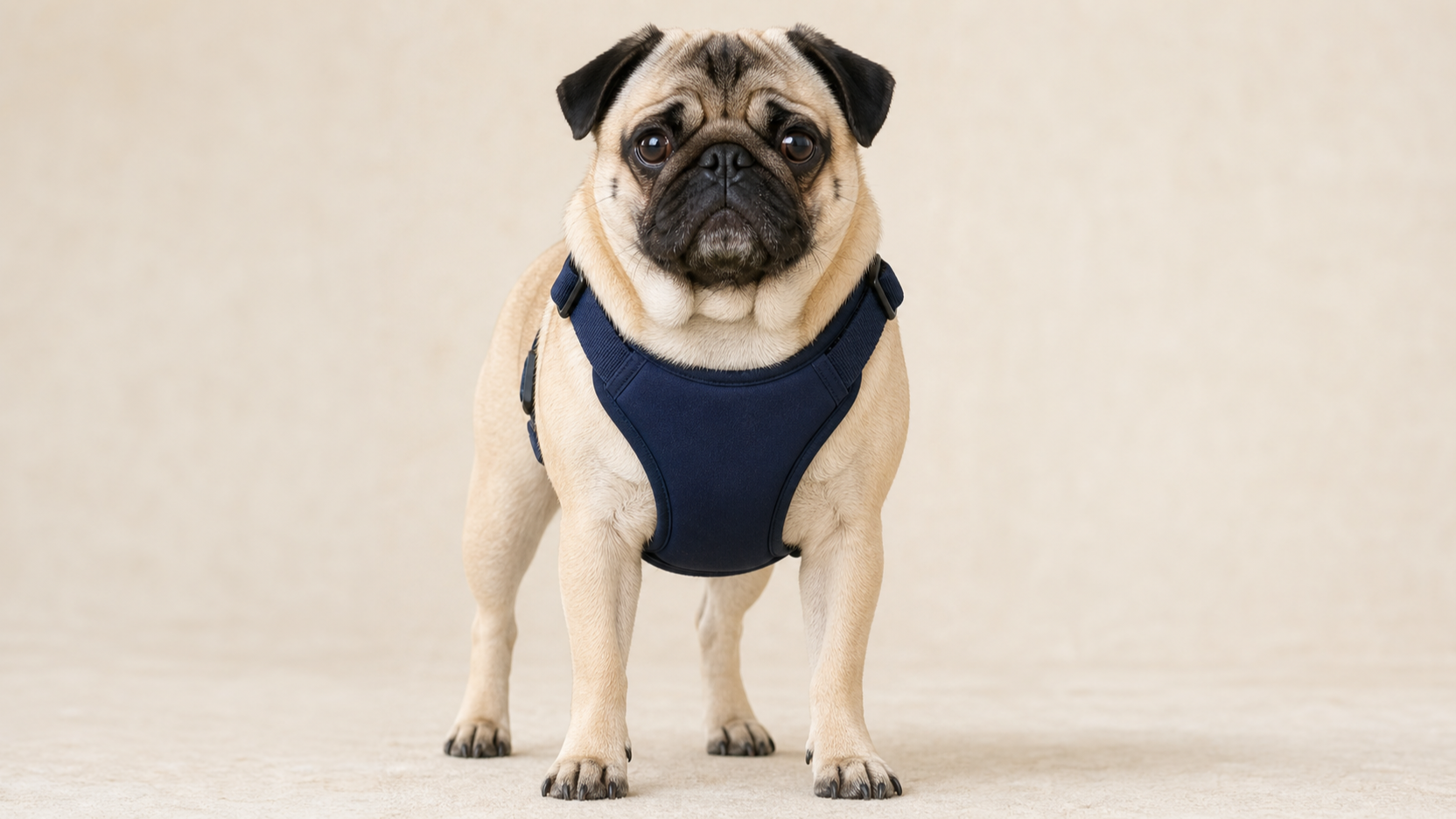
AKC’s pug page lists the breed at 14–18 pounds and 10–13 inches tall. That is the catalog pug. Your dog may be a stocky 22 lb pet pug. Shop the ribcage.
Related: small-breed harness, harness size guide, harness for pulling, leashes for pullers, cooling vest, city stroller, puppy harness, dachshund harness, corgi harness.
Our guides are reader-supported. This article may contain affiliate links. As an Amazon Associate we may earn a commission if you buy through links, at no extra cost to you.
Quick picks at a glance
- Best listed light-coverage front-clip: PetSafe Easy Walk — $22.99. No overhead. No back ring. Training class.
- Best listed no-pull dual-connect: 2 Hounds Freedom — from $32.98. Velvet armpit lining. Made in North Carolina (maker sentence).
- Best listed barrel-chest six-point: Blue-9 Balance — $39.95. Neck buckle. Measure 2 in behind the elbow.
- Best listed everyday padded dual-clip: Ruffwear Front Range — $59.99. Four-point. Between sizes, choose larger.
- Best listed lightweight six-point + handle: Ruffwear Flagline — $69.99. Heat-day structure. Between sizes, choose larger.
- Best listed Houdini / lift: Ruffwear Web Master — $79.99. Neck buckle + handle. Between sizes, choose smaller.
How pug harness listings compare on labels
Four jobs. A foam-padded vest at 4 p.m. in July is a heat sink. A back-clip-only mesh on a lunging pug is a sled hitch on a short neck.
| Job | What actually works | Maker class on this page | Fails if you skip the real job |
|---|---|---|---|
| Everyday walk, mild morning | Padded dual-clip, four-point | Front Range | Easy Walk as all-day fashion |
| No-pull redirect | Front ring you actually use | Easy Walk; Freedom; Front Range chest clip | Back-only mesh |
| Barrel chest + head-shy | Six-point or neck buckle | Blue-9; Web Master | Overhead hole on a wide skull |
| Lift / stairs / Houdini | Handle + third strap | Web Master; Flagline | Two-strap tube they reverse out of |
Before you shop: (1) you measured girth behind the front legs, (2) two fingers under a strap, (3) the chest plate sits on the sternum, not the throat, (4) panting, gum color, and heat level decide whether the walk happens — AAHA’s brachycephalic heat rule, (5) cyanosis, collapse, or a dog that already snores at rest is a veterinarian, not a second Amazon size. Fail gate 4 and this checklist is a costume.
AAHA (updated May 19, 2026): consider heatstroke above 80°F or when humidity is high. Brachycephalic dogs stay inside except short bathroom breaks. AAHA (June 11, 2026): normal pet temperature typically 100–102.5°F; heatstroke usually above 104°F. Those are the numbers.
Top 7 Harness for pugs
The picks below are the 7 harness for pugs on sale right now, listed with what each suits best and an honest drawback. Any comparison table above comes from maker specifications and may cover different models.
1. Voyager Step-in Air Dog Vest Harness
Best for: Easy on-off daily neighborhood walks
The Voyager is a step-in air vest at a budget list price. The pug steps through the holes and the back closes, which is the on/off story in this article’s title. Owners report it is easy to put on for short walks, and they also say you must measure chest girth because a step-in vest has little slack between sizes.
Pros: Low-price step-in vest; Air vest skips over-head Cons: Step-in fit is unforgiving
2. Patas Lague Dog Harness Small Sized Dog Pet Vest with Leash Set Black
Best for: Cheapest small-dog vest-and-leash starter
This is the cheapest card here: a small-size vest sold with a leash, in black. The name points to a generic small-pet cut, not a pug last. Owners report the bundle is handy as a spare walk kit, and they also say to size up if a barrel chest sits between two bands.
Pros: Lowest-price leash included; Small-dog vest form Cons: Generic small-pet cut
3. BEAUTYZOO Dog Harness Medium Sized and Leash Set
Best for: Barrel-chested adults needing medium
BEAUTYZOO lists a medium harness with a leash in the same box. That size word is why it belongs on a pug page: many adult pugs measure past a toy band. Owners report the set covers a basic walk, and they also say ‘medium’ still needs a tape before you buy.
Pros: Medium band for stockier chests; Leash included in set Cons: Not a pug-specific cut
4. WINGOIN Green Tactical Dog Harness for Small Dogs
Best for: Hikes that need a lift handle
WINGOIN sells a green tactical vest for small dogs, a heavier style than the air walk vests above it. The name signals a military-style plate with a handle, not a thin daily vest. Owners report the handle helps on stairs and curbs, and they also say a tactical vest can feel bulky on a short-backed pug used only for sidewalk laps.
Pros: Tactical vest with handle; Sized for small dogs Cons: Bulkier than thin walk vests
5. QTpawz Pug Vest Harness and Matching Leash
Best for: Pug-cut vest with matching leash
QTpawz is the only vest on this list that names the pug and ships a matching leash. That breed label is the barrel-chest pitch: a vest cut for a wide ribcage and a short neck. Owners report the set looks finished on a pug, and they also say it costs more than the generic walk kits here.
Pros: Pug-named vest cut; Matching leash in box Cons: Highest price on this list
6. IVY&LANE No Pull Dog Harness for Small Dogs
Best for: Small pugs that surge on leash
IVY&LANE labels this a no-pull harness for small dogs. That type is meant to take leash force on the chest, which is the usual airway reason owners skip a collar on a pug. Owners report the no-pull idea helps on the sidewalk, and they also say the extra straps take a quiet minute to set the first time.
Pros: No-pull small-dog vest; Chest-load instead of collar Cons: More straps to set
7. SAEGYPET Dog Harness with Leash Set
Best for: One vest-and-leash purchase
SAEGYPET sells a harness and a leash as one set, with no breed name on the card. The listing is a generic walk vest, not a pug last. Owners report the included leash is the point of the price, and they also say you still measure the chest because the size names are broad.
Pros: Vest and leash together; Complete walk kit in one Cons: No pug-specific sizing
Comparison: Harness for pugs at a Glance
Want to browse every option? See the full range of harness for pugs on Amazon →
How the desk scored the best harness for pugs
This comparison uses four readable maker signals plus the printed sticker:
- Clip map. Front, back, or both. Front-only (Easy Walk) vs dual vs three-point.
- On/off. Neck buckle vs step-in vs overhead.
- Adjustment count. Six-point vs four-point.
- Coverage class. Less-coverage training vs foam pad vs lightweight structure vs three-strap bulk.
- Printed maker price. $22.99–$79.99. 6 of 6 (100%).
Price is not a safety grade. A $23 Easy Walk you use on the front ring beats a $80 Web Master you wear at 4 p.m. in July “to get your money’s worth.”
How these products compare on labels and price
| Harness (named makers) | Maker-listed price | Clip / on-off | Pug job |
|---|---|---|---|
| PetSafe Easy Walk | $22.99 | Front only; step-in snaps | Light training |
| 2 Hounds Freedom | $32.98+ | Dual; overhead / strap | No-pull + armpit lining |
| Blue-9 Balance | $39.95 | Front and/or back; neck buckle | Barrel fit |
| Ruffwear Front Range | $59.99 | Dual; overhead | Everyday pad |
| Ruffwear Flagline | $69.99 | Three points; overhead | Light + handle |
| Ruffwear Web Master | $79.99 | Three points; neck buckle | Lift / escape |
Desk kit math: Maker snapshot sum is $305.89. Mean tile is $50.98. Median is $49.97 (Blue-9 $39.95 and Front Range $59.99 straddle it). Web Master $79.99 is 3.48× Easy Walk $22.99. Flagline $69.99 is 3.04× Easy Walk. Front Range $59.99 is 2.61× Easy Walk. Blue-9 $39.95 is 1.74× Easy Walk. Freedom $32.98 is 1.43× Easy Walk. Ruffwear’s three tiles ($59.99 + $69.99 + $79.99 = $209.97) are 68.6% of the dollar sum and 50% of the catalog — half the aisle’s names, more than two-thirds of the printed dollars. The three non-Ruffwear tiles ($22.99 + $32.98 + $39.95 = $95.92) are 31.4% of dollars and 50% of the catalog. The two neck-buckle tiles (Blue-9 + Web Master = $119.94) are 39.2% of dollars and 33% of the catalog. The two handle-core tiles (Flagline + Web Master = $149.98) are 49.0% of dollars. ”
First decision for the best harness for pugs: which pug, and which job
“Pug” on a carton is not a size. AKC’s breed page lists 10–13 inches tall and 14–18 pounds, compact and solid. That is the catalog pug. The animal on your floor may be a lean 12-pound adult, a stocky 22-pound pet pug, a puppy still growing through three strap lengths, or a senior who already snorts at rest. Shop the ribcage, not the word “small.”
Then pick the job, not a breed slogan.
- Everyday walk. Dual clip, enough padding that a strap does not saw the armpit, enough adjustability that the chest plate sits on the sternum and not on the throat. Detail on measuring lives on the harness size guide.
- No-pull redirect. A front chest ring, or a dual-clip setup you actually use on the front, so a lunge turns the shoulders instead of loading a collar. The broader pull map lives on the harness-for-pulling page. The leash is half of that setup: leashes for pullers.
- On/off without a fight. A short neck and a wide head do not love an overhead loop. A neck buckle, a step-in, or a chest buckle is a different object from a pullover.
- Lift / crowd / stairs. A handle on a structured back panel. That is assist, not a “safety rating.”
- Heat day. Less fabric, more mesh or open webbing, a shorter walk, or no walk. A cooling vest is a different object and is not a license to go farther: cooling-vest page.
- Puppy. Lightweight, wide adjustability, expect to replace it. That job also lives on the puppy-harness page.
AVMA’s ownership guidelines ask for physical and mental stimulation that fits the animal’s species, age, breed, and health. A ten-minute sniff walk on a fitted harness can be that stimulation. A lunch-hour power walk in August is not.
Shape siblings, not substitutes: dachshund harness, corgi harness.
The airway and heat rule (read this before you shop)
AVMA’s FAQ on short-nosed dogs is blunt. Brachycephalic breeds still have to pack the same nasal passages, sinuses, and palate into a shorter face. The result is a cramped airway: smaller-than-normal nostrils, a longer-than-normal soft palate, and a narrowed trachea. They do not breathe as efficiently as dogs with a normal-length muzzle. They have a harder time cooling off when they play, exercise, get stressed, or overheat. When they are stressed, the airway can collapse — AVMA’s image is breathing through a straw that folds when you suck hard. That can cut off oxygen and cause collapse. Obesity makes it worse. Pugs are on that list by name, next to Boston Terriers, Pekingese, and bulldogs.
The American College of Veterinary Surgeons uses the same anatomy and gives it a name: brachycephalic syndrome — elongated soft palate, stenotic nares, everted laryngeal saccules, and sometimes a hypoplastic trachea or laryngeal collapse. English Bulldogs, French Bulldogs, Pugs, Pekingese, and Boston Terriers are the dogs on that page. The clinical signs ACVS lists are the walk stop signs: noisy inward breathing, retch or gag, exercise intolerance, blue tongue or gums, collapse after over-activity, excitement, or heat and humidity. Obesity aggravates it. A harness does not surgically shorten a palate. It only decides whether the leash adds a second problem at the throat.
AAHA’s heatstroke-prevention page (updated May 19, 2026) is the outdoor rule. Dogs do not sweat the way people do. They pant, plus a little through the paw pads. Consider heatstroke whenever the temperature is above 80°F or humidity is high. Check the heat level, not just the thermometer. Walk in early morning or late evening. Never leave a dog in a parked car. If pavement burns the back of your hand, it burns paws. Brachycephalic, overweight, senior, very young, or medically fragile pets should stay indoors in hot weather except for short bathroom breaks.
AAHA’s companion page (updated June 11, 2026) puts numbers on the crisis: a pet’s normal temperature is typically 100–102.5°F; heatstroke is usually above 104°F. Early signs include heavy panting, thick ropey drool, lethargy, bright red or pale gums, and collapse. A short muzzle cannot pant as a cooling system the way a long muzzle can. Extra body fat is an insulator and also loads the airway. AVMA’s walking page matches that: short-nosed and overweight dogs need more rests, shorter walks, or a schedule that skips the hottest hours. Heat stress can progress to heat stroke and death without immediate veterinary care.
A 2017 paper in the Journal of the American Veterinary Medical Association found that brachycephalic dogs increased respiratory rate more under heat stress than non-brachycephalic dogs, and that body-condition score was a stronger driver of body temperature than breed type. Short face plus extra weight is a worse cooler than either one alone.
What that means for a harness: less coverage on warm days; stop at the first change in panting or gum color; a cooling vest is not a license to go farther; indoor jobs do not ask the airway to sprint; a city stroller is a mobility tool if the sidewalk already wins.
If your pug already snores at rest, tires on a short walk, or has had a breathing crisis, this is a veterinarian conversation before it is a shopping conversation.
Harness vs collar on a short neck
AVMA’s walking page is the sentence that matters: ensure the collar or harness fits properly to prevent injury or escape; some dogs have airway, neck, or other conditions that require a harness instead of a collar.
A pug is that dog on paper. The neck is short and thick. The trachea is already the narrow part of a cramped airway. A flat collar that holds ID tags is not the same object as a collar that takes a lunge. When the dog hits the end of the leash, a neck collar concentrates that force on the throat. A harness, if it is sitting on the sternum and not riding up into the neck opening, spreads the same force across a wider area of chest and shoulder.
That is geometry, not a crash test. We are not calling any harness “trachea-safe.” We are saying some listings' “safety-focused” language is the wrong promise. The honest promise is: do not put the walk on the neck if you can put it on the chest.
A few practical splits:
- Walking load belongs on a harness. That is this page.
- ID still has to live somewhere. AVMA wants up-to-date tags. Use an ID pocket or a flat tag collar that never takes the leash. The puppy version of this split lives on the puppy collar-vs-harness page.
- Head-collars, slip leads, and martingale collars still load the neck. Wrong default.
- Running harnesses assume a dog that can sustain gait. Wrong default job for a pug.
A harness that is too loose will slip toward the head on a pull and become a collar anyway. Fit is the whole argument. A poorly fitted “no-pull” is still a neck problem.
Decision framework for the best harness for pugs
Harness buying for a pug has six hard edges. Match the object to the job and the torso, not to a “best of” list.
1. Job first — everyday is not no-pull is not lift
A padded dual-clip is an everyday walk object. A front-only martingale is a training-redirect object. A three-strap with a handle is lift-and-hold. A lightweight six-point is a heat-day object. Some roundups mixed those into one “top 7” that was four marketplace names. That is how you buy a GPS vest for a dog that needed a front clip and a shorter walk.
If the problem is pulling, the harness is half the answer. A front clip without a handler who turns and pays for slack is just a different tug-of-war. Pair it with a leash you can shorten: leashes for pullers.
2. Clip location — front, back, or both
Back clip. Everyday attachment. Comfortable. Also the geometry that lets a determined dog lean into the harness and pull like a sled. Fine for a dog that already walks on a loose leash. A poor default if the problem is lunging.
Front clip. The leash attaches on the chest. A forward surge turns the shoulders toward you. PetSafe, 2 Hounds, and Ruffwear all describe a chest attachment that redirects a puller and keeps load off the throat. Those are maker sentences, not a promise your pug stops pulling on day one.
Dual clip. Front and back on the same walk, usually with a double-ended leash. 2 Hounds recommends that setup on the Freedom. Blue-9 says use the front and/or back rings. A communication tool, not a ranking.
Do not buy a back-clip-only mesh and call it a no-pull plan.
3. On/off — overhead is a pug problem
A wide skull plus a short neck makes an overhead loop a wrestling match. Some dogs tolerate it. Many do not. The designs that avoid it:
- Neck buckle (Blue-9 Balance, Ruffwear Web Master). The neck strap opens. You do not have to stuff the head through a hole.
- Step-in / belly-and-shoulder snaps (PetSafe Easy Walk style). Legs in, snaps over the back. No overhead.
- Overhead with a wide opening (some everyday padded harnesses). Faster on a cooperative dog. Worse on a head-shy one.
Pick the on/off before you pick the color. A “perfect” harness that takes three people to put on will live on a hook.
4. Barrel chest — count the adjustment points
A pug is wide through the ribs and short through the back. A harness cut for a narrow terrier sits high on the throat, hangs a chest strap in the armpits, and leaves a back plate floating behind the shoulders. What you want, in maker language:
- Enough adjustment points to change neck, chest depth, and girth independently. Blue-9 and Ruffwear Flagline print six. Ruffwear Front Range and Web Master print four. PetSafe Easy Walk prints four.
- A chest strap that can sit behind the front legs without creeping into the axilla. 2 Hounds says this outright. Blue-9 measures the ribcage about 2 inches behind the elbow.
- A neck opening that is not the leash. If the only tight circle is around the neck, you bought a collar with extra straps.
Between sizes, follow the maker, not a forum. Ruffwear Front Range and Flagline say choose the larger size. Ruffwear Web Master says choose the smaller size. Those two sentences are on the same company’s charts. Read the one that matches the SKU.
5. Coverage vs heat
Padding spreads pressure. Padding also holds heat. On a pug, that is not a style choice. AAHA already told you this dog stays inside on hot days except for a bathroom break. If you are walking at 7 a.m. on a mild morning, a foam-padded everyday harness is a comfort object. If you are walking at 4 p.m. in July, less fabric is the less-bad object, and a shorter route is the actual fix.
We are repeating maker coverage language: Easy Walk advertises less coverage; Flagline a lightweight shell; Front Range foam-padded wear; Web Master perforated foam. Different jobs.
6. Measure the ribcage, not the carton
Wrap a soft tape around the widest part of the chest, just behind the front legs. That number is girth. It is the number every maker on this page uses. Weight is a footnote. 14–18 pounds will not save you if this dog’s girth is 21 inches and you bought the 17-inch strap.
The full measuring habit — tape placement, two-finger check, when to remeasure — lives on the harness size guide. A short version is enough here:
- Two fingers under a strap is the fit language 2 Hounds and Blue-9 both print.
- Recheck after ten minutes. Nylon settles. A pug wriggles.
- Remeasure after weight change. Extra weight is an airway problem (JAVMA 2017, ACVS), and a fit problem.
- Do not “grow into” a loose harness. A loose harness is an escape and a throat slide.
Product examples mapped to jobs (not a ranking)
Everyday padded dual-clip — Ruffwear Front Range
Where verified: Ruffwear’s Front Range page. Listed price $59.99.
Ruffwear describes a padded everyday harness with four points of adjustment, an aluminum V-ring on the back, and a reinforced front chest clip “to redirect dogs that pull on leash.” ID pocket, reflective trim, Beacon light loop. Girth (widest rib cage):
- XXS 13–17 in (33–43 cm)
- XS 17–22 in (43–56 cm)
- S 22–27 in (56–69 cm)
- M 27–32 in (69–81 cm)
- L/XL 32–42 in (81–107 cm)
In between sizes, Ruffwear says choose the larger size. Shell is 300D recycled polyester ripstop with PE foam and mesh lining. Hand wash, air dry.
This is on the page because it is a named everyday dual-clip with a printed girth band that reaches a compact adult. A catalog 14–18 lb pug often lands in XXS or XS if the tape says so — Padding is comfort and heat; pick the walk time accordingly.
Barrel-chest six-point, buckle neck — Blue-9 Balance
Where verified: Blue-9’s Balance Harness product page and the maker’s published sizing chart. Listed price $39.95.
Blue-9 describes a six-point adjustable harness built so the thing actually fits: front and/or back rings, a buckle on the neck loop for dogs that do not enjoy having a harness slipped over the head, washable soft-touch nylon, designed by dog-training experts. Measure the ribcage about 2 inches behind the elbow. Official chart:
- XS 13.5–18 in, 5/8 in strap
- S 17.5–25.5 in, 5/8 in strap
- M 21–32 in, 3/4 in strap
- M/L 24–35.5 in, 1 in strap
- L 29–43.5 in, 1 in strap
Blue-9 also prints metric bands and says most products are made in the USA.
This is on the page because six adjustments plus a neck buckle is the geometry a barrel chest and a short neck need. XS and S cover most adult pugs if you measure. ” If the tape sits in the 17.5–18 in overlap, size for remaining adjustment, not for a breed nickname.
No-pull dual-connect with armpit lining — 2 Hounds Freedom
Where verified: 2 Hounds Design’s Freedom No-Pull page. Starting price $32.98. Made in North Carolina with globally sourced materials.
2 Hounds describes a dual-connection harness: a front chest ring that redirects the shoulders, and a patented martingale loop on the back that tightens gently around the chest. Pressure, in their words, is distributed across the chest and torso — not the throat. Swiss velvet lining behind the front legs is the chafing feature. Stainless-steel hardware. Maker-stated webbing strength: 3800 lb test. That is their sentence, not a pull test we ran on a pug.
Chest measurement is the size. Maker bands that matter here: 3/8 in XXS 13–16 in (approx 6–15 lb); 5/8 in XS 14–20 in (approx 15–25 lb); 5/8 in Small 20–24 in (approx 25–35 lb). Wider 1 in sizes exist above that. Weight is approximate.
Fit language on that page: chest strap behind the front legs; two fingers under the straps; snug, not tight. Wash in a pillowcase on gentle, or soak; air dry.
This is on the page because dual connect plus a lined armpit is a named no-pull job, not a back-clip mesh with a “no-pull” vibe. If you only clip the back ring, you left the redirect on the table.
Lightweight front-clip, less coverage — PetSafe Easy Walk
Where verified: PetSafe’s Easy Walk page. Listed price $22.99.
PetSafe describes a front-chest no-pull harness created by a veterinary behaviorist in 2004. The leash attaches on the chest. A patented martingale loop on the front tightens and puts gradual pressure on the shoulders. The harness “rests across your dog’s chest instead of his throat.” Four adjustment points. Quick-snap shoulder and belly straps; the belly strap is a different color so you can tell them apart. PetSafe’s own coverage sentence: less coverage than other harnesses, lightweight and breathable. Front attachment only — there is no everyday back ring on this SKU.
Maker chart (weight is approximate; measure chest width and girth; between sizes, choose larger):
| Size | Chest width | Girth | Approx. weight |
|---|---|---|---|
| Petite | 7–8 in | 12–17 in | under 10 lb |
| Petite / Small | 8–9 in | 13–18 in | 10–15 lb |
| Small | 9–12 in | 15–21 in | 15–25 lb |
| Small / Medium | 11–13 in | 19–26 in | 20–30 lb |
| Medium | 12–15 in | 22–32 in | 25–50 lb |
Larger sizes exist on that page. A catalog 14–18 lb pug often lands in Petite/Small or Small if chest width agrees. A barrel 20 lb pug can outgrow Small on width before weight. That is why this chart has a chest-width column.
This is the light-coverage, front-only, no-overhead job. PetSafe named the throat as the thing they are trying not to load. It is a training harness, not an all-day padded vest.
Neck-buckle, handle, three-strap — Ruffwear Web Master
Where verified: Ruffwear’s Web Master page. Listed price $79.99.
Ruffwear describes this as the company’s first harness, now with a front leash point and a neck buckle “to eliminate the over-the-head on/off experience for head-shy dogs.” Three-strap style — they call it great for Houdini dogs. Reinforced handle for balanced lift and assist. Perforated foam back panel for breathable structure. Four points of adjustment. Three leash attachments: aluminum V-ring and a reinforced webbing loop on the back, plus a reinforced chest loop for dogs that pull. Reflective trim and a Beacon loop. Same girth bands as Front Range (XXS 13–17 through L/XL 32–42 in). In between sizes, choose the smaller size — the opposite of Front Range. Read that twice before you order.
150D polyester ripstop shell, closed-cell foam, mesh lining. Hand wash, air dry.
This is on the page for the pug that backs out of a two-strap, or the household that needs a grab handle on stairs. The handle is lift-and-assist. It is not a crash handle, and it is not a reason to let the dog dangle. More fabric than Flagline.
Lightweight six-point with handle — Ruffwear Flagline
Where verified: Ruffwear’s Flagline page. Listed price $69.99.
Ruffwear describes a fast, light body harness with a handle and a load-dispersing chest/belly panel. Six points of adjustment. Three leash points: aluminum V-ring on the back and two reinforced webbing loops (chest and back). Debris-resistant liner. Reflective trim and a Beacon loop. Same girth bands as Front Range. In between sizes, choose the larger size.
150D polyester ripstop shell, debris-resistant liner. Hand wash, air dry.
This is the lighter structured job: handle plus six-point fit without Front Range’s foam slab or Web Master’s three-strap bulk. On a pug, less fabric is the heat-day argument. It still has to sit behind the armpits.
Fit failures that look like “the wrong brand”
Most returns on a pug are not brand failures. They are tape failures.
Riding up into the neck. The girth is loose, or the chest strap is too far forward, so a pull slides the whole thing toward the head. You now have a collar. Tighten the girth behind the ribs. Move the chest strap back until it sits behind the front legs. If the neck loop is the only thing that can get tight, the design is wrong for this torso — look at six-point or a buckle-neck, not a smaller overhead hole.
Armpit chafe. The girth is too far forward, or a hard strap edge is sitting in the axilla. 2 Hounds put velvet there for this reason. A padded everyday harness can still rub if it is an inch off. Two fingers. Recheck after the walk. Red skin means stop, not “it will break in.”
Backing out. A two-strap harness on a compact, flexible dog can become a tube they reverse out of. That is the Houdini job. Web Master’s third strap exists for that sentence. A tighter girth on a two-strap is the first fix; a three-strap is the second. Do not solve escape by choking the neck loop.
Twisting. A back-only clip on a short-backed, wide-chested dog can rotate. Dual clip or a structured belly panel (Flagline, Web Master) is the geometry answer. A shorter leash in the first block of the walk is the handler answer.
Loosening mid-walk. Plastic sliders creep. Recheck. Replace when stitching parts, a buckle cracks, webbing frays, or the fit will not stay.
Step-in as a type is a fair on/off job. Those SKUs are not on this page.
Worked example: three pugs, three kits
Pug A — 16 lb catalog adult, mild morning, mild pull. Kit: Front Range $59.99 or Blue-9 $39.95 after the tape. Front clip for the first block. Do not buy Web Master $79.99 “for safety.”
Pug B — 22 lb stocky pet pug, head-shy, lunges at scooters. Kit: Blue-9 $39.95 (neck buckle + six-point) or Freedom $32.98+ (front ring you actually use). Easy Walk $22.99 if you accept no back ring and a training class. Pair with a leash for pullers.
Pug C — senior, stairs, reverses out of two-straps, heat-sensitive. Kit: Web Master $79.99 for lift / third strap on cool days. Flagline $69.99 if you need a handle with less fabric. AAHA heat rule still wins the calendar. A city stroller is a mobility tool if the sidewalk already won.
When the walk is the wrong object
Respiratory distress, blue gums, or collapse during exertion require emergency veterinary care — not a different harness brand. Brachycephalic breeds need shorter walks in heat. Gear supports management. It does not fix airway anatomy.
Sudden limp. A dog that will not put a front foot down. A dog that already snores at rest and now gags on a short block. Those are clinic conversations. A second Amazon size is not a diagnosis.
How to choose the best harness for pugs this month
- Rule out a breathing crisis. That is a veterinarian, not a vest.
- Measure girth behind the front legs. Write the number down.
- Name the job: everyday, no-pull, head-shy on/off, lift / Houdini, or heat-day.
- Pick a maker class from the table. Skip marketplace names without a verifiable maker chart.
- Open the maker chart. If the band does not contain your number, leave.
- Between sizes, follow that SKU’s sentence (larger vs smaller).
- Fit. Two fingers. Sternum. Indoor back-out test. Recheck after ten minutes.
- Pair with a leash you will not wrap around a hand. Shorten the walk when the heat level says so.
What is the best harness for pugs on this URL?
The best harness for pugs examples on this URL are PetSafe Easy Walk $22.99 for light front-only training, 2 Hounds Freedom from $32.98 for dual-connect + lined armpit, Blue-9 Balance $39.95 for six-point neck-buckle barrel fit, Ruffwear Front Range $59.99 for everyday pad, Flagline $69.99 for light structure + handle, and Web Master $79.99 for three-strap lift / Houdini.
How should you measure a dog for the best harness for pugs?
Measure girth at the widest rib, just behind the front legs. Blue-9 says about 2 inches behind the elbow. Easy Walk also wants chest width. Weight is a footnote. Two fingers under a strap. The chest plate sits on the sternum, not the throat. Sit the dog. Recheck. Indoor back-out test. These six maker pages print charts.
Brachycephalic fit checks for the best harness for pugs
Pugs average 14–18 pounds with chest girth often in the mid-teens to low-20s inches and short muzzles that overheat quickly. Harnesses must clear the trachea — collar-only walking increases collapse risk per published veterinary summaries. Front clips steer without neck torque; mesh panels reduce heat retention on summer walks.
| Fit checkpoint | Pass | Fail |
|---|---|---|
| Two-finger girth slack | Yes | Choking or gaping |
| Front strap position | Sternum | Throat |
| Back-out test (indoor) | Stays put | Slips shoulders |
| Panting after 10 min walk | Normal | Excessive |
This is desk research comparing specs and owner themes, not laboratory certification.
Frequently asked questions about the best harness for pugs
Is a harness safer than a collar for a pug?
A fitted harness puts walking load on the chest instead of a short neck. AVMA’s walking page is why some dogs need a harness. We are not calling any SKU “trachea-safe.”
Did you safety-test these harnesses?
No.
What size harness does a pug need?
Girth, not the word “small.” Catalog 14–18 lb often lands in XXS/XS on Ruffwear or XS/S on Blue-9 if the tape says so. A 22 lb pet pug can outgrow those bands. Easy Walk also wants chest width.
Can a puppy wear a no-pull harness?
A lightweight, widely adjustable harness is the puppy job. Expect to replace it. See the puppy-harness page. A front-clip is a cue, not a reason to power-walk a growing pug in July.
How often should I replace a pug’s harness?
Replace when stitching parts, a buckle cracks, webbing frays, or the fit will not stay. ”
Can I run with a pug in a harness?
Running assumes a dog that can sustain gait and cool. Wrong default job for a pug. AAHA’s heat rule still wins. Ask a veterinarian before you invent a jogging plan.
Do any of these have a veterinary endorsement?
PetSafe says Easy Walk was created by a veterinary behaviorist in 2004. That is their sentence about product origin. It is not a review of this page. Nothing here has been reviewed by a veterinarian on our behalf.
Why are there no product cards?
We found no maker sheets we could verify for the marketplace listings, so this page names manufacturers instead.
Why does Web Master say choose smaller when Front Range says choose larger?
Those two sentences are on the same company’s charts for different SKUs. Read the one that matches the harness you are buying. Mixing them is how you order the wrong Ruffwear size twice.
When the best harness for pugs is not enough
Respiratory distress, blue gums, or collapse during exertion require emergency veterinary care — not a different harness brand. Brachycephalic breeds need shorter walks in heat. Gear supports management. It does not fix airway anatomy. A city stroller is a mobility tool. A cooling vest is not a license to go farther.
Two-harness households
Easy Walk or Freedom for training walks. Front Range or Flagline for easy days. Web Master if they reverse out. Do not wear Web Master’s three-strap bulk at 4 p.m. in July “to get your money’s worth.” Buying all six “to compare at home” is how you own $305.89 of webbing and still skip the tape.
Night walks and the best harness for pugs
Add a light. Reflective trim (Front Range, Flagline, Web Master print it) is not a headlamp. A dark pug at 5:30 a.m. is a visibility problem. The harness is half of that. You are the other half.
Extra desk notes: heat, chafe, and the week the tape wins
Heat. Easy Walk $22.99 advertises less coverage. Flagline $69.99 is the light structured job. Front Range $59.99 is foam. Web Master $79.99 is more fabric. AAHA’s 80°F / high-humidity rule is the calendar, not the SKU.
Chafe. Freedom’s velvet armpit lining exists because barrel chests rub. Two fingers. Recheck after ten minutes. Red skin means stop.
Between-size trap. Front Range / Flagline → larger. Web Master → smaller. Same brand. Opposite sentence. Write the SKU name on the order.
Ruffwear dollar share. 3 of 6 names. 68.6% of printed dollars. That is a catalog fact, not a medal.
Desk row you can reuse. Light training, no overhead → Easy Walk $22.99. No-pull + lined armpit → Freedom $32.98+. Barrel + neck buckle → Blue-9 $39.95. Everyday pad → Front Range $59.99. Heat-day handle → Flagline $69.99. Houdini / lift → Web Master $79.99. Snoring at rest / cyanosis → veterinarian first. That is the whole checklist.
How we researched the best harness for pugs
Desk research. We read the titles and descriptions of six named maker pages on printed price, clip map, on/off, adjustment count, and girth-chart honesty for a barrel-chested, short-necked breed. We read AVMA walking and short-nosed FAQ pages, ACVS brachycephalic syndrome, AAHA heatstroke pages (May/June 2026 updates), a 2017 JAVMA heat-stress paper, and the AKC pug breed page. Dimensions, clip counts, and prices above are maker-stated unless we say otherwise.
Limitations: maker charts change; pet pugs outgrow catalog 14–18 lb; marketplace clones return; this URL has no product cards.
Keep a simple log: girth, chest width if you used Easy Walk, which clip you used, whether the vest walked forward, heat level, and whether you actually walked twice. A hook sculpture is a failed category row.
Sources
Manufacturer:
- https://ruffwear.com/products/front-range-everyday-dog-harness
- https://ruffwear.com/products/web-master-harness
- https://ruffwear.com/products/flagline-dog-harness
- https://www.blue-9.com/products/bhb
- https://www.blue-9.com/blogs/learn/balance-harness
- https://cdn.shopify.com/s/files/1/0587/0816/4806/files/Balance_Harness_Blue-9_Sizing_Chart_2020.jpg?v=1634742497
- https://2houndsdesign.com/products/royal-blue-freedom-no-pull-dog-harness
- https://www.petsafe.com/p/easy-walk-harness/EWH-HC-S-FWN/
Institutions and clinical education:
- https://www.avma.org/resources-tools/pet-owners/petcare/walking-your-pet
- https://www.avma.org/resources-tools/pet-owners/petcare/air-travel-and-short-nosed-dogs-faq
- https://www.avma.org/resources-tools/avma-policies/pet-ownership-guidelines
- https://www.acvs.org/small-animal/brachycephalic-syndrome/
- https://www.aaha.org/resources/how-to-prevent-heatstroke-in-dogs-and-cats/
- https://www.aaha.org/resources/heatstroke-in-pets/
- https://avmajournals.avma.org/view/journals/javma/251/10/javma.251.10.1160.xml
- https://www.akc.org/dog-breeds/pug/