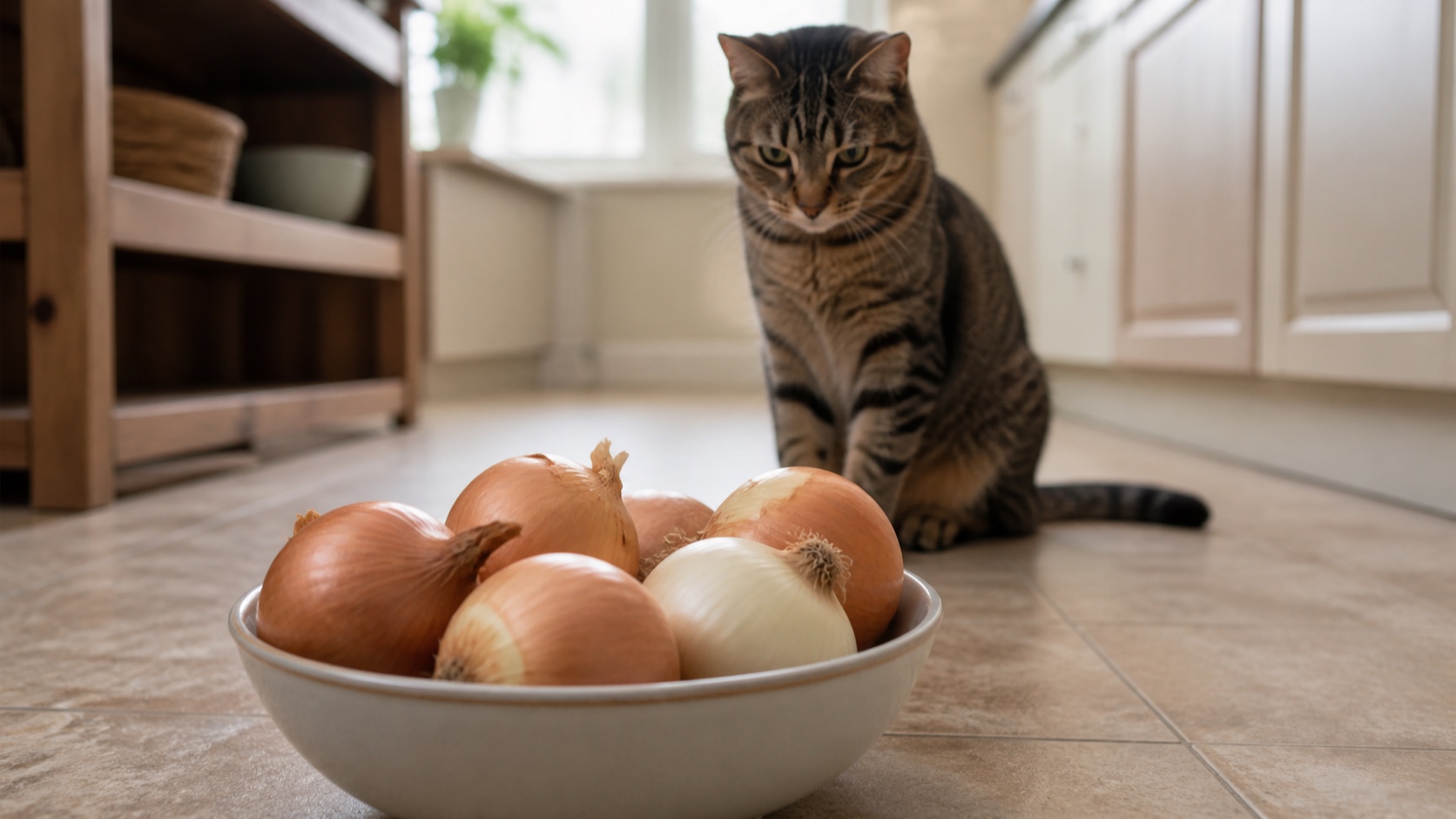
Quick answer: Do not give cats any onion, raw, cooked, dried, or powdered. Call your clinic or ASPCA Animal Poison Control at 888-426-4435 if your cat ate any. Keep Allium foods off plates, counters, and trash.
Cats cannot eat onions; the Merck Veterinary Manual reports toxicosis below one teaspoon of cooked onion.
This page is a research-desk brief on onion and other Allium foods in cats.
Selection rule: we covered only currently sold complete-and-balanced cat foods. Each maker page had to publish a guaranteed analysis. The ingredient list could not name onion, garlic, leek, chive, shallot, or Allium.
We excluded baby food, people-food broths, leftover scraps, and any recipe that lists an Allium ingredient.
Why even a little onion damages cat blood
Onions belong to Allium, with garlic, leeks, chives, and shallots. The ASPCA lists onion, garlic, and chives among people foods that can damage red blood cells.
The Merck Veterinary Manual names cats as the most susceptible species. Sulfur oxidants in the plant attack hemoglobin after chopping, cooking, or chewing.
Those oxidants create Heinz bodies and methemoglobin. The Merck Veterinary Manual says those changes begin within 24 hours and peak at about 72 hours.
Hemolysis typically follows 3 to 5 days later. A cat can look fine the night it ate stew, then crash later.
The U.S. Food and Drug Administration lists onions and garlic among hazardous edible items for pets. Cooking does not make the plant safe.
How much onion is too much
The Merck Veterinary Manual reports toxicosis in cats after less than a teaspoon of cooked onion. It also cites 5 g/kg of raw onion. ASPCA Animal Poison Control uses that same 5 g/kg onion figure as its dose of concern.
Its garlic figure is 1 g/kg.
Our research team applied the 5 g/kg raw-onion figure to common indoor cat weights. A 4 kg (8.8 lb) cat reaches that published dose at 20 grams of raw onion.
A 5 kg (11 lb) cat reaches it at 25 grams. A 4.5 kg (10 lb) cat reaches it at 22.5 grams.
Those gram figures are not a home “safe serving.” They convert a published dose of concern into household weights. The Merck Veterinary Manual also records toxicosis below one teaspoon of cooked onion.
The Merck Veterinary Manual states garlic is 3 to 5 times more toxic than onion. Powder, flakes, and soup mix are concentrated.
Dogs are less sensitive, not safe. The Merck Veterinary Manual cites clinical signs in dogs after 15 to 30 g/kg of raw onion.
A 1998 Journal of the American Veterinary Medical Association paper by Robertson, Christopher, and Rogers fed 42 healthy adult cats. Baby food with onion powder produced Heinz-body percentages that peaked at 33 to 53 percent.
The same study fed canned diets with 0, 0.3, 0.75, 1.5, or 2.5 percent onion powder for 2 months. The 2.5 percent onion-powder diet lowered packed cell volume.
Methemoglobin rose in the baby-food group but stayed at or below 1.2 percent. The authors advised against baby food with similar onion-powder levels in cats.
Hidden onion in leftovers, powder, and baby food
The kitchen, not the garden, is the usual source. Pizza, soup, gravy, salsa, stuffing, and stir-fry often carry onion or onion powder.
Powder packs more toxin per teaspoon than a raw slice. The Merck Veterinary Manual flags dehydrated flakes, powders, and dry onion soup mixes as common concentrated forms.
Baby food is a documented route. The 1998 Journal of the American Veterinary Medical Association study used commercial baby food that already contained onion powder.
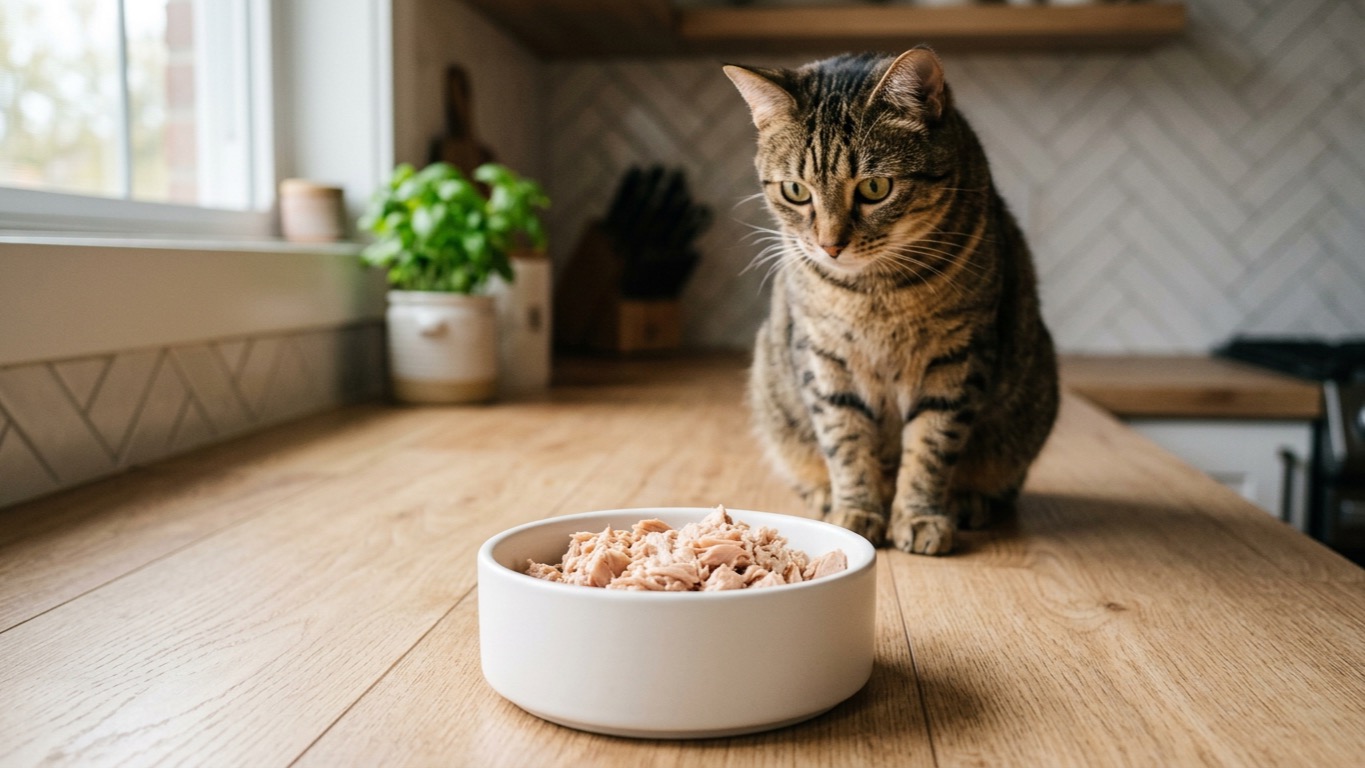
Do not use leftover tuna salad as a bland meal after a scare. Many deli salads hide onion, and plain tuna is a separate feeding question.
Green onion, scallion, shallot, and chive are Allium too. The ASPCA groups onion, garlic, and chives on the same people-food list.
Read every jar and can. AAFCO requires pet-food ingredients to appear in order of predominance by weight, each by its proper name.
AAFCO also states that a human-food ingredient is not automatically acceptable in pet food. A stew onion does not become a cat-food ingredient by home habit.
What to do if your cat ate onion
Note what was eaten, how much, and when. Then call your clinic or a poison line before you wait for pale gums.
The FDA lists two animal poison centers. They are ASPCA Animal Poison Control at 888-426-4435 and Pet Poison Helpline at 855-764-7661. The ASPCA publishes the same 888 number on its people-foods page.
Do not force vomiting unless a clinician tells you to do it. Home peroxide is not a plan for cats.
ASPCA Animal Poison Control advises monitoring red-cell parameters for 5 to 7 days after Allium ingestion. That window matches the Merck Veterinary Manual’s 3-to-5-day hemolysis timeline.
Watch for vomiting, diarrhea, lethargy, pale or yellow gums, fast breathing, and dark urine. ASPCA Animal Poison Control also lists depression, pale or icteric membranes, tachypnea, abdominal pain, and pigmenturia.
Keep the cat quiet and warm. Excitement raises oxygen demand while red cells are failing.
If a dog in the same house also licked the plate, treat that as a separate Allium problem. Cat food is not a workaround for a dog that ate people food.
Onion-free meals that replace table scraps
After an onion scare, feed a labeled complete cat food. Do not offer a second human leftover. Comparing published specs, none of the four foods below name an Allium ingredient.
Hill’s Pet Nutrition lists Hill’s Science Diet Adult Indoor Chicken Recipe for indoor cats ages 1 to 6. The maker page publishes 3,492 kcal/kg and 327 kcal/cup. Dry-matter protein is 36.1 percent.
Hill’s feeding chart on that page allots a 10 lb (4.5 kg) cat 3/4 cup, or 70 grams, per day. The same page states that animal feeding tests using AAFCO procedures support adult maintenance.
Royal Canin Feline Health Nutrition Adult Instinctive Loaf in Sauce is sold as a 5.1 oz can. Royal Canin lists 11.0 percent minimum crude protein, 81.0 percent maximum moisture, 805 kcal/kg, and 117 kcal per can.
Royal Canin states that this loaf is formulated to meet AAFCO Cat Food Nutrient Profiles for maintenance. Its published ingredient list starts with water, pork by-products, chicken, and chicken liver.
Weruva Classic Cat Paw Lickin’ Chicken is shredded chicken breast in gravy. Weruva lists 10 percent minimum crude protein, 85 percent maximum moisture, 0.05 percent minimum taurine, and 673 kcal/kg.
Weruva publishes 57 kcal in the 3 oz can, 105 kcal in the 5.5 oz can, and 192 kcal in the 10 oz can. The feeding line is 1 oz of food per pound of body weight daily, split into two meals.
Instinct Original Grain-Free Recipe with Real Chicken is a dry kibble. Instinct Pet Food lists 41.0 percent minimum crude protein, 21.0 percent minimum fat, 9.0 percent maximum moisture, and 81 percent real animal ingredients.
Instinct lists 60,000,000 CFU/lb of Bacillus coagulans and 100 IU/kg minimum vitamin E. Bags on that page include 4.5 lb, 5 lb, 10 lb, and 11 lb.
Hill’s Indoor dry page says it is not for kittens or for pregnant or nursing cats. A kitten that licked onion still needs a growth diet. Adult cat food is a separate kitten-feeding question.
| Product | Form and listed size | Protein as published | Moisture (max) | Calories as published | Allium named on ingredient list |
|---|---|---|---|---|---|
| Hill’s Science Diet Adult Indoor Chicken Recipe | Dry; 3.5, 7, and 15.5 lb bags | 36.1% dry-matter protein | Not stated as a max % | 3,492 kcal/kg; 327 kcal/cup | No |
| Royal Canin Adult Instinctive Loaf in Sauce | Canned; 5.1 oz | 11.0% min (as fed) | 81.0% | 805 kcal/kg; 117 kcal/can | No |
| Weruva Classic Cat Paw Lickin’ Chicken | Canned; 3, 5.5, and 10 oz | 10% min (as fed) | 85% | 673 kcal/kg; 57 / 105 / 192 kcal by can | No |
| Instinct Original Grain-Free Recipe with Real Chicken | Dry; 4.5, 5, 10, and 11 lb bags | 41.0% min (as fed) | 9.0% | Not listed on the maker page | No |
This table is an attribute comparison, not a ranking. Our research team compared maker pages only.
Protein columns are not interchangeable. Hill’s figure is a dry-matter average. The other three are as-fed minimums.
Other Allium foods and kitchen look-alikes
Garlic is not a milder cousin. The Merck Veterinary Manual rates it 3 to 5 times more toxic than onion. ASPCA Animal Poison Control sets garlic concern at 1 g/kg.
Chives and leeks belong on the same ban list. The Merck Veterinary Manual includes garlic, onions, chives, and leeks in Allium.
Onion powder in spice jars is easy to knock over. A few licks of powder can outpace a slice of raw onion.
Bone broth, gravy packets, and savory baby food need a full ingredient read. The 1998 Journal of the American Veterinary Medical Association work is why baby food keeps appearing here.
If the label is missing, do not share the food. AAFCO’s ingredient-name rule only helps when the label is still on the package.
FAQ
Can cats eat a tiny bit of cooked onion?
No. The Merck Veterinary Manual reports toxicosis after less than a teaspoon of cooked onion. Cooking does not destroy the oxidants.
Treat any cooked-onion bite as an exposure.
Can cats eat onion powder or onion soup mix?
No. The Merck Veterinary Manual flags powders, flakes, and dry onion soup mixes as concentrated Allium forms. A small lick can exceed the raw-onion gram figures our research team calculated.
Call a clinic or ASPCA Animal Poison Control at 888-426-4435.
What if my cat only licked gravy that had onion?
Gravy still carries the oxidants. Note the dish, the time, and a best guess at volume. Call a poison line before you wait for dark urine.
ASPCA Animal Poison Control monitors red-cell values for 5 to 7 days after Allium exposure.
How soon will my cat look sick?
Early signs can be vague, such as vomiting or low energy. The Merck Veterinary Manual says Heinz bodies rise within 24 hours and peak near 72 hours. Hemolysis often shows at 3 to 5 days.
A normal first night does not close the case.
Are green onions, chives, and garlic safer than yellow onions?
No. The ASPCA groups onion, garlic, and chives together. The Merck Veterinary Manual rates garlic 3 to 5 times more toxic than onion. Green onion and shallot are still Allium.
Can I feed baby food after an onion scare?
Only if the jar lists no Allium ingredient, and only as a short clinic-directed stopgap. The 1998 Journal of the American Veterinary Medical Association study found Heinz-body peaks of 33 to 53 percent. Those cats ate baby food with onion powder.
A labeled complete cat food is the default swap.
Should I give my cat tuna or leftover meat instead?
Do not replace a meal with seasoned leftovers. Onion hides in tuna salad, meatloaf, and gravy. Tuna as a cat food is its own problem.
Use one of the onion-free complete foods above, or the food your clinic names.