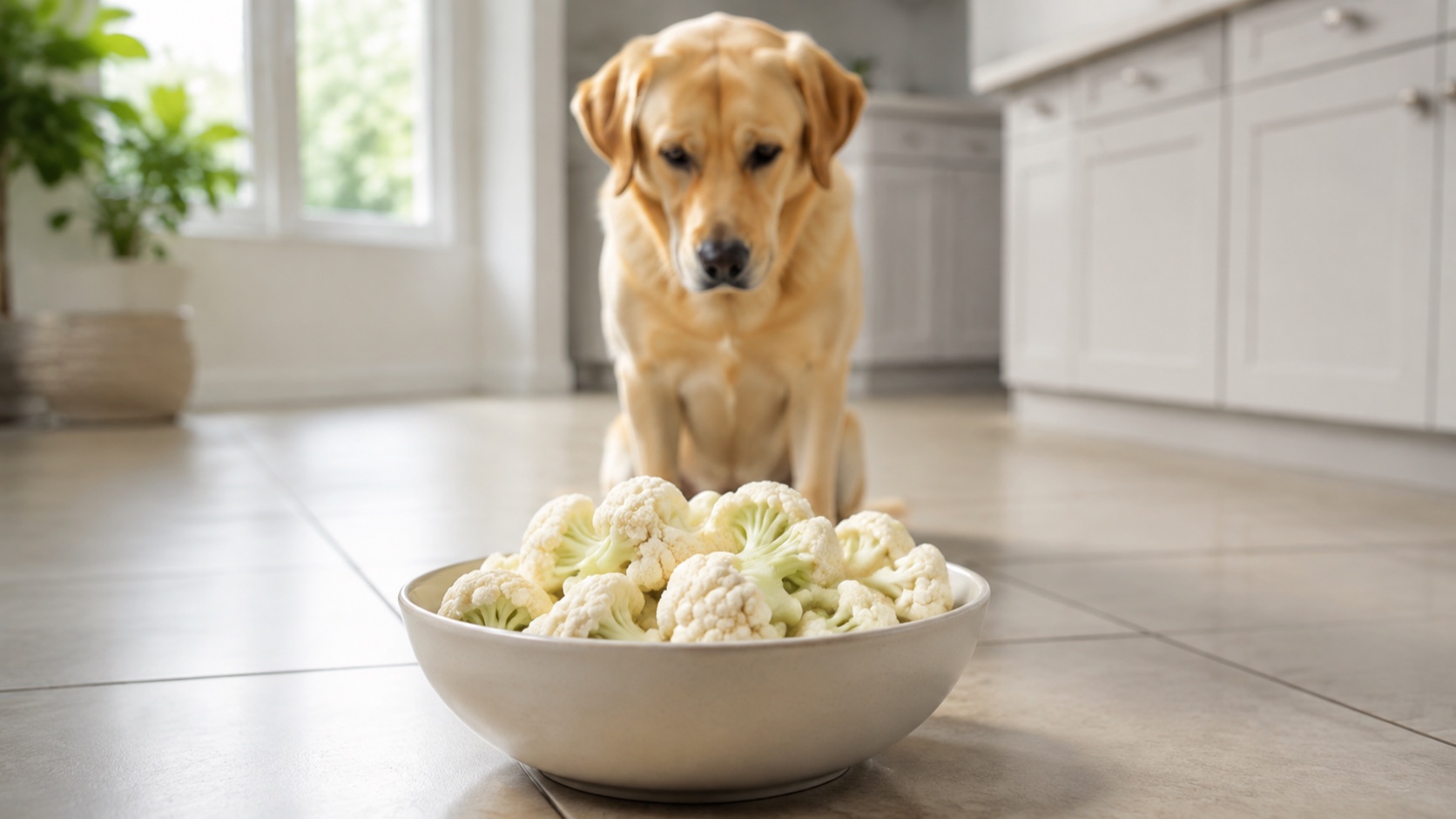
Quick answer: Yes. Most healthy dogs can eat a few small pieces of plain cauliflower. Steam it, skip butter and seasoning, and keep it as a snack, not a meal.
Dogs can eat plain cauliflower; USDA lists one 13-gram floret at about 3 calories.
This page is a Pet Bench research desk brief on a common kitchen vegetable. Our research team analyzed USDA FoodData Central records and current maker labels.
Selection rule: a product entered only if its maker page names cauliflower and lists protein, fat, fiber, or calories. We left out garlic-onion riced blends, cheese sauces, and unconfirmed SKUs.
How much cauliflower a dog can eat
The UC Davis School of Veterinary Medicine states treats should stay at or under 10 percent of daily calories. The other 90 percent should come from a complete and balanced food.
That share covers every extra. Produce, training bits, and table scraps all count.
USDA FoodData Central record 169986 lists raw cauliflower at 25 kcal per 100 grams. One floweret in that file weighs 13 grams. That piece is about 3 calories.
UC Davis uses a 100-calorie daily example. That example leaves a 10-calorie treat budget. Three raw florets fill that budget if cauliflower is the only extra.
If a dog’s posted daily target is 800 calories, the 10 percent share is 80 calories. That is about 26 raw florets by those USDA weights. Most dogs do not need that many.
Start with one bite-size piece. Wait a day. Watch for gas, loose stool, or a tight belly.
Cauliflower is a snack. The U.S. Food and Drug Administration states treats are not meant to be a pet’s sole diet. Look for “complete and balanced” on the regular food.
The FDA says that claim must rest on an AAFCO nutrient profile or feeding trial. A steamed floret meets neither test.
Raw versus cooked cauliflower
Both forms appear in USDA files. Neither file marks cauliflower as a toxic food.
USDA record 170397 covers cauliflower cooked, boiled, drained, without salt. That entry lists 23 kcal per 100 grams. Water rises to 93.0 grams per 100 grams.
Potassium falls from 299 milligrams in the raw file to 142 milligrams after boiling. Our research team compared those two published values. Boiling cuts listed potassium by more than half.
Vitamin C stays high either way. The raw file lists 48.2 milligrams per 100 grams. The cooked file lists 44.3 milligrams.
Three cooked flowerets in the USDA cooked file weigh 54 grams. That serving is about 12 calories.
Raw florets stay firm. Cut them small. A whole chunk can lodge in a small throat.
Steaming or boiling in unsalted water softens the fiber. That is often easier on the gut. Do not add butter, oil, salt, or broth.
Skip the roasting pan if you plan to share. Oil and seasoning change the calorie math. They also add salt.
Mashed or riced plain cauliflower is easier to portion. Green Giant Riced Cauliflower is sold as 100 percent vegetables with no sauce.
Green Giant’s cauliflower page lists 20 calories per cup. It lists 4 grams of carbohydrate, 2 grams of fiber, 2 grams of protein, and 0 grams of fat.
The product page states the riced veggie has 85 percent fewer calories than the leading prepared white rice. That comparison is the maker’s claim.
Cooked leftovers from a human dinner are a different food. If the pan held onion, garlic, or cheese, do not share it.
The FDA lists garlic, onions, grapes, and raisins among potentially dangerous items for pets. Those are not cauliflower problems. They are topping problems.
A riced bag can still be wrong. Read the ingredient line. If it names onion, garlic, or a cheese sauce, skip it.
Cheese leftovers are a separate calorie load. See our can dogs eat cheese brief for that dairy snack.
Grapes are not a “maybe.” See our can dogs eat grapes page. That fruit is a known hazard.
Banana slices are another produce extra. They are sweeter and denser. Compare them in our can dogs eat bananas brief.
We also left out cauliflower pizza crust, buffalo bites, and tempura. Those are batter, fat, and salt. They are not the vegetable.
Stems are not a poison. They are denser. Chop them smaller than the florets, or skip them.
The FDA notes that some swallowed items can block the gut. Corn cobs and pits are the examples it names. A large raw stem is still a poor chew toy.
What USDA numbers actually show
USDA FoodData Central published the raw record on April 1, 2019. The scientific name in that file is Brassica oleracea (Botrytis Group).
Water is 92.07 grams per 100 grams of raw cauliflower. Fat is 0.28 grams, protein is 1.92 grams, and carbohydrate is 4.97 grams. Fiber is 2.0 grams.
Sodium is 30 milligrams per 100 grams raw. Calcium is 22 milligrams. Those modest mineral numbers do not replace a balanced dog food.
One cup of chopped raw pieces weighs 107 grams in the USDA portion list. That cup is about 27 calories.
A medium head, 5 to 6 inches across, weighs 588 grams. That head is about 147 calories. Feeding a whole head as a “healthy treat” can wipe a small dog’s daily treat share in one sitting.
A small head weighs 265 grams. A large head, 6 to 7 inches, weighs 840 grams. Those are USDA portion weights, not kitchen guesses.
The AAFCO Common food listing review dated January 20, 2026, lists cauliflower as a common animal-food item. That index is a labeling tool. It is not a serving chart.
AAFCO’s Dog Food Nutrient Profiles set calcium-to-phosphorus between 1:1 and 2:1. Adult maintenance calcium sits at 0.5 percent minimum and 2.5 percent maximum on a dry-matter basis. Plain cauliflower does not meet those profiles by itself.
The FDA notes that AAFCO issued the first Dog Food Nutrient Profiles in 1991. The agency says AAFCO most recently updated the profiles in 2016.
The FDA also states canned pet food is typically 75 to 78 percent moisture. Dry pet food is typically 10 to 12 percent moisture. Compare labels on a dry-matter basis if the moisture numbers differ.
Commercial foods that name cauliflower
Some complete foods list cauliflower as a vegetable, not as the meal. The FDA still requires an AAFCO profile or feeding trial for a complete-and-balanced claim.
JustFoodForDogs Lamb & Brown Rice Recipe, 18-ounce pack, lists cauliflower with lamb, brown rice, spinach, and carrots. The maker lists 1,482 kcal ME per kilogram and 42 kcal ME per ounce.
That same page lists crude protein at 7.5 percent minimum and crude fat at 5.5 percent minimum. Crude fiber is 1.5 percent maximum. Moisture is 70 percent maximum.
The calcium-to-phosphorus ratio is listed at 1.5:1. That sits inside the AAFCO 1:1 to 2:1 window.
JustFoodForDogs says feeding trials using AAFCO procedures substantiate that recipe for maintenance.
JustFoodForDogs Pantry Fresh Lamb & Brown Rice, 12.5-ounce pack, also names cauliflower. The maker lists 1,332 kcal ME per kilogram and 38 kcal ME per ounce. The pack is listed at 475 kcal ME.
Pantry Fresh protein is 6.0 percent minimum. Fat is 5.0 percent minimum. Fiber is 1.0 percent maximum.
Moisture is 77 percent maximum. The page says the recipe is formulated to AAFCO adult-maintenance profiles.
American Natural Premium Beef with Carrots & Cauliflower is a dry recipe. The maker lists crude protein at 24 percent and crude fat at 14 percent. Crude fiber is 4 percent, and total moisture is 10 percent.
Calories are listed at 375 kcal per cup.
Bag sizes on that American Natural Premium page are 4 pounds, 12 pounds, and 30 pounds. Cauliflower appears mid-list, after grains and before organ meats.
Green Giant Riced Cauliflower is a frozen human food, not a complete dog diet. It is useful when you want a labeled, unseasoned rice-size cut.
Our research team applied the FDA’s dry-matter conversion to those published guarantees. JustFoodForDogs Lamb & Brown Rice at 70 percent moisture converts to about 25 percent protein on a dry-matter basis. Pantry Fresh at 77 percent moisture converts to about 26 percent.
American Natural Premium at 10 percent moisture converts to about 27 percent. The as-fed labels look far apart. The dry-matter protein figures sit close.
The same desk compared listed energy density. The two JustFoodForDogs lamb recipes sit at 42 and 38 kcal per ounce. USDA raw cauliflower sits near 7 kcal per ounce.
The gap is the rest of the recipe, not the vegetable.
The Association for Pet Obesity Prevention’s 2022 U.S. prevalence survey found 59 percent of evaluated dogs were overweight or had obesity. A low-calorie vegetable still counts if the bowl is already too full.
| Product | Format | Protein as listed | Fat as listed | Fiber as listed | Moisture as listed | Calorie figure as listed |
|---|---|---|---|---|---|---|
| JustFoodForDogs Lamb & Brown Rice Recipe, 18 oz | Refrigerated fresh | 7.5% min | 5.5% min | 1.5% max | 70% max | 1,482 kcal ME/kg; 42 kcal ME/oz |
| JustFoodForDogs Pantry Fresh Lamb & Brown Rice, 12.5 oz | Shelf-stable wet | 6.0% min | 5.0% min | 1.0% max | 77% max | 1,332 kcal ME/kg; 475 kcal ME/12.5 oz |
| American Natural Premium Beef with Carrots & Cauliflower | Dry kibble | 24% | 14% | 4% | 10% | 375 kcal/cup |
| Green Giant Riced Cauliflower | Frozen riced vegetable | 2 g per cup | 0 g per cup | 2 g per cup | Not listed | 20 calories per cup |
These are label attributes. They are not a ranking.
When to skip cauliflower
Skip it if your dog already has gas from other cruciferous vegetables. More fiber can mean more air.
Skip large raw pieces for puppies and tiny breeds. Cut to pea size, or steam first.
Skip it if your clinician has limited fermentable fiber for a specific gut plan. This page cannot override that plan.
Skip any mix with onion or garlic. The FDA lists both as potentially dangerous.
Skip fried or buttered florets. Fat is the problem, not the plant.
If your dog has a history of pancreatitis, keep extras lean and tiny. Ask the clinic that manages that history before you add a new food.
Introduce one new food at a time. If stool changes, stop. Go back to the regular diet.
FAQ
Can dogs eat raw cauliflower?
Yes, in small, chopped pieces. USDA raw data do not mark it as a toxic food. Steam firm florets if your dog gulps food whole.
Can dogs eat cooked cauliflower?
Yes, if it is plain. USDA cooked cauliflower, boiled and drained without salt, is 23 kcal per 100 grams. Do not add butter, oil, salt, onion, or garlic.
How much cauliflower can I give a small dog?
Use the 10 percent calorie share from UC Davis. One USDA raw floret is about 3 calories. One or two small pieces is a cautious first serving.
Is cauliflower rice safe for dogs?
Plain riced cauliflower is just chopped cauliflower. Green Giant Riced Cauliflower lists no sauce and 20 calories per cup. Seasoned restaurant riced sides are a different food.
Can puppies eat cauliflower?
A tiny steamed piece is the cautious path. Puppies need a growth diet that meets AAFCO growth or all-life-stages rules. A vegetable does not replace that food.
Why does cauliflower make some dogs gassy?
It is a cruciferous vegetable with fermentable fiber. USDA raw cauliflower lists 2.0 grams of fiber per 100 grams. Gut bacteria make gas from that fiber.
Can cauliflower replace dog food?
No. The FDA says treats and snacks are typically not complete and balanced. Cauliflower lacks the full AAFCO nutrient set, so keep it as an extra.