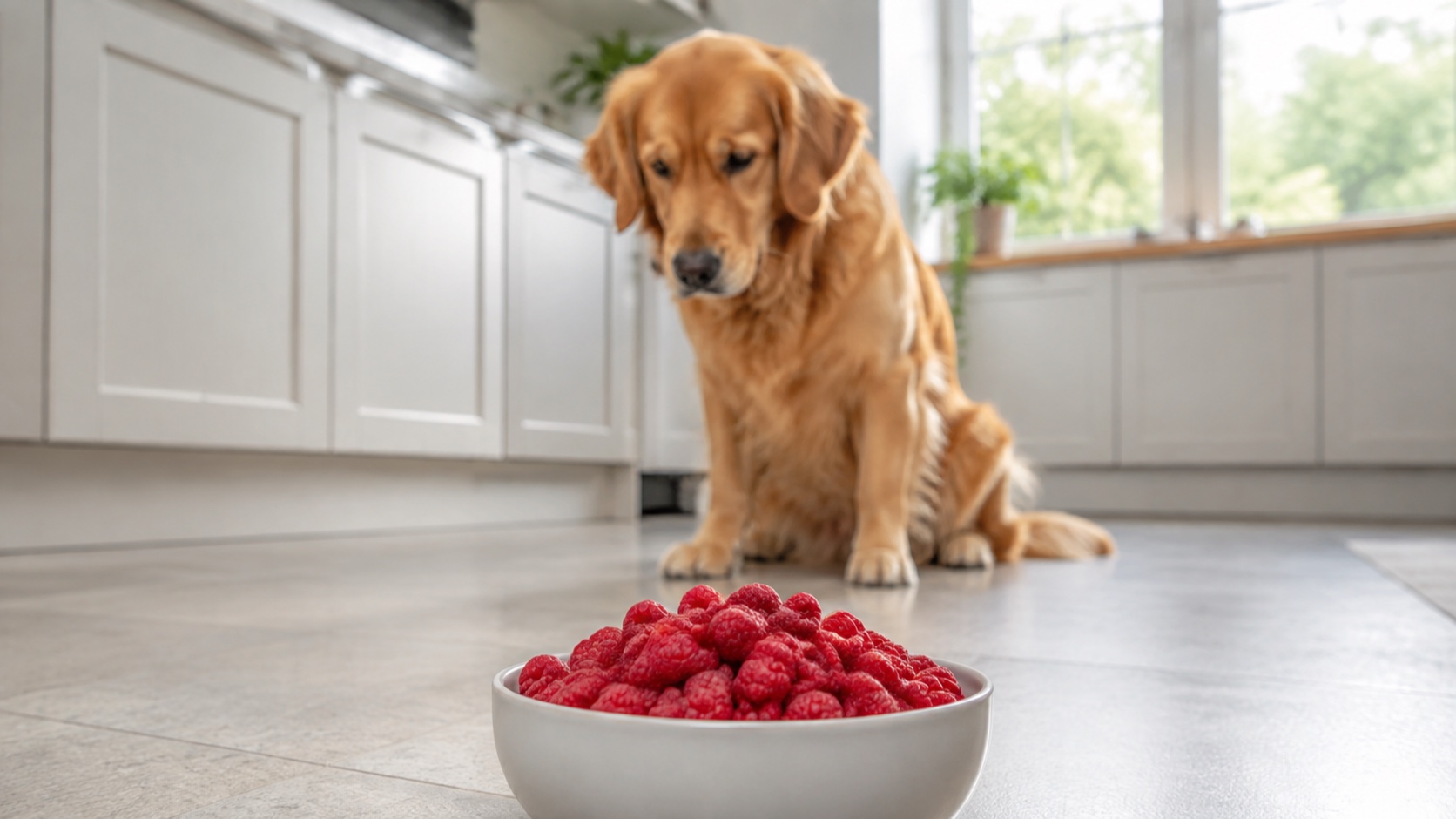
Quick answer: Yes, healthy dogs can eat a few washed, plain raspberries as an occasional treat. Skip jam, syrup, and any raspberry food that lists xylitol. Keep fruit treats inside the 10 percent daily-calorie share set by the 2021 AAHA Nutrition and Weight Management Guidelines.
A 22-pound dog would need over 5.5 pounds of raspberries to hit Merck’s 100 mg/kg xylitol hypoglycemia dose. That figure uses the 400 μg per gram xylitol level reported by Mäkinen and Söderling in the Journal of Food Science.
This page is a desk comparison of published labels and papers, and
The selection rule we used
Our research team analyzed maker pages and primary papers only. We included a product when the current maker page lists raspberries as the sole fruit or a named ingredient. We excluded jam, jelly, syrup, baked goods, and any human snack whose label lists added xylitol or added sugar.
We also skipped competitor blogs. A number stays out unless it appears on a maker page, the FDA page, AAHA, Merck Veterinary Manual, USDA ARS, or a named journal paper.
This is a treat guide, not a meal plan. Raspberries do not replace a complete diet.
What the xylitol numbers actually say
Added xylitol in gum and sugar-free snacks is the real emergency. The FDA consumer update “Paws Off Xylitol; It’s Dangerous for Dogs” says blood sugar can drop fast. That drop can start within 10 to 60 minutes after that kind of ingestion.
The Merck Veterinary Manual states doses above about 100 mg/kg have been tied to hypoglycemia. Doses above 500 mg/kg may cause severe liver injury.
Those thresholds describe concentrated sweetener, not a few berries. Mäkinen and Söderling measured about 400 μg of xylitol per gram of fresh raspberry. That is 40 mg per 100 grams of fruit.
A 22-pound dog is about 10 kilograms. Merck’s 100 mg/kg line is 1,000 mg of xylitol. At 0.4 mg per gram of fruit, that dose is 2,500 grams of raspberries, or 5.5 pounds.
Merck’s 500 mg/kg liver line is five times higher. The same dog would need about 27.5 pounds of fruit in one sitting.
USDA ARS researcher Jungmin Lee reviewed 82 Rubus samples in Food Chemistry in 2015. Only three samples showed any detectable sugar alcohol. One red raspberry sample held 0.03 g per 100 g.
Lee’s interpretive summary puts that load in household terms. A 140 g serving at the highest reported raspberry sugar-alcohol level would hold only 0.042 g of sorbitol.
Most ripe Rubus fruit in that review had none detected. The “highest natural xylitol” warning still points to a tiny load next to gum.
The ASPCA Animal Poison Control Center still treats added xylitol as a hospital problem. Its 2019 update lists sugarless gum first. It then lists sugar-free foods, gummy vitamins, liquid medicines, and dental products.
If a dog eats a labeled xylitol product, call the number on the ASPCA page. That line is 888-426-4435. Bring the package to a clinic.
How many raspberries fit a treat budget
Xylitol math sets a ceiling. Calories set the everyday limit.
The 2021 AAHA Nutrition and Weight Management Guidelines flag noncomplete foods above 10 percent of daily calories as a risk. They also ask that the complete diet supply at least 90 percent of intake.
Driscoll’s lists 60 calories in one cup (123 g) of fresh raspberries. That cup is 8 g of fiber and 5 g of sugar.
Added sugar is 0 g. Sodium is 1 mg.
At that labeled density, 20 g of raspberries is about 10 calories. For a dog whose daily need is 600 calories, AAHA’s 10 percent treat share is 60 calories. One full human cup would spend the entire share.
A few berries stay well under that share. A bowl does not.
Start with one or two berries the first time. Watch stool and appetite for a day. Fiber is the more common problem at home, not xylitol.
Driscoll’s 8 g of fiber per 123 g is dense for a small stomach. Loose stool is the usual signal you overdid it.
Frozen unsweetened fruit uses the same calorie math after it thaws. Cascadian Farm Organic Frozen Red Raspberries lists 60 calories per 1 1/4 cup serving. Fiber is 5 g.
Total sugars are 5 g. Added sugars are 0 g. The bag lists two servings.
Wyman’s Red Raspberries lists 70 calories per 1 cup (140 g). Fiber is 9 g. Total sugars are 6 g.
Added sugars are 0 g. Vitamin C is 37 mg, which Wyman’s labels as 40 percent of the human Daily Value.
Wyman’s 12 oz bag holds 2.5 servings. The maker page says fruit is harvested, washed, and flash frozen within 24 hours.
Count calories from every extra. A cube of cheese can spend that 10 percent share faster than a few berries.
Plain bananas follow that same treat-budget rule.
Fresh, frozen, and foods that list raspberries
Comparing published specs, these five currently sold items met the selection rule. The table is attribute-only. It is not a ranking.
| Product | Form | Raspberry role | Labeled unit | Calories | Fiber or protein | Label note |
|---|---|---|---|---|---|---|
| Driscoll’s Raspberries | Fresh | Sole ingredient | 1 cup (123 g) | 60 kcal | 8 g fiber | 0 g added sugar; 1 mg sodium |
| Cascadian Farm Organic Frozen Red Raspberries | Frozen | Organic raspberries only | 1 1/4 cup; 2 servings per container | 60 kcal | 5 g fiber | 0 g added sugar; 0 mg sodium |
| Wyman’s Red Raspberries | Frozen | Red raspberries only | 1 cup (140 g); 12 oz bag | 70 kcal | 9 g fiber | 0 g added sugar; 37 mg vitamin C |
| Nulo Freeze-Dried Raw Lamb Recipe with Raspberries | Freeze-dried meal | Named fruit in the recipe | 1 cup; bags in 1 oz, 8 oz, 18 oz | 200 kcal/cup; 5,207 kcal/kg | 30.0% min protein | AAFCO all life stages except large-breed growth (70 lb or more) |
| Taste of the Wild High Prairie Canine Recipe with Bison in Gravy | Canned complete food | Listed after tomatoes and blueberries | 13.2 oz can (374 g) | 335 kcal/can; 895 kcal/kg | 8.0% min protein | AAFCO growth and maintenance, including large-breed growth |
Driscoll’s, Cascadian Farm, and Wyman’s are plain fruit. Feed a few pieces, not the labeled human serving.
Nulo’s page lists raspberries after lamb kidney. The recipe is 80 percent lamb, organs, and bone. Moisture is 5.0 percent maximum.
Crude fat is 35.0 percent minimum. Crude fiber is 4.0 percent maximum. Bacillus coagulans is listed at 1,000,000,000 CFU per pound.
Nulo is a meal or topper, not a berry snack. Follow the cup amounts on that page. Dogs from 5 to 20 pounds are listed at 1 to 2 1/2 cups a day when the food is the full meal.
Taste of the Wild High Prairie Canine Recipe with Bison in Gravy lists raspberries near the end. Moisture is 82.0 percent maximum.
Crude fat is 3.5 percent minimum. Crude fiber is 1.0 percent maximum.
A 13.2 oz can is 335 kcal. The maker feeding table starts at 1/4 to 1 can a day for dogs from 2 to 12 pounds when the can is the only food.
Those two dog foods already carry AAFCO complete-and-balanced statements. They do not need extra raspberries on top unless you cut the meal calories to match.
How to serve a few berries
Wash fresh fruit under cool water. Pull off stems and leaves. Those parts are not the treat.
For a toy-breed dog, mash or halve the berry. A whole berry can be gulped.
Serve the fruit plain, with no cream, sugar, syrup, or chocolate drizzle.
Frozen berries from Cascadian Farm or Wyman’s are fine after you confirm the bag lists only raspberries. Let them thaw slightly for small dogs. A rock-hard berry is a poor chew for a puppy.
Do not pour a smoothie. Blended fruit hides volume. You can overshoot the 10 percent share without seeing it.
Skip the yogurt mix unless the cup is plain, unsweetened, and xylitol-free. Many “light” dairy cups use sugar alcohols.
One idea per day is enough. Fruit is a garnish.
What this page leaves out
Jam and jelly are out. They concentrate sugar. Some “sugar-free” jars swap in xylitol.
The FDA list of xylitol products includes sugar-free candy, baked goods, peanut butters, toothpaste, and “skinny” ice cream.
That is a different risk than fruit. A few raspberries and a pack of sugar-free gum are not the same object.
Grapes are also out of this comparison. That fruit has its own toxicity profile. It is not a “berry treat” analog.
Those labels change by lot. Many add sugar or concentrate the fruit.
Identification errors are common. Garden sprays are not on a nutrition panel.
Puppies, pregnant dogs, and dogs with a history of pancreatitis need a tighter treat budget than this page can set. Ask the clinic that knows that dog.
When a handful is not the problem
Call a clinic or the ASPCA Animal Poison Control Center if the dog ate a sugar-free product. The FDA page lists vomiting, weakness, staggering, collapse, and seizures as signs after added xylitol.
Merck notes hypoglycemia signs can start in 30 minutes. Some gum bases delay signs 12 to 18 hours.
Liver enzyme changes may show in 4 to 12 hours. Clinical liver injury can wait 24 to 48 hours.
A few extra berries usually mean a soft stool, not that timeline. A dog that vomits, slumps, or seizes after any unknown snack needs a clinic.
Keep human toothpaste and sugar-free peanut butter off the counter. The FDA update says to check those labels before you stuff a toy.
Raspberries in a sealed clamshell are a low-stakes treat. The gum in a purse is not.
FAQ
Can dogs eat raspberries every day?
They can, if the portion stays inside AAHA’s 10 percent calorie share and the rest of the diet stays complete. Daily fruit is optional. Most dogs do fine with raspberries a few times a week.
Can dogs eat frozen raspberries?
Yes, when the bag lists only raspberries. Cascadian Farm and Wyman’s both list 0 g added sugar on the servings we compared. Thaw or crush them for small dogs.
Do raspberries have enough xylitol to poison a dog?
Not at snack size. Mäkinen’s 400 μg per gram figure still requires pounds of fruit to reach Merck’s 100 mg/kg line. Added xylitol in gum is the dose that matches that line.
Can dogs eat raspberry jam?
No. Jam is a sugar concentrate, and some sugar-free jams use xylitol. Neither form meets this page’s selection rule.
Can puppies eat raspberries?
A mashed half berry is a reasonable first try for a weaned puppy. Keep the calorie share tighter during growth. AAHA lists growth as a life stage that changes nutrient need.
What if my dog ate a whole carton?
A standard clamshell is far below 5.5 pounds. Expect digestive upset before xylitol signs. Call a clinic if the dog vomits, seems weak, or ate anything else from the fridge.
Are commercial dog foods with raspberries safer than fresh fruit?
They are different jobs. Nulo and Taste of the Wild High Prairie use raspberries as a minor named ingredient inside an AAFCO-stated recipe. Fresh fruit is a treat and counts toward the 10 percent share.