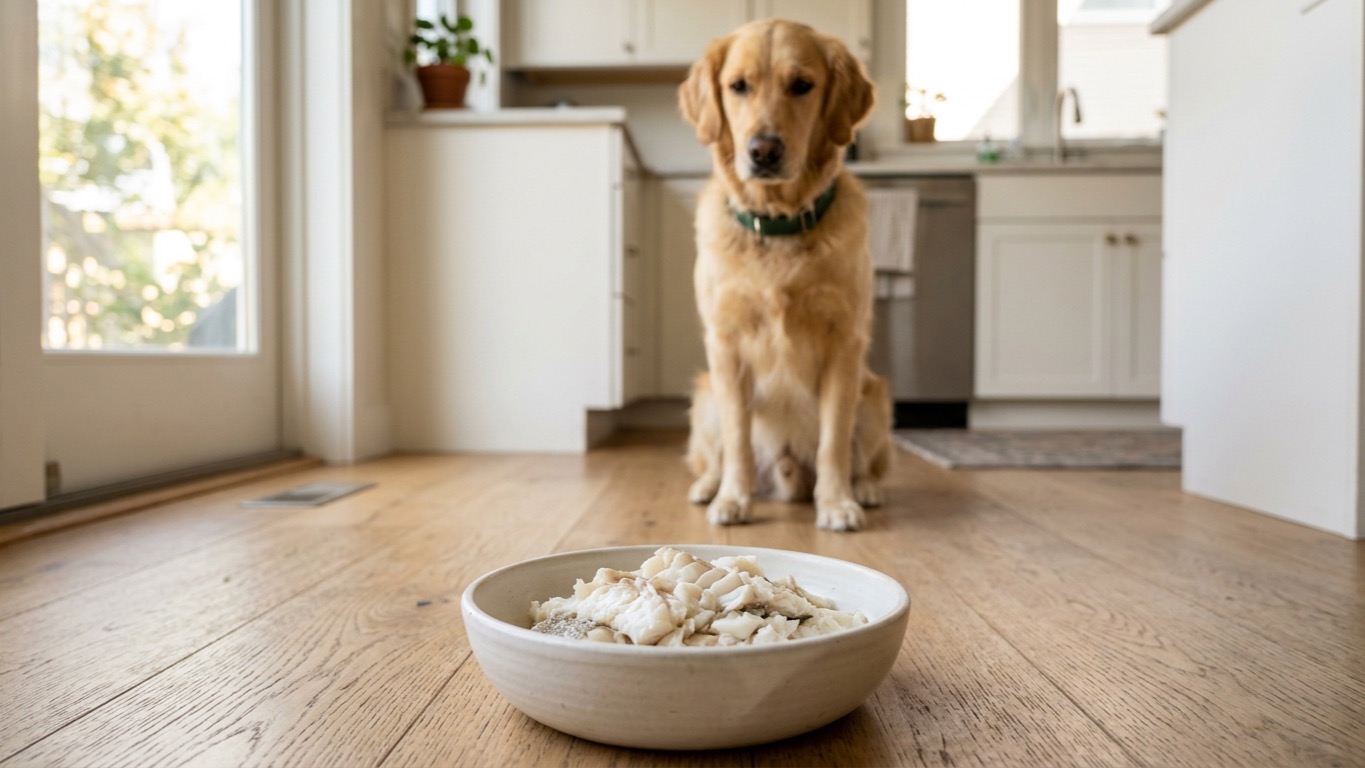
Quick answer: Yes. Most dogs can eat plain cooked boneless cod as an occasional treat. Skip raw fillets, bones, butter, and seasoning.
Cooked boneless cod is a safe occasional treat for most dogs; raw cod and fish bones are not.
This page is a research-desk comparison of published cooking rules, nutrient tables, and treat labels.
The Cod Inclusion Rule
Our selection rule is narrow on purpose. We cover boneless cooked Atlantic or Pacific cod flesh. We also cover single-ingredient commercial treats that name only cod on the maker page and publish a guaranteed analysis.
We leave out breaded, battered, smoked, salted, oil-packed, and mixed-protein fish snacks. We also leave out restaurant leftovers and any fillet still carrying pin bones.
Cooked Versus Raw
Heat is the first split. The U.S. Food and Drug Administration lists 145°F as the safe minimum internal temperature for fin fish.
The flesh should also turn opaque and separate easily with a fork. Color alone is a weak check. The FDA says a food thermometer is the reliable tool for seafood.
Raw fish is a different product. The FDA Center for Veterinary Medicine screened pet foods across two years ending in July 2012. Of 196 commercial raw dog and cat food samples, 15 held Salmonella and 32 held Listeria monocytogenes.
The same FDA page says thorough cooking kills Salmonella, Listeria monocytogenes, and other harmful foodborne bacteria. That is why this page treats raw cod as a leftover to withhold.
A second raw-fish problem is thiaminase. A 2017 review in Veterinary Sciences, published by MDPI, states that thiaminase in some dead fish can destroy vitamin B1. The same review notes that heat denatures the enzyme.
That risk rises when raw fish makes up most of a diet. It is not a reason to panic over one stolen bite. It is a reason not to build meals from uncooked fillets.
The FDA estimates about 48 million human foodborne illness cases each year in the United States. Those cases include an estimated 128,000 hospitalizations and 3,000 deaths. Kitchen leftovers move through the same counters and hands, so cook the fish and wash the board.
Bones, Skin, and Leftover Parts
Fish bones are the second split. Pin bones are thin, sharp, and easy to miss in a supermarket fillet.
A swallowed bone can lodge, scratch, or perforate. That is a mechanical injury, not a nutrient debate. Pull every bone before the plate reaches the floor.
Heads, tails, and fins stay off the list for the same reason.
Cooked skin is a closer call. Commercial air-dried cod-skin treats exist as labeled snacks. A greasy pan skin from a buttered dinner is not the same item.
If you offer skin, use a plain cooked piece with scales and bones gone. Skip skin fried in oil or dusted with salt.
Canned cod packed in oil or brine fails the inclusion rule. Extra sodium and fat are not part of the lean-flesh case.
What 100 Grams of Cooked Cod Contains
USDA FoodData Central lists Fish, cod, Atlantic, cooked, dry heat at 105 kcal per 100 g. That same 100 g entry lists 22.8 g protein and 0.86 g fat.
The USDA entry also lists 78 mg sodium, 244 mg potassium, 55 mg cholesterol, and 1.2 µg vitamin D per 100 g.
Raw Atlantic cod is leaner on a wet-weight basis. USDA FoodData Central lists 82 kcal, 17.81 g protein, and 0.67 g fat per 100 g, plus 54 mg sodium.
Cooking drives off water. That is why the cooked 100 g serving looks denser.
Our research team compared those USDA cooked-cod figures with the agency’s cooked Atlantic herring entry. Herring lists 11.6 g fat and 203 kcal per 100 g. Cod stays the low-fat white fish in that pair.
The Association of American Feed Control Officials sets a minimum of 18.0% crude protein, dry-matter basis, for adult-maintenance dog foods. Growth and reproduction diets have a 22.0% dry-matter protein minimum.
Cooked cod is a protein-dense extra, not a complete diet. AAFCO does not require treats labeled snack or treat to meet those complete-and-balanced profiles. The AAFCO treats page says those products should be given sparingly as an occasional reward.
Mercury is a separate human-diet chart. The FDA and the U.S. Environmental Protection Agency, in advice revised in October 2021, place cod on the Best Choices list for people watching mercury.
That chart is written for human servings, not dog bowls. It still explains why this page treats cod as a lower-mercury fish than swordfish or shark. It is not a license to feed fish every day.
Safe Amounts for a Treat, Not a Meal
Portion math should start from calories, not from a vague handful.
USDA FoodData Central puts cooked Atlantic cod at 105 kcal per 100 g. PureBites states on its Cod Skin Air Dried Jerky page that calories from treats should not exceed 10% of a dog’s daily calorie need.
Use that 10% cap as a working ceiling for extras. On a 500-calorie daily ration, the leftover budget is 50 kcal. That equals about 48 g of plain cooked boneless Atlantic cod.
A 1,000-calorie ration leaves 100 kcal for extras. That is about 95 g of the same cooked flesh. Bigger dogs do not get a free pass to eat the whole fillet.
Those examples assume the regular food is already complete. AAFCO warns that too many treats can upset an otherwise complete diet and add unneeded calories.
Start smaller than the ceiling. Offer a few flakes, then wait a day. Watch stool, itching, and vomiting before you raise the amount.
Dogs with a known fish allergy should skip the experiment. Dogs on a prescription diet should keep extras inside the plan written for that diet.
People food is not interchangeable. Grapes stay off the plate even when fish is fine. Cod does not cancel other kitchen hazards.
Commercial Single-Ingredient Cod Treats Compared
Our research team analyzed published specs on four maker pages that sell single-ingredient cod snacks now. We compared listed protein, fat, moisture, and calories.
Polkadog Alaskan Cod Chips list one ingredient: cod. The maker page lists 78% minimum crude protein, 1% minimum crude fat, and 12% maximum moisture. It also lists 2,910 kcal/kg and 8.73 kcal per treat.
PureBites Cod Skin Air Dried Jerky lists Canadian-sourced wild-caught cod skin. The maker page lists 70% minimum protein, 8% minimum fat, and 12% maximum moisture. It also lists 4,370 kcal/kg and 33 kcal per treat on average.
The same PureBites page says the 4.8 oz bag is made from 1.6 lb of raw cod skin. That is a process claim, not a serving size.
The Honest Kitchen Ocean Chews Crispy Cod Fish Skins Beams list dehydrated codfish skins. The maker page lists 80% protein, 4% fat, 14% moisture, and 24 kcal per average small chew.
Open Farm Icelandic Air-Dried Cod Skins Dog Treat Sticks list wild-caught cod skins. The maker page lists 80% minimum crude protein, 1% minimum crude fat, and 10% maximum moisture. It also lists 0.5% minimum omega-3 fatty acids, 3,148 kcal/kg, and 74 kcal per stick.
The calorie spread is the useful finding. Listed energy per piece runs from 8.73 kcal on Polkadog Alaskan Cod Chips to 74 kcal on the Open Farm stick.
A 50-calorie treat budget holds about five Polkadog chips, or about two Honest Kitchen small chews. It holds one PureBites cube with room left. It does not hold a full Open Farm stick unless you snap the stick and count the pieces.
| Product | Listed ingredients | Protein (min) | Fat (min) | Moisture (max) | Listed calories |
|---|---|---|---|---|---|
| Polkadog Alaskan Cod Chips | Cod | 78% | 1% | 12% | 8.73 kcal/treat; 2,910 kcal/kg |
| PureBites Cod Skin Air Dried Jerky | Wild-caught cod skin | 70% | 8% | 12% | 33 kcal/treat; 4,370 kcal/kg |
| The Honest Kitchen Ocean Chews Crispy Cod Fish Skins Beams | Dehydrated codfish skins | 80% | 4% | 14% | 24 kcal per avg small chew |
| Open Farm Icelandic Air-Dried Cod Skins Dog Treat Sticks | Wild-caught cod skins | 80% | 1% | 10% | 74 kcal/stick; 3,148 kcal/kg |
Open Farm also states the product is for intermittent or supplemental feeding only. That matches the AAFCO treat stance. These bags are snacks, not kibble replacements.
Supervise any long skin chew. Open Farm notes the stick can be larger than a dog’s mouth and can be broken into bite-size pieces.
When to Skip Cod, and What Else Fits
Skip raw fillets. Skip bones. Skip butter, garlic, onion, salt, lemon-pepper rubs, and breading.
Skip fried restaurant portions. Batter, oil, and table seasoning take the fillet outside this page’s rule.
Skip daily fish-only feeding. AAFCO complete-and-balanced statements belong on the main food.
Skip cod if the last new protein caused hives, ear flares, or repeated diarrhea. One more novel protein is not a test you run at dinner.
Cheese is another kitchen protein with a different fat load. It is not a substitute for a fish trial. It is not a free extra on the same night.
Bananas are a separate occasional treat with almost no protein. Use them when you want a sweet bite, not when you want the lean-fish case.
If a dog gulps a bone-in piece, watch for gagging, drooling, or a tense belly. Those signs need a clinic, not another snack.
If you handle raw fish at home, follow the FDA kitchen steps. Wash hands with soap for at least 20 seconds. Keep the fridge at 40°F or below.
Refrigerate leftovers within 2 hours. Cut that window to 1 hour if the room is above 90°F. Shared counters spread the same bacteria to people in the house.
FAQ
Can puppies eat cooked cod?
A small flake of plain cooked boneless cod is the same extra it is for adults. Puppies still need a growth diet that meets the AAFCO 22.0% dry-matter protein minimum for growth and reproduction.
Do not let fish crowd that main food. Keep the first serving tiny and watch stool the next day.
Can dogs eat raw sushi-grade cod?
A sushi label is a human retail term, not a pet-food safety stamp. This page still treats raw cod as a withhold.
The FDA cooking chart for fin fish is 145°F. Cold raw slices do not meet that number.
Can dogs eat breaded or fried cod?
No. Breading, oil, salt, and onion or garlic seasoning take the fillet outside the inclusion rule.
Those extras add fat and sodium the USDA plain-cod numbers do not describe. Serve the fish only if you can strip it back to plain flesh.
How often can a dog eat cooked cod?
Treat frequency should stay inside the 10% calorie cap that PureBites prints on its feeding notes. Stay inside AAFCO’s “sparingly” language for snacks as well.
Two small servings a week can fit that cap for many dogs. Daily fillets usually will not.
Is canned cod safe for dogs?
Only if the can is plain fish in water with no salt, oil, or onion. Most pantry cans fail that check.
When the label is unclear, skip the can and cook a fresh boneless fillet instead.
What should I do if my dog ate a cod bone?
Do not induce vomiting at home unless a clinician tells you to. Watch for choking, repeated gagging, vomiting, or a painful abdomen.
Those signs need prompt clinic care. A bone that passed once is not proof the next one will.
Does cod replace salmon oil or a complete food?
No. USDA cooked Atlantic cod is a lean protein extra at 0.86 g fat per 100 g. It is not a measured omega-3 dose, and it is not a complete diet.
Keep the balanced food in the bowl. Use cod as a flake, a training bit, or a labeled single-ingredient chew.