
Quick answer: Offer hard pellets and a plant-wood chew every day. Check the four front teeth weekly for even length. Book a small-mammal clinic visit if eating slows, drool appears, or an incisor curves.
Hamsters are not small rabbits with the same tooth plan. Hamster incisors grow for life, so daily gnawing—not home clipping—keeps the 16-tooth set at working length. This page is a research-desk brief on published hamster dentition and current chew specs. We did not handle live hamsters, did not clip teeth, and did not run wear trials.
Our research team analyzed laboratory chapters and five maker pages that still list these SKUs. We did not scrape marketplace listings for missing sizes.
What we included, and what we left out
A chew enters this article only if the brand’s own page names hamsters. The gerbils-and-hamsters pairing on Oxbow pages also counts. The page must state a plant material and an explicit teeth-wear sentence.
Living World Green Chews Mango Wood Sticks enter on a narrower exception. That page says “other small animals” and prints a stick length.
We left out seed-on-a-stick treats, mineral wheels, and cage furniture sold as chew toys. We also left out any SKU whose only numbers lived on a retailer page.
This is not a ranked list. The table below is an attribute sheet, not a buying order.
What a hamster mouth actually contains
The chapter “Biology and Diseases of Hamsters” counts 16 teeth. The formula is (I 1/1, C 0/0, PM 0/0, M 3/3) × 2 = 16. That is four incisors and twelve molars.
A gap called a diastema sits between the incisors and the cheek teeth. The same chapter draws a hard line between those two groups. Incisors erupt continuously.
The cuspidate molars do not continue to grow. A wood stick can wear the front pair. It cannot reshape hidden molars.
The United States Department of Agriculture figure inside that chapter is dated. About 146,000 hamsters were used in United States research in 2010. The tooth formula attached to it has not changed.
The National Research Council’s 1995 hamster chapter adds a timing fact. Incisors are already erupted at birth. Pups start solid food within 7 to 10 days.
Wear work begins before weaning. It does not wait for the first store-bought chew.
The MSD Veterinary Manual’s hamster care chapter is blunt on the incisors. They grow throughout life. Food and other chew items have to offset that growth.
Powdered food can lodge in the back teeth and set up cavities. That is a molar problem, not an incisor-length problem.
We did not find a primary enamel-color measurement on the pages we read. Yellow or orange front teeth are often treated as normal in clinic writing. We are not repeating an unmeasured pigment claim as fact.
Growth from birth to adult weight
“Biology and Diseases of Hamsters” gives a Syrian pup weight of 2–3 g at birth. Incisors are visible on day one. Ears open at day 4–5.
Hair shows at day 9. Eyes open between days 14 and 16. Weaning is day 21, at 35–40 g.
The National Research Council cites a nearby figure. Young hamsters weigh 2 to 4 g at birth. They weigh 40 g when weaned at 21 days.
Adult mass comes later. The same biology chapter puts maturity at 6–8 weeks. Males then weigh 85–110 g.
Females weigh 95–120 g. A weight drop after that window is a flag. Overgrown teeth are one cause, not the only cause.
The National Research Council also notes a feeding rhythm. Hamsters eat at about 2-hour intervals through the day. Missed meals and uneaten hard food beat a late incisor photo.
A weekend without a new stick is rarely the crisis. A week of skipped hard food is. The incisors keep erupting whether the hamster gnaws or not.
Overgrowth signs, and what chewing cannot fix
The MSD Veterinary Manual lists drooling, loss of appetite, and weight loss when teeth outgrow wear. It also says hamsters tend to have fewer dental problems than some other rodents. “Fewer” is not “none.”
Watch the bite, not just the tip length. Upper and lower incisors should meet so each pair files the other. A tooth that hooks, crosses, or shoots past the lip is a feeding problem.
Home clipping is a common search idea. We are not walking through it. Incisors are thin, and a bad cut can shatter the tooth.
The MSD chapter says a clinician may need to trim teeth when normal gnawing fails. That is clinic work, not a cage-side craft.
Chews also fail when the jaw itself is misaligned. Extra apple wood will not correct a congenital bite. Injury to one incisor can leave the opposite tooth unopposed.
A laboratory detail from “Biology and Diseases of Hamsters” shows how hardware can break teeth. Feeders with 5/16-inch-wide slots stopped pellets from dropping. Hamsters bit both sides of the metal strips.
The result was broken teeth and severe weight loss. Bar spacing and feeder gaps belong in the same file as chew choice.
If a hamster stops eating, do not wait for the next chew shipment. Soft food is a short bridge, not a plan. Uneaten droppings and a wet chin are reasons to travel that day.
Plant-wood chews that name hamsters
Our research team compared published specs on five current maker pages. Three published a pack count or a listed dimension. Two Oxbow pages named hamsters and a wear claim but listed no pack count on the product page.
Kaytee Apple Orchard Sticks are a 10-pack of apple wood. Kaytee lists hamsters and says the sticks help keep teeth healthy, clean, and trim. Package size is 0.75" × 4.5" × 6.5" at 0.1 pounds.
Oxbow Enriched Life Timothy Apples & Stix mixes timothy hay with natural apple sticks. Oxbow names gerbils and hamsters. The page calls the chew ideal for keeping teeth healthy and properly worn.
Oxbow also tells owners to offer a variety of Enriched Life items daily. Oxbow Enriched Life Woody Combo uses untreated wood and natural apple sticks. The same hamster listing and dental-wear claim appear, still with no pack count.
Ware Pretzel Sticks are 100% natural willow. Ware names hamsters and calls them a wood chew that helps trim teeth. Listed size is width 5.00, depth 1.00, and height 6.50.
Living World Green Chews Mango Wood Sticks are 100% mango wood. The pack is 10 pieces at 100 mm (4"). Living World says to place one or two sticks, then replace them when soiled.
| Chew | Maker-listed material | Maker-listed pack or size | Species named on the maker page | Maker wear language |
|---|---|---|---|---|
| Kaytee Apple Orchard Sticks | Apple wood | 10 sticks; package 0.75" × 4.5" × 6.5"; 0.1 lb | Rabbits, guinea pigs, hamsters | Helps keep teeth healthy, clean, and trim |
| Oxbow Enriched Life Timothy Apples & Stix | Timothy hay and natural apple sticks | Pack count not listed on the maker page | Gerbils and hamsters | Ideal for keeping teeth healthy and properly worn |
| Oxbow Enriched Life Woody Combo | Untreated wood and natural apple sticks | Pack count not listed on the maker page | Gerbils and hamsters | Coarse materials promote essential dental wear |
| Ware Pretzel Sticks | 100% natural willow | Listed 5.00 × 1.00 × 6.50 | Hamsters, plus rabbits, guinea pigs, chinchillas, rats, gerbils | Helps trim teeth |
| Living World Green Chews Mango Wood Sticks | 100% natural mango wood | 10 pieces, 100 mm (4") | Rabbits, guinea pigs, and other small animals | Helps keep teeth trim and healthy |
Rotate textures. Oxbow’s own copy pairs wood with paper and hay-based chews. A hamster that ignores apple wood may work willow or hay instead.
Refusal of every chew plus falling weight is not a brand problem. It is a clinic problem.
Inspect sticks when you spot-clean. Toss a piece that is wet, moldy, or small enough to wedge in a cheek pouch.
Pellets, protein, and the wear that food can provide
Chews do not replace the daily diet. The National Research Council put 18 percent crude protein behind growth near 2 g/day in weanlings. That chapter also treats 18 percent as adequate for reproduction.
Kaytee Forti-Diet Pro Health Nourish+Protect Hamster and Gerbil Food sits lower on the label. Kaytee’s current page lists 12.0% minimum crude protein and 6.0% minimum crude fat. Maximum crude fiber and moisture are both 12.0%.
Omega-3 fatty acids are listed at 0.6% minimum. Total Bacillus species are listed at 80,000 CFU/g. Kaytee’s hamster feeding amount is 2 tablespoons, about 20 g.
The 3-pound bag measures 3.5" × 7" × 8". Kaytee tells owners to transition over 7 to 10 days. After opening, use the food within 30 to 45 days.
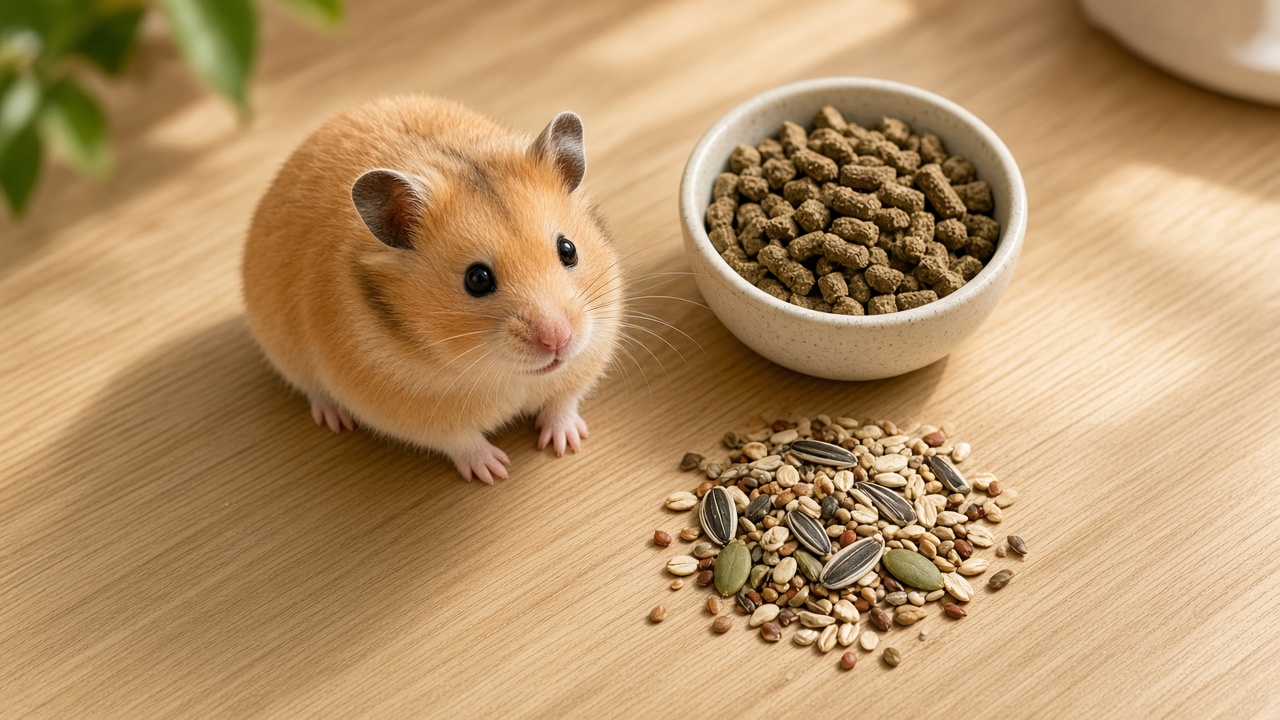
Kaytee says crunchy pieces encourage chewing and support dental health. That is a maker statement, not a wear trial we ran. Hard pellets still beat a seed-only bowl for even bites.
If the only chew in the cage is a soft treat stick, the incisors lose their mill. Keep the pellet in the rotation. Treat wood as the extra file, not the meal.
Bars, bedding crumbs, and cage upkeep
Bar chewing is not dental care. It is a boredom or escape behavior. The MSD chapter warns that hamsters gnaw electrical cords and furniture if they get loose.
A DIY hamster cage should use untreated wood and gaps that cannot trap an incisor. Skip painted crates and pressure-treated lumber.
Soiled sticks belong with wet bedding. Follow a full how to clean a hamster cage pass when urine reaches the chew pile. Pair that habit with how often to clean a hamster cage so mold never becomes the night snack.
Replace chewed-down stubs during that clean. A 100 mm mango stick that is now a splinter is waste, not enrichment. Kaytee’s 10-pack and Living World’s 10-pack exist because sticks disappear.
The MSD chapter states that no vaccines are currently required for hamsters. That does not make dental checks optional. A hamster’s normal body temperature, per that chapter, is 98°F to 101°F.
A cold, still animal that has stopped eating is an emergency. It is not a wait-and-see chew restock.
FAQ
How many teeth does a hamster have?
Sixteen, per “Biology and Diseases of Hamsters”: (I 1/1, C 0/0, PM 0/0, M 3/3) × 2 = 16. Four are incisors. Twelve are molars.
Do all hamster teeth keep growing?
No. The same chapter says incisors erupt continuously, and the molars do not. A chew mainly files the front four.
Are hamsters born with teeth?
Yes. The National Research Council and “Biology and Diseases of Hamsters” both state that incisors are present at birth. Solid food starts at 7 to 10 days, and weaning weight is about 35–40 g at day 21.
Can I clip overgrown hamster teeth at home?
Do not. This desk did not clip teeth and will not publish a home method. The MSD Veterinary Manual treats trimming as clinic work when normal gnawing fails.
How often should I put out a new wood chew?
Oxbow’s hamster-listed pages say to offer a variety of chews daily. Living World says to place one or two mango sticks and replace them when soiled. Use soiling and remaining length, not a calendar slogan.
What food numbers sit on a current hamster bag?
Kaytee’s current Forti-Diet hamster page lists 12.0% minimum crude protein and a 20 g daily amount. The National Research Council’s lab chapter used 18 percent crude protein as a growth benchmark. Those are two documents, not a ranking.
When is overgrowth an emergency?
When the hamster stops eating, drops weight, drools, or cannot close the mouth. The MSD chapter ties those signs to overgrown teeth. Soft food can buy hours, not days.