Quick answer: A long-haired hamster is a fluffy Syrian, often sold as a teddy bear hamster. House one hamster alone on unscented paper bedding. Brush the hindquarters each week so waste and bedding do not mat in the coat.
A long-haired hamster is a long-coated Syrian, not a separate species, and its coat mats without weekly brushing. This page is a research-desk guide that compares published housing figures and maker specs.
The Coat-Trap Rule we used
Our research team used one selection rule for every product and scenario below. We call it the Coat-Trap Rule.
We included only items that keep long fur from holding urine, feces, or fibrous nesting. We excluded cotton fluff, scented paper, and wire wheels.
We also dropped any product whose maker page does not list hamsters or a solid running surface. That is why this guide names paper bedding, a lidded sand box, and a plastic wheel.
Comparing published specs is the method.
What a long-haired hamster actually is
The Association of Exotic Mammal Veterinarians names the golden or Syrian hamster, Mesocricetus auratus, as the most common pet hamster. A “teddy bear” or “long-haired hamster” is a coat variety of that same species.
It is not a dwarf hamster. Males often carry longer skirts of fur around the hips and rump. Bedding and droppings catch there first.
The Association of Exotic Mammal Veterinarians says most hamsters should be housed individually. The MSD Veterinary Manual says the same, except during breeding.
Two long-haired Syrians in one box will fight. A second hamster does not keep the coat cleaner.
Grooming the coat without a water bath
Do not soak a hamster in a sink. Wet fur chills a small body. It also mats faster as it dries.
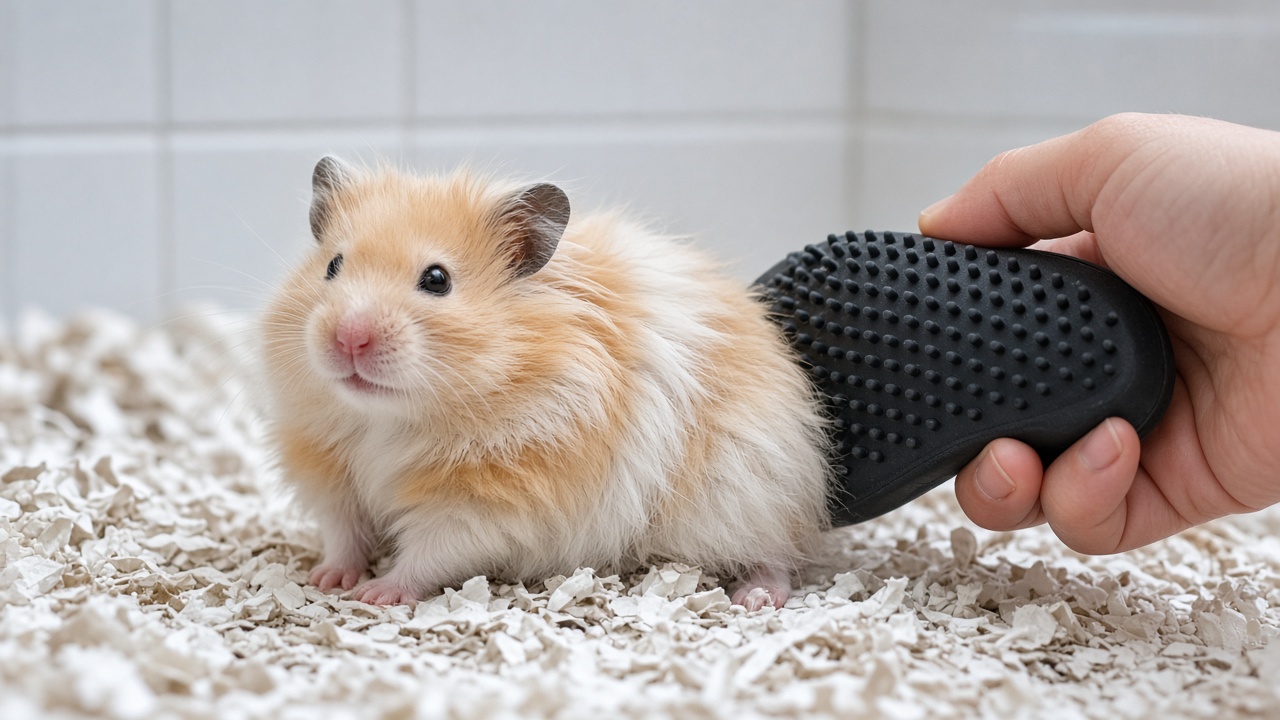
Use a dry routine. Check the rump, belly, and tail area each evening when the hamster wakes.
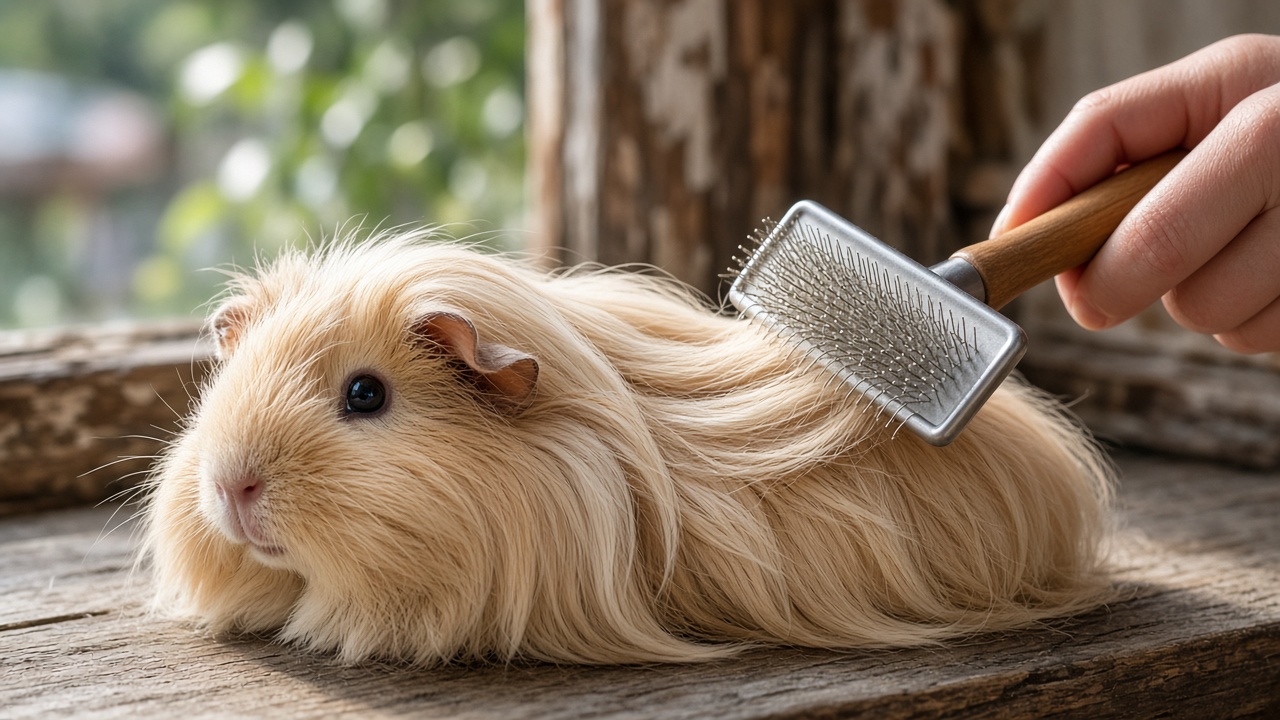
A soft toothbrush or a small bristle brush is enough for most coats. Work with the hair, not against it. Stop if the hamster freezes or tries to bite.
Mats form where urine wets the skirt. Tease them apart with fingers first. Cut only a stuck clump with blunt-tip scissors.
The Association of Exotic Mammal Veterinarians warns against cloth nesting with strings that wrap limbs. The MSD Veterinary Manual warns that cotton balls can catch in toenails and feet.
Both materials also weave into a long coat.
Offer a dry sand bath instead of water. The Niteangel Small Animal Sand-Bath Box is a rectangle listed at 12.2 by 8.6 by 4 inches.
The acrylic box has a removable half-lid that limits scatter. Fill it with clean sand labeled as sand, not bath dust.
Scoop soiled sand daily. Replace the sand when it clumps or smells.
Bedding that does not weave into fur
Paper bedding is the substrate that survives the Coat-Trap Rule. It is soft, short-fiber, and easy to spot-clean.
The Association of Exotic Mammal Veterinarians tells owners to use paper bedding or soft wood shavings. It also tells owners to avoid pine, cedar, and corn cob.
The MSD Veterinary Manual tells owners to avoid cedar chips and fresh pine. Our research team compared three paper products that still list hamsters on the maker page.
Kaytee Clean & Cozy White Bedding is fragrance-free paper. Kaytee says it absorbs up to 6 times its weight in liquid and is 99.9% dust-free. Bag volumes on that page are 24.6, 49.2, and 85 liters.
Oxbow Pure Comfort Natural Bedding is 100% never-printed paper and 99.9% dust-free. Oxbow Animal Health sells 28 liter bags (1,709 cubic inches) and 56 liter bags (3,417 cubic inches).
Oxbow’s use direction is 1 to 3 inches, with a full change at least once a week.
carefresh Natural Paper Small Pet Bedding is 100% reclaimed fiber. Healthy Pet lists 99% dust-free performance. It also lists absorbency 2 times that of shavings and odor control for up to 10 days.
The same carefresh page gives hamsters a 650 square inch habitat and a 2 to 5 inch bedding depth.
Those depth notes do not match. Oxbow’s 1 to 3 inches is a hygiene direction. Healthy Pet’s 2 to 5 inches is a hamster-specific row.
The Association of Exotic Mammal Veterinarians asks for deep litter for burrowing, without a number. Deep paper still helps if the toilet corner stays dry.
A wet 5 inch pit will soak the skirt. Skip dyed or lavender paper.
| Product | Role | Maker-listed size | Maker-listed material and dust claim | Coat-relevant maker note |
|---|---|---|---|---|
| Kaytee Clean & Cozy White Bedding | Paper substrate | 24.6 L, 49.2 L, or 85 L | Paper; absorbs up to 6× its weight; 99.9% dust-free | Fragrance-free; lists hamsters |
| Oxbow Pure Comfort Natural Bedding | Paper substrate | 28 L (1,709 cu in) or 56 L (3,417 cu in) | 100% never-printed paper; 99.9% dust-free | Place 1–3 inches; weekly full change |
| carefresh Natural Paper Small Pet Bedding | Paper substrate | Natural 14 L, 30 L, or 60 L | 100% reclaimed fiber; 99% dust-free; 2× shavings absorbency | Hamster row: 650 sq in; 2–5 in depth |
| Niteangel Small Animal Sand-Bath Box | Dry coat bath | 12.2 × 8.6 × 4 in | Acrylic with removable half-lid | Maker lists hamsters |
| Kaytee Silent Spinner Wheel | Solid wheel | 4.5, 6.5, 10, and 12 in | Plastic running surface; enclosed hub | 12 in is the largest listed size |
| Kaytee Forti-Diet Pro Health Nourish+Protect Hamster and Gerbil Food | Daily diet | 3 lb or 8 lb; 2 Tbsp (~20 g) | Protein 12.0% min; fat 6.0% min | Use within 30 to 45 days after opening |
Enclosure, wheel, and sand-bath layout
Floor space is the first number owners argue about. Our research team put two published figures next to each other.
The Association of Exotic Mammal Veterinarians lists at least 150 square inches of floor space. It also lists a height of at least 6 to 10 inches. Healthy Pet’s carefresh hamster row lists 650 square inches.
Those are not the same standard. One is a professional companion-care floor. The other is a bedding brand’s habitat note.
The MSD Veterinary Manual says the enclosure should be at least 6 inches high. It adds that 8 inches or more allows deeper bedding.
A DIY hamster cage can add wall height.
Keep the room in the published temperature bands. The Association of Exotic Mammal Veterinarians lists 65 to 79°F. Young hamsters sit at 71 to 75°F.
Relative humidity sits at 40 to 70%. The MSD Veterinary Manual lists 64°F to 79°F.
The Association of Exotic Mammal Veterinarians also says a 20 gallon tank is appropriate for an aquarium-style box.
Use a solid wheel. The Association of Exotic Mammal Veterinarians and the MSD Veterinary Manual both reject open wire rungs.
Kaytee lists the Silent Spinner Wheel in 4.5, 6.5, 10, and 12 inch sizes. The page lists a plastic running surface and an enclosed hub.
A long-haired Syrian fills a small wheel. The 12 inch listing leaves the most room for a skirted rump.
Place the sand box in a dry corner, not in the toilet pile. Long fur that rolls in urine sand will mat by morning.
Diet numbers that show up in the coat
A dull, sparse coat is not only a brush problem. Diet shows in the hair.
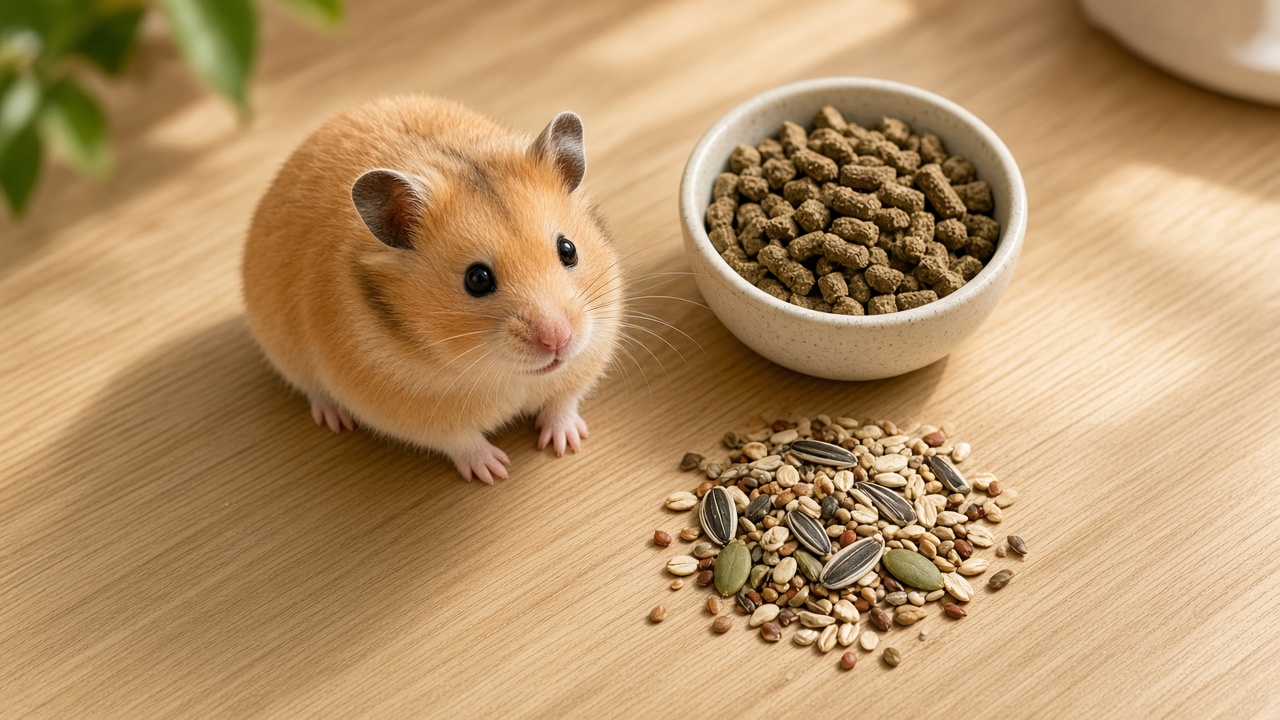
The MSD Veterinary Manual says commercial mouse and rat pellets are suitable when they contain 15% to 20% protein. It limits fruit, vegetable, and chewy treats to not more than 10% of the total diet.
The National Research Council’s hamster chapter reports a 13.7% crude protein figure. That diet supported gains of 1.8 to 2 grams per day in young golden hamsters.
The same chapter says 18% crude protein is thought to meet amino acid needs for reproduction. It also records that a fat-free diet produced hair loss and scaly skin.
Kaytee Forti-Diet Pro Health Nourish+Protect Hamster and Gerbil Food is a currently sold mix. Kaytee lists crude protein at 12.0% minimum and crude fat at 6.0% minimum.
Crude fiber and moisture each sit at 12.0% maximum. Omega-3 fatty acids sit at 0.6% minimum. The same page lists 80,000 CFU per gram of Bacillus species.
Kaytee’s feeding amount is 2 tablespoons, about 20 grams. Mix old and new food over 7 to 10 days. Use the bag within 30 to 45 days after opening.
Our research team compared those protein figures in one row. Kaytee’s 12.0% minimum sits below the MSD Veterinary Manual’s 15% to 20% pellet range.
It also sits below the National Research Council’s 13.7% growth figure. That gap is why a seed-heavy bowl is a poor coat plan.
The Association of American Feed Control Officials writes “complete and balanced” rules around dogs and cats. Hamster bags are specialty pet food. Read the species line and the feeding amount.
The Association of Exotic Mammal Veterinarians prefers a commercial uniform pellet over a picky seed mix. Selective eating leaves a greasy rump and a thin back.
Water must stay clean. The Association of Exotic Mammal Veterinarians says to change drinking water daily so the sipper does not clog.
Cleaning when fur holds debris
A long coat turns a missed spot-clean into a mat. Remove wet paper every day. Do not wait for the whole bin to smell.
The Association of Exotic Mammal Veterinarians says to clean the enclosure at least weekly. It also says to check hoarded food that spoils in hiding spots.
Oxbow’s Pure Comfort directions say to replace all bedding at least once a week. A soiled skirt needs a same-day paper swap in the toilet corner.
Healthy Pet’s carefresh instructions say to apply 2 to 6 inches of bedding and to spot-clean damp areas. They also say to wash the cage once a week with warm water and gentle soap.
See how to clean a hamster cage for the wash step. See how often to clean a hamster cage for weekly timing.
A long-haired Syrian usually needs the daily scoop plus that weekly reset. Skip scented cleaners on hides.
FAQ
Is a teddy bear hamster the same as a long-haired hamster?
Yes. Both names point to a long-coated Syrian hamster, not a separate species. The Association of Exotic Mammal Veterinarians identifies the golden or Syrian hamster as the usual pet species.
How often should I brush a long-haired hamster?
Check the hindquarters every day. Brush at least twice a week, and again when paper or droppings cling.
Skip a water bath. Use a sand box and a soft brush instead.
What bedding will not tangle in long hamster fur?
Use unscented paper bedding. We compared Kaytee Clean & Cozy White, Oxbow Pure Comfort Natural, and carefresh Natural Paper from their maker pages.
Avoid pine, cedar, corn cob, and cotton fluff.
How big should the cage be for a long-haired Syrian?
The Association of Exotic Mammal Veterinarians lists at least 150 square inches of floor. It lists a height of 6 to 10 inches. Healthy Pet’s carefresh hamster row lists 650 square inches.
Can I keep two long-haired hamsters together so they groom each other?
No. The Association of Exotic Mammal Veterinarians says most hamsters should live alone. The MSD Veterinary Manual says adult females fight and that single housing is safest except for breeding.
Do long-haired hamsters need a special diet for their fur?
They need a species-labeled pellet or block, not a seed buffet. The MSD Veterinary Manual cites 15% to 20% protein in mouse and rat pellets. It caps treats at 10% of the diet.
Kaytee’s Forti-Diet hamster page lists 12.0% minimum protein and a 20 gram daily amount. Do not chase coat shine with extra seeds.
Should I trim the whole coat?
No. Full-body haircuts are not a care routine. Trim only a mat you cannot tease out, and only with blunt-tip scissors.
If the skin is red, wet, or bald in patches, stop home trimming and get a clinician involved.