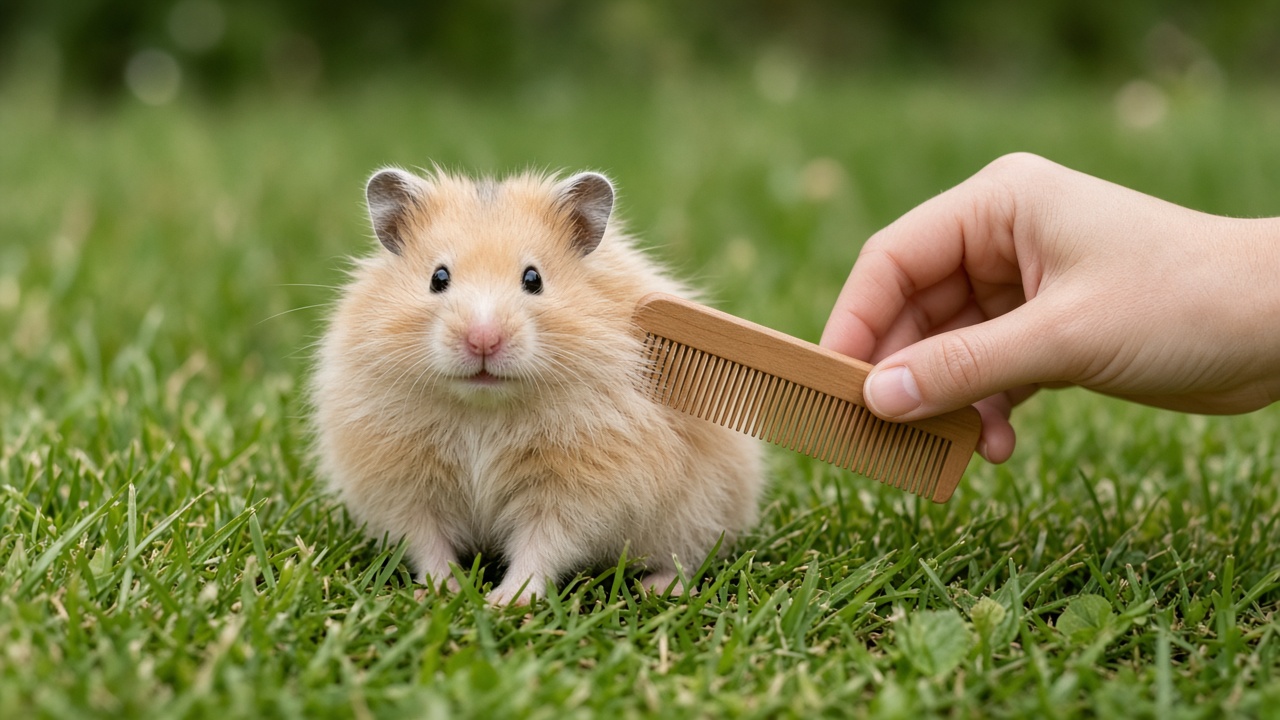
Quick answer: A teddy bear hamster is a long-haired Syrian hamster kept alone, not a dwarf breed. Give it a large single-level cage, a 12-inch solid wheel, and daily coat checks around the rear. Plan on two to three years of care, not a decade.
A teddy bear hamster is a long-haired Syrian that typically reaches 6 to 8 inches and lives 18 months to 3 years.
This page is a research-desk comparison of published species, cage, and product specs.
Selection rule: we cover only one already-weaned long-haired Syrian housed alone. We leave out dwarf hamsters, pair housing, breeding, and show-coat clipping.
What a teddy bear hamster actually is
The name is a pet-trade coat label, not a second species. Merck Veterinary Manual says Syrian fur mutations include longhaired animals also known as teddy bear hamsters.
That Merck chapter says testosterone sets coat length. From sexual maturity, males grow substantially longer hair than females.
MSD Veterinary Manual notes that most pet Syrians descend from three littermates caught in 1930. The body plan stays Syrian: cheek pouches, flank glands, and a solitary habit.
PDSA says Syrian hamsters live alone in the wild and will fight if housed together. A 2022 Journal of Small Animal Practice VetCompass paper from the Royal Veterinary College reviewed 16,605 pet hamsters.
Syrian hamsters were 73.45% of that sample. Bite injuries from other hamsters appeared in 5.88% of the 3,998 records read in detail. That is why this page skips pair housing.
Adult size and weight
MSD Veterinary Manual lists adult Syrians at about 6 to 8 inches (15 to 20 centimeters). Weight is 4 to 5 ounces (110 to 140 grams).
Merck Veterinary Manual is tighter on length. It gives head-and-body length as 170 to 180 millimeters, plus a 12-millimeter tail. Weight is again 110 to 140 grams, and females are larger than males.
The VetCompass paper reported a median adult Syrian bodyweight of 133 grams. The interquartile range was 100 to 160 grams.
Those clinic weights sit inside the MSD and Merck bands. Winter white dwarfs in the same paper had a median of 45 grams. Roborovski hamsters had a median of 25 grams.
A teddy bear hamster is the same size as a short-haired Syrian. Extra hair does not add body length. It does add coat volume you must keep clean.
Merck Veterinary Manual says young Syrians wean at about 20 days and can breed at 7 to 8 weeks. Gestation is 16 to 19 days. This page stops before breeding because those ages collide with the long coat.
Lifespan versus clinic records
MSD Veterinary Manual says pet hamsters may live from 18 months to 3 years. Merck Veterinary Manual gives Syrian lifespan as 2 to 3 years.
PDSA’s December 2024 hamster advice also says two to three years. Clinic records sit lower.
The VetCompass paper found a median age at death of 1.75 years across hamsters under care. The interquartile range was 0.83 to 2.20 years. The recorded range ran from 0.01 to 3.65 years.
That 1.75-year median is a hard number, not a slogan. Later clinic datasets could land higher.
Wet tail was the most common precise disorder in that sample, at 7.33%. It was also the most common precise cause of death, at 7.88%. Overgrown nails were 4.13%, and overgrown incisors were 3.98%.
Long hair does not change those risks by itself. It does hide a soiled rear. Daily checks matter more on a teddy bear than on a short coat.
Cage floor, height, and wheel
PDSA says most shop cages are not big enough. It cites the German Veterinary Association for Animal Welfare minimum of 100 by 50 centimeters of floor. It calls that a minimum, not a target.
Our research team compared published inner floors against that 100 by 50 centimeter line. We used maker-listed inches, not photos.
Niteangel Pet lists the Bigger World Medium inner size as 39.4 by 19.7 by 19.7 inches. That footprint is 776 square inches. It matches a 100 by 50 centimeter rectangle.
Niteangel Pet lists the Bigger World Large inner size as 47.2 by 19.7 by 23.6 inches. That footprint is 930 square inches. The maker says the line is recommended for most Syrian hamsters.
Kaytee lists the Crittertrail 2-Level Habitat at 11.5 by 20 by 16 inches. That base is 230 square inches. Kaytee lists bar spacing at 0.29 inch and includes a stock wheel.
PDSA prefers a large single level over a tall multi-level cage. Hamsters have poor eyesight and can fall.
The Kaytee 2-Level can house a hamster. It does not meet the PDSA-cited floor.
If a ready cage misses that floor, build a DIY hamster cage to 100 by 50 centimeters. Use a secure lid. Hamsters escape.
PDSA wants the enclosure tall enough for at least 25 centimeters (10 inches) of bedding. Merck Veterinary Manual goes further. It says 40 to 80 centimeters (about 15 to 30 inches) of bedding enhance Syrian welfare.
Niteangel Pet says Bigger World height is over 17.7 inches so bedding can stay deep. The Medium inner height is 19.7 inches. The Large inner height is 23.6 inches.
That height can hold PDSA’s 10-inch bed. It cannot hold Merck’s 15 to 30 inches unless lid toys come out.
PDSA says a Syrian wheel should be at least 30 centimeters (12 inches) across. The running surface must be solid, not bars.
Niteangel Pet lists Super-Silent drums at 8.2, 10, 11, and 12.6 inches. Only the 12.6-inch XL meets the PDSA 12-inch Syrian line. The 11-inch Large does not.
Niteangel Pet lists a dual ball-bearing hub. Base height adjusts from 1 to 4 inches. That range matters when bedding is deep.
| Product | Category | Listed size | Other listed attribute |
|---|---|---|---|
| Niteangel Bigger World Medium | Enclosure | Inner 39.4 × 19.7 × 19.7 in | Over 17.7 in height for bedding |
| Niteangel Bigger World Large | Enclosure | Inner 47.2 × 19.7 × 23.6 in | Maker lists it for most Syrians |
| Kaytee Crittertrail 2-Level Habitat | Enclosure | 11.5 × 20 × 16 in | 0.29 in bar spacing; includes a wheel |
| Niteangel Super-Silent Wheel XL | Wheel | 12.6 in drum | Dual ball bearings; 1–4 in base height |
| Oxbow Essentials Hamster & Gerbil Food | Food | 15.00% protein min; 4.50% fat min | 1/3 cup daily for an adult large hamster |
| Kaytee Clean & Cozy White | Bedding | 24.6 L, 49.2 L, or 85 L bags | Absorbs up to 6× its weight; 99.9% dust-free |
Bedding, temperature, and cleaning
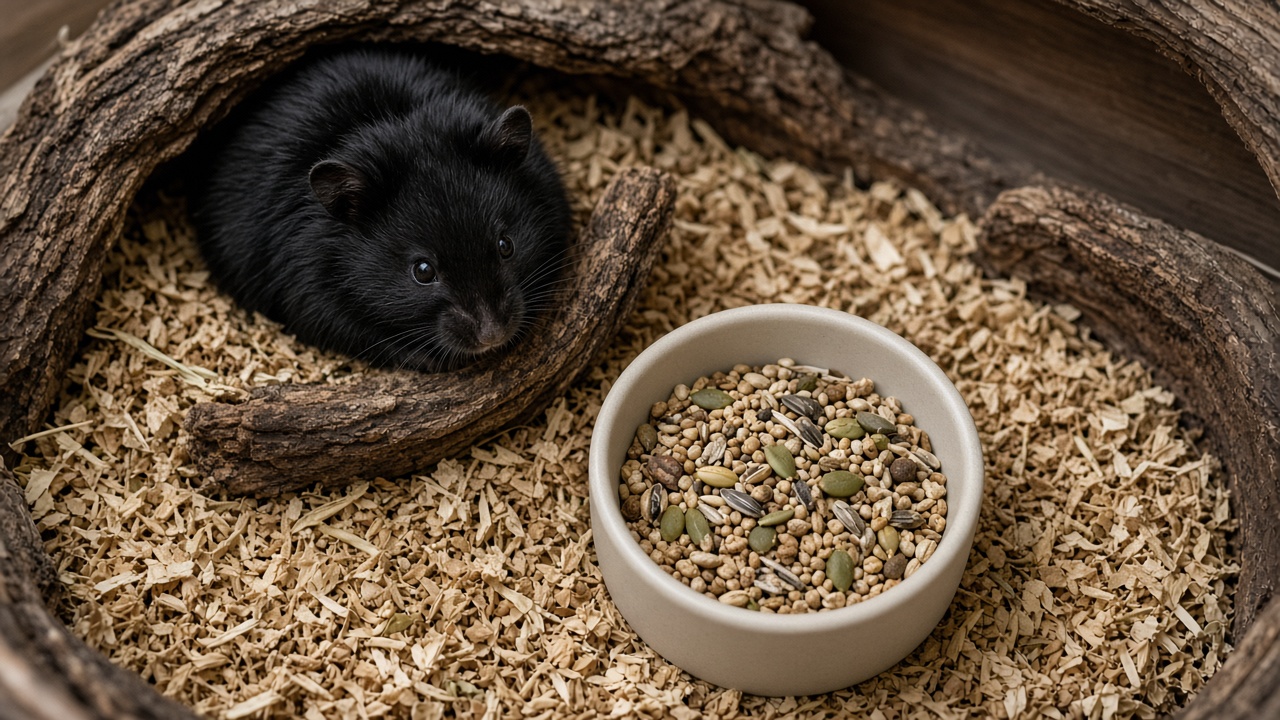
PDSA wants no less than 25 centimeters (10 inches) of bedding that holds a tunnel. Paper-based bedding can stand alone. Aspen, spruce, or hemp should be mixed with paper so burrows do not collapse.
Kaytee lists Clean & Cozy White as paper bedding that absorbs up to six times its weight in liquid. The same page lists it as 99.9% dust-free and fragrance-free. Bag volumes are 24.6, 49.2, and 85 liters.
PDSA warns against cotton wool, kapok, bamboo fluff, and other loose fibers. Those fibers wrap legs and can block a gut if eaten. Scented bedding and newspaper ink are also on the PDSA unsafe list.
Put the cage in a quiet room. PDSA wants a steady 18 to 21°C (64 to 70°F), away from drafts and sun. If the cage overheats, the hamster cannot leave.
If the room gets too cold, PDSA says the animal may enter torpor. Merck Veterinary Manual says Syrian hamsters often hibernate below 5°C (41°F). They do not fatten first and can starve if they do not wake to eat.
PDSA splits cleaning into a daily spot pass and a fuller reset. Small cages often need a full clean weekly. Larger setups may wait a few weeks.
Keep some dry, unscented old bedding so the cage still smells like home. For the step sequence, use our how to clean a hamster cage guide. For timing by cage size, use how often to clean a hamster cage.
Long hair holds urine and feces. Spot-clean the toilet corner every day. Do not dump the whole burrow if it is dry and intact.
Coat care for long-haired Syrians
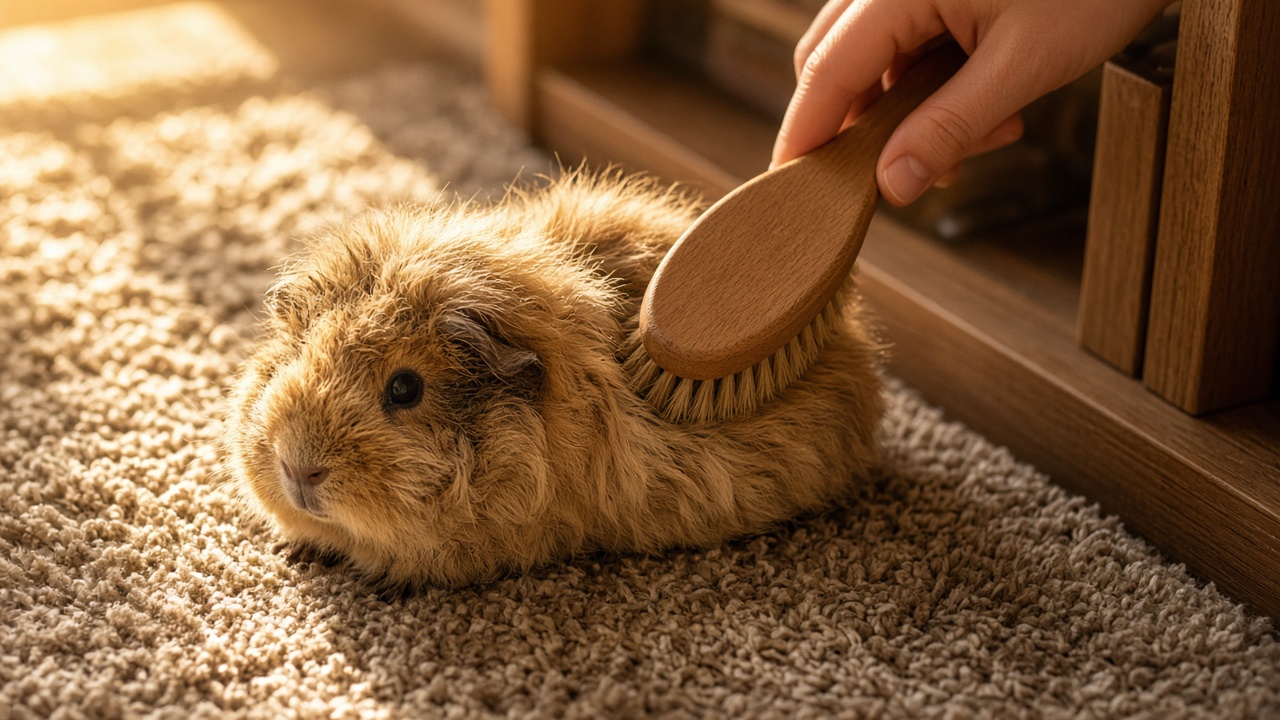
A teddy bear hamster grooms itself. The long rear coat still mats. Feces and bedding cling under the tail.
Check the hindquarters every day. That is a look, not a bath. If you see a clump, lift it with a wide-tooth comb.
Do not yank mats. Brush the belly and rear a few times a week with a soft small-animal brush. Work when the hamster is awake.
PDSA says never handle a sleeping hamster. It may bite. Males carry more coat after maturity, per Merck Veterinary Manual, so they need more comb time.
Do not bathe a hamster in water unless a clinician directs it. Water soaks the undercoat and chills a 110 to 140 gram body. A dry wipe on a soiled patch is safer.
Watch for wet tail signs that PDSA lists: diarrhea, a wet rear, low appetite, and low energy. Long hair can hide the wet. Part the fur, and treat wet skin as urgent.
Overgrown nails were common in the VetCompass set. Long hair hides nails too. PDSA says trim only the white tip, because the pink bed holds blood.
Food labels and daily amounts
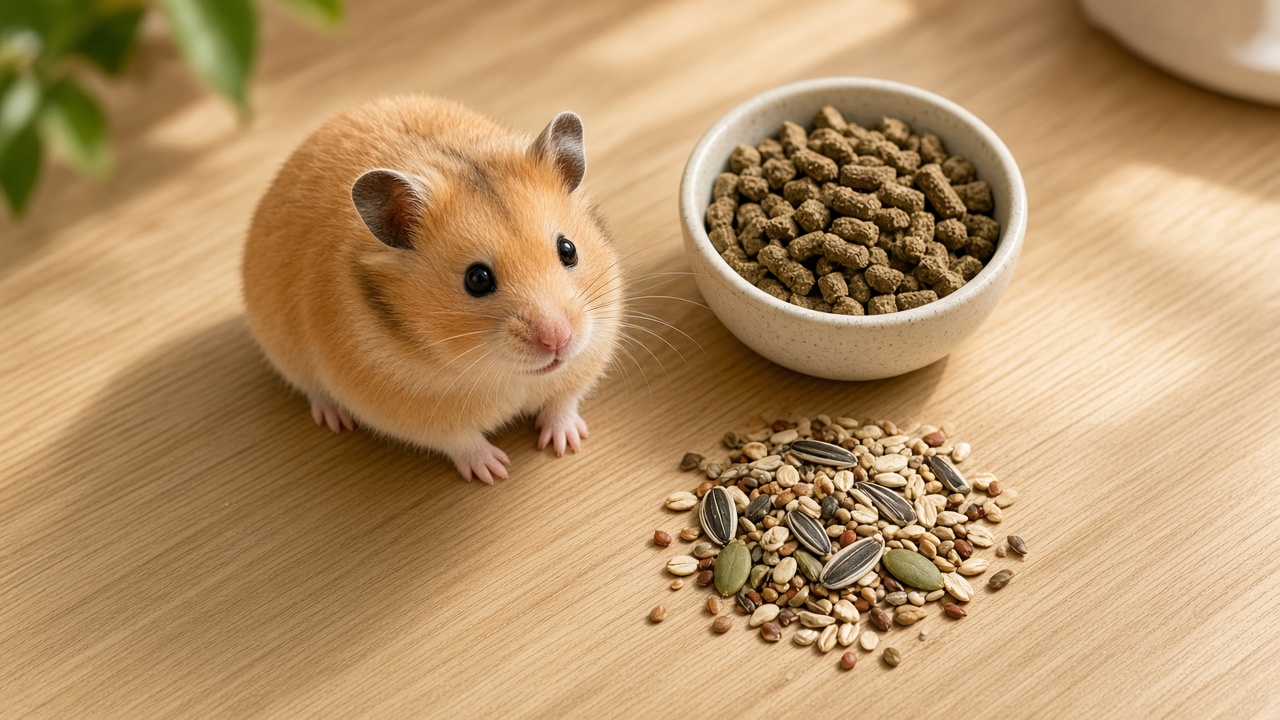
Hamsters are omnivores. PDSA wants a uniform pellet as the base. Muesli mixes let them pick sugar and leave fiber.
AAFCO’s reading-labels page recognizes only dog and cat nutrient profiles, plus dog and cat feeding protocols. There is no AAFCO hamster nutrient profile on that page.
AAFCO still requires four basic guarantees on pet food. Those are minimum crude protein, minimum crude fat, maximum crude fiber, and maximum moisture. Read those four numbers.
Oxbow Animal Health lists Essentials Hamster & Gerbil Food at 15.00% crude protein minimum and 4.50% crude fat minimum. Crude fiber is 10.00% minimum and 15.00% maximum. Moisture is 10.00% maximum.
Oxbow lists calcium at 0.60% to 1.00% and phosphorus at 0.40% minimum. The feeding table gives an adult large hamster 1/3 cup a day. Young, pregnant, or nursing large hamsters get unlimited feed.
Oxbow warns that hamsters hoard. Check stashes before you add more. PDSA adds a teaspoon or two of washed vegetables a day, not a bowl.
Occasional treats can include a bit of boiled egg or mealworms. Scatter pellets so the hamster works for them. Merck Veterinary Manual says to feed a complete pelleted hamster diet and to avoid generic seed mixes.
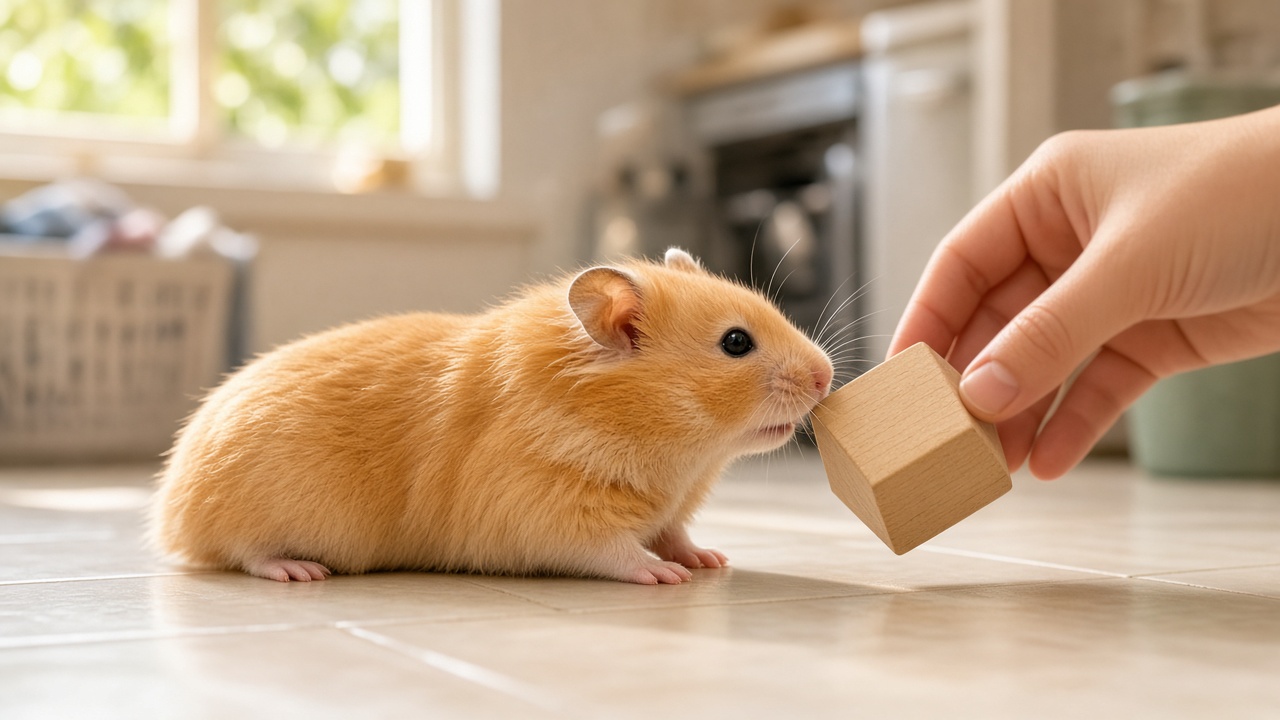
Offer free-choice hay for nesting, as Oxbow notes. Hay is not the calorie staple. PDSA lists untreated softwood, cardboard, and gnaw blocks for teeth.
FAQ
Is a teddy bear hamster a different species from a Syrian hamster?
No. Merck Veterinary Manual names longhaired Syrians as teddy bear hamsters. The body, lifespan band, and solitary housing rule are Syrian rules. Only the coat is longer.
How big does a teddy bear hamster get?
MSD Veterinary Manual lists 6 to 8 inches and 110 to 140 grams. Merck Veterinary Manual lists 170 to 180 millimeters and the same gram range. The VetCompass Syrian median was 133 grams.
How long do teddy bear hamsters live?
Manuals cluster at 18 months to 3 years. The VetCompass clinic median was 1.75 years. Plan the cage, diet, and coat care for that short window.
Can two teddy bear hamsters share a cage?
Not on this page. PDSA says Syrians fight, and fights can kill. VetCompass recorded bite injuries from other hamsters in 5.88% of reviewed records.
What cage size does a teddy bear hamster need?
PDSA cites 100 by 50 centimeters of floor as a published minimum. The Niteangel Bigger World Medium inner floor meets that rectangle. The Kaytee Crittertrail 2-Level base of 11.5 by 20 inches does not.
How often should I brush a teddy bear hamster?
Check the rear daily. Brush the belly and hindquarters a few times a week. Males with the longer Merck-described coat need more passes.
What should I feed a teddy bear hamster?
Use a uniform hamster pellet and read the four AAFCO guarantees. Oxbow lists 15.00% protein and 1/3 cup a day for an adult large hamster. Add only a teaspoon or two of vegetables, as PDSA states.