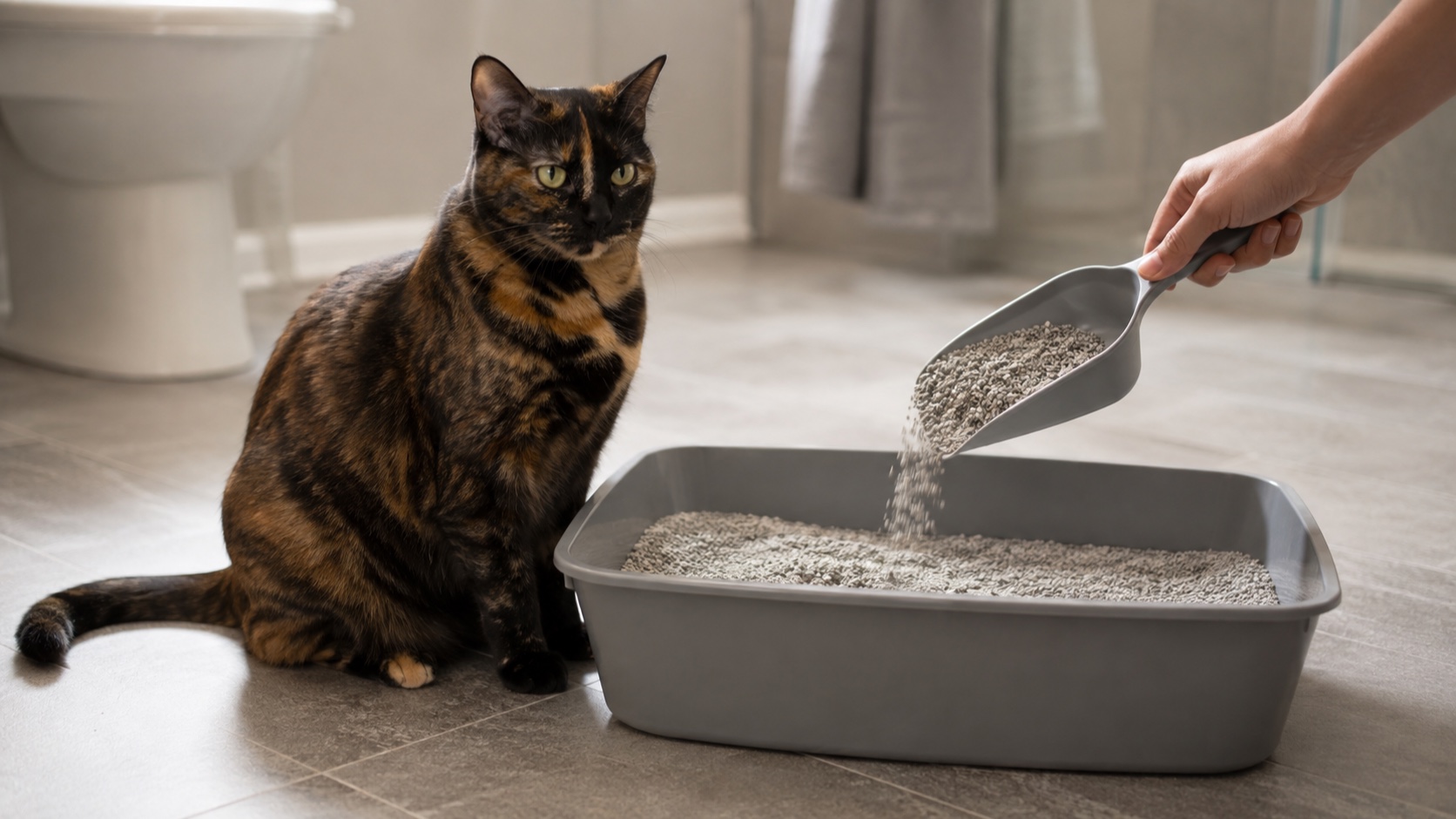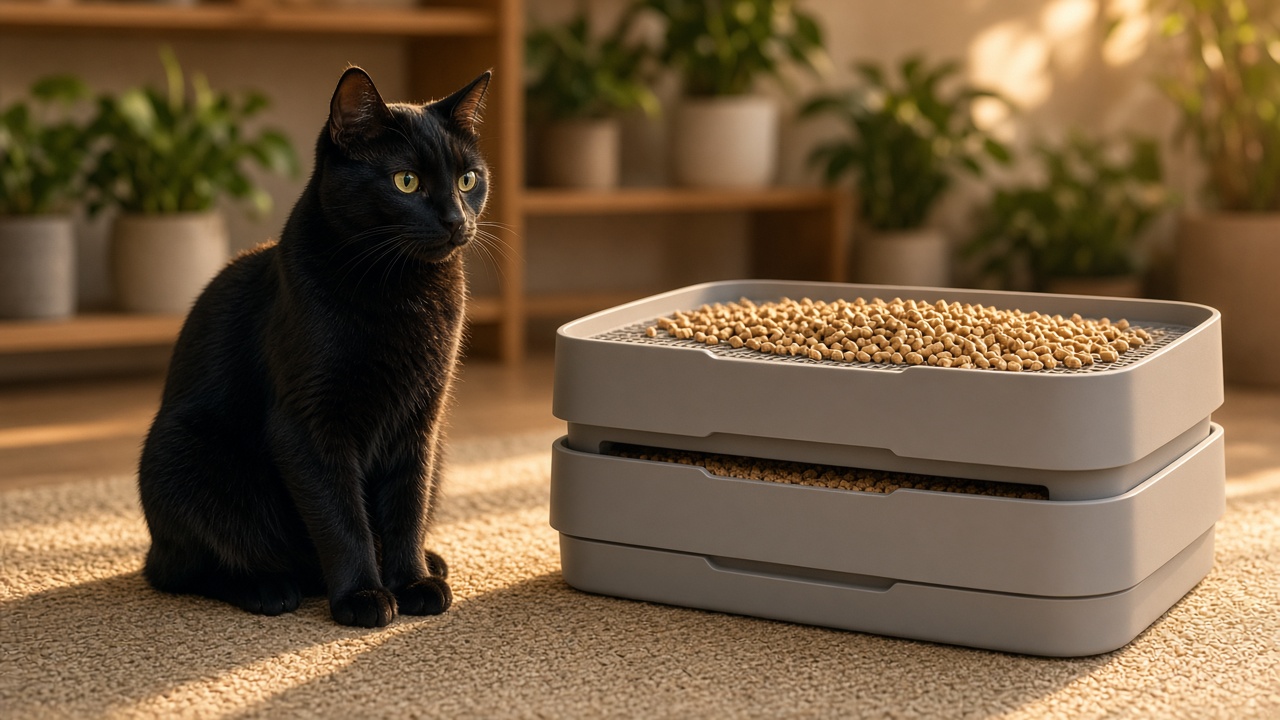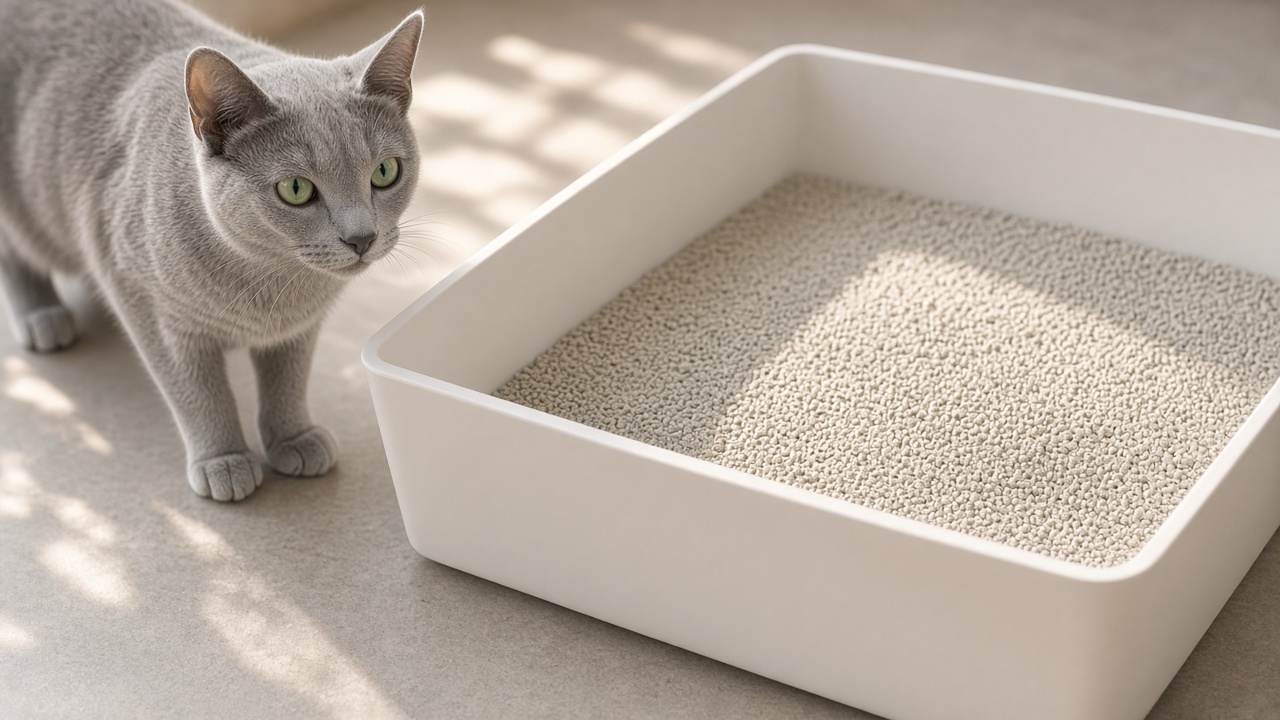
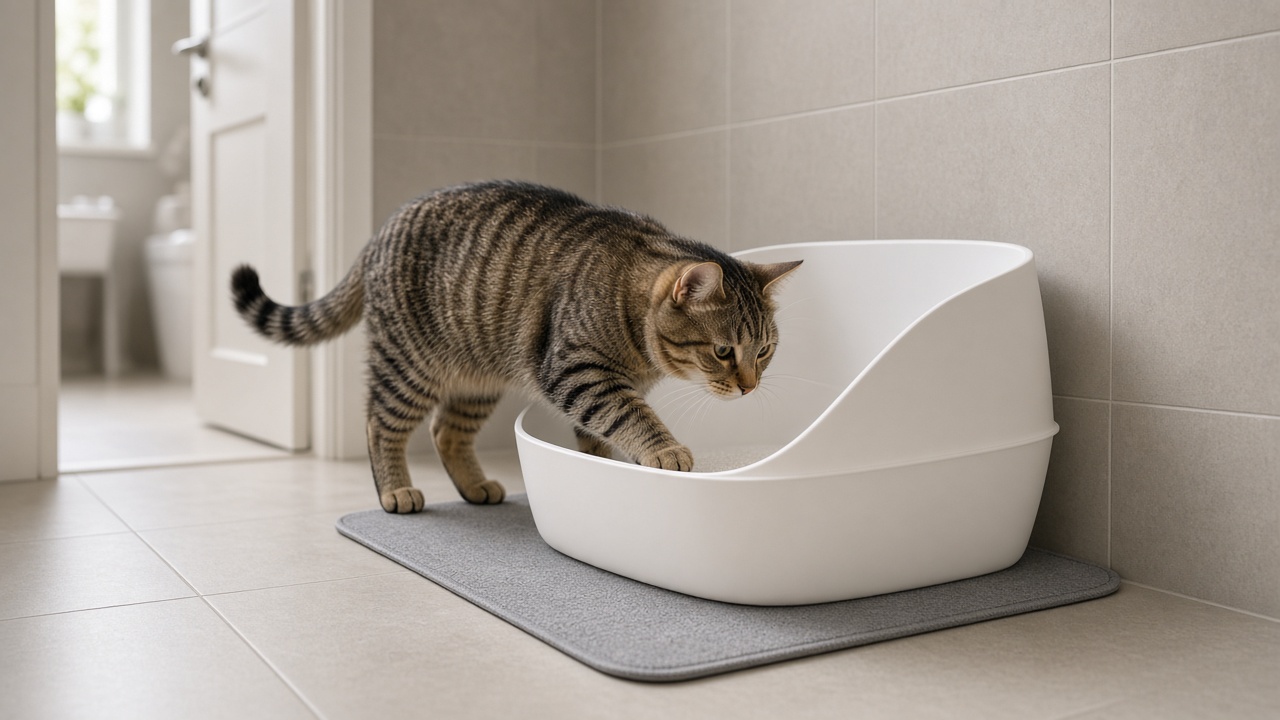
Quick answer: Place the box in a quiet room your cat already uses, with the door left open day and night and the food bowls at least one room away. Add a second box on another path. Skip closed guest rooms and washer-side nooks.
The litter box belongs in an always-open, low-traffic room with two exit paths, never beside a washer.
This page is a room-by-room placement guide built from published feline-care pages and current maker specs.
The Two-Doorway Rule We Used
Our research team used one selection rule for every room below. We call it the Two-Doorway Rule.
A room stays in this guide only if a cat can reach the box without crossing the feeding station. The same room must offer a second way out. Rooms that stay shut more than one hour a day are out.
Garages, open balconies, and washer-side dead ends are out. That is why a spare bath can beat a laundry closet. It is also why a hallway alcove can beat a locked guest room.
The American Animal Hospital Association, in its 2021 feline life-stage notes, asks for boxes in different quiet spots. Those spots need an escape route. The ASPCA says the same in plainer words.
Place boxes away from high traffic. Keep them away from spots where a cat feels trapped.
The Ohio State University Indoor Pet Initiative adds a path check. Do not make a cat climb over furniture or another animal. A box behind a couch fails that test.
So does a box next to a dog bed. We followed those published checks.
Bathroom Placement
An always-open bathroom is the easiest room that still passes the rule. Tile wipes clean. Food already sits in another room.
The door is the failure point. A closed bath is a locked toilet. If people shut that door for showers or guests, the box fails the one-hour lockout test.
Leave the door ajar. A latch that holds it open works. A baby gate that a cat can pass also works.
Watch the fan and the pipes. Ohio State’s Indoor Pet Initiative warns against sudden noise from appliances and air ducts. A bath fan that roars on a timer can startle a cat mid-use.
Place the box on the wall opposite the fan. Skip the space under a vanity. That same Ohio State page says tight spots under sinks block a cat from standing and turning.
Size still matters in a small bath. The American Animal Hospital Association sets a size floor. The box should be at least one and a half times the cat’s length from nose to tip of tail.
Most store boxes fall short. If your cat is long, start with a larger pan. Our guide to boxes for large cats covers those sizes.
Automatic units need a dry outlet. Whisker lists a 22 by 27 inch footprint and a 29.5 inch height for Litter-Robot 4. That unit will not slide under a vanity.
It will sit on open tile if two sides stay clear.
Laundry Rooms and Utility Closets
Laundry rooms fail more often than they look. They feel private to people. They feel loud and trapped to cats.
The ASPCA names the washer and dryer as intimidating spots. Ohio State’s Indoor Pet Initiative says the same about appliances that start without warning. A spin cycle is that warning.
A utility closet with one door is a dead end. It fails the Two-Doorway Rule even when the machines are off. A cat blocked by a dog or a person has no second exit.
If the laundry room is your only spare floor, treat it as a last resort. Put the box on the far wall from the machines. Keep the hall door and a second path open.
Watch the first week. If the cat pauses at the doorway, move the box that day. Do not hide the box beside the dryer.
Neither a low pan nor a hooded box fixes a loud room. Move the box.
Bedrooms, Offices, and Spare Rooms
A spare bedroom that stays unlocked is a strong second site. It is quiet. It usually sits one closed door away from food.
The Cornell Feline Health Center says a cat that prefers a new spot may be avoiding the old one. Place a box where the cat already goes. Then move it a few inches a day if you must shift it.
Stop if use drops. Slide it back to the last working spot.
Your own bedroom is riskier. People shut that door at night. That lockout fails our rule.
If you sleep with the door open, and the cat already spends nights there, the room can work. If the door closes, pick another room.
Home offices fail when calls shut the door. They work when the door stays open. Sit the box on a side wall, not in a three-sided cubby.
Cornell asks for more than one way out. Do not pin the box between a desk, a wall, and a cabinet.
Kittens and older cats need a low step. The ASPCA notes that geriatric cats struggle with high sides and top-entry lids.
Modkat lists a 6.25 inch front-entry height from the floor on the Modkat XL. Keep the front-entry panel on for a senior cat. Leave the top-entry lid for younger cats that jump cleanly.
Living Rooms Without Hiding the Box
A living room can pass the Two-Doorway Rule. Many living rooms fail a different test. People hide the box, then block the exits.
Do not slide the box behind a sofa. Ohio State’s Indoor Pet Initiative flags that exact layout. The path is long, and ambush is easy.
Do not lock the box inside a cabinet with one small hole. That is a covered trap with no second exit. If you want furniture around a box, leave two open sides.
Our enclosure furniture guide walks through those layouts.
Open living rooms need a box that does not spray onto baseboards. IRIS USA lists its Top Entry Cat Litter Box at 20.8 by 16.1 by 14.6 inches. That compact lid can sit along a side wall.
Top entry is a poor match for kittens and stiff seniors. Keep a second, low-entry box on another path.
Catit lists its Jumbo Airsift hooded box at 22.4 by 19.7 by 18.3 inches. The door is 10.4 by 9.6 inches. The hood cuts scatter in a shared room.
Cornell notes that covers also hold odor. Scoop daily. The ASPCA says most cats dislike lids and liners.
The ASPCA says put food bowls somewhere other than right next to the box. One doorway of separation is our floor. Same-wall placement next to a feeder fails.
Stairs, Basements, and Multi-Floor Homes
The ASPCA says a multistory home may need a box on each level. Ohio State’s Indoor Pet Initiative is blunter. Boxes must sit on each level.
Cats do not like a long walk to the nearest box. A basement-only box fails cats that live upstairs. Cold concrete and furnace noise add two more reasons to skip it.
If the basement is finished, quiet, and on a daily path, it can hold one extra box. It should not be the only box.
Stairs are the delay. An older cat that pauses on landings needs a box on the sleep floor. Do not make that cat descend two flights after midnight.
Side-by-side boxes on one landing count as one site. The American Animal Hospital Association wants boxes in different locations. Put the extra box in another room.
Two cats need three boxes. The ASPCA’s example is plain. Three cats need four boxes.
Split those boxes across floors and paths. Do not line them along one wall.
Box Shapes That Fit Real Rooms
Placement fails when the box cannot fit the room you chose. Our research team compared published specs from five currently sold models. We used maker pages only.
Three of the five boxes list a footprint longer than 22 inches. Those three need a clear wall, not a leftover corner behind a hamper.
Whisker lists Litter-Robot 4 at 22 by 27 inches and 29.5 inches tall. Empty weight is 24 pounds. Whisker rates the unit for cats from 3 to 25 pounds.
The unit needs a 15 volt DC outlet.
PetSafe lists the ScoopFree Crystal Pro Legacy at 27.6 by 19.1 inches. Front-entry height is 16.0 inches. PetSafe says one tray can last up to 30 days in a single-cat home.
Leave the unit unplugged, PetSafe says, until a kitten is 6 months old.
Modkat lists the Modkat XL at 21.0 by 16.5 by 17.0 inches. The top opening is 10.25 inches wide. This is the shortest footprint in our set.
Automatic units change the outlet map. Start with rooms that already have a plug. Then read our automatic litter box guide.
| Model | Maker | Footprint | Height | Entry | Power |
|---|---|---|---|---|---|
| Litter-Robot 4 | Whisker | 22 × 27 in | 29.5 in | Front, 15.75 × 15.75 in | 15 V DC |
| ScoopFree Crystal Pro Legacy | PetSafe | 27.6 × 19.1 in | 16.0 in hooded | Front or top hood | Plug-in |
| Modkat XL | Modkat | 21.0 × 16.5 in | 17.0 in | Top 10.25 in or front 8.3 × 9.8 in | None |
| Top Entry Cat Litter Box | IRIS USA | 20.8 × 16.1 in | 14.6 in | Top | None |
| Airsift Jumbo hooded box | Catit | 22.4 × 19.7 in | 18.3 in | Front door 10.4 × 9.6 in | None |
Depth of litter is a placement issue too. The ASPCA says cats usually prefer 1 to 2 inches, not 3 to 4. Ohio State’s Indoor Pet Initiative uses about 2 inches.
The Centers for Disease Control and Prevention says to change the box daily. The Toxoplasma parasite, the CDC writes, does not become infectious until 1 to 5 days after a cat sheds it.
Daily scooping is a placement habit. A box you will not walk to every day is in the wrong room. The ASPCA reports that at least 10% of all cats develop elimination problems.
FAQ
How many litter boxes do I need?
Use one box per cat, plus one extra. The ASPCA’s example is three cats and four boxes. Split those boxes across rooms, not one closet.
Can I put a litter box in the bathroom?
Yes, if the door stays open and the box is not jammed under the sink. Tile is easy to wipe. If people shut that door for long showers, add a second box on an open path.
Is the laundry room a bad place for a litter box?
It is a weak first choice. The ASPCA warns against placing a box next to a washer or dryer. Use that room only if it has two exits and the box sits on the far wall.
Should I hide the box in a closet or cabinet?
No, not if the closet has one door and no second exit. Ohio State’s Indoor Pet Initiative warns against tight spots. Cornell asks for a wide view when ambush is a risk.
How far should the box sit from food and water?
Keep at least one doorway between the box and the bowls. The ASPCA says not to put food right next to the box. Move the bowls first if they share a wall with the box.
Can two boxes sit side by side?
They can sit near each other. They should not be your only pair. The American Animal Hospital Association wants boxes in different locations.
Where should a box go in a studio apartment?
Use the bathroom if the door can stay open. If the bath is too small, use the living-area wall farthest from the kitchen. A compact box such as the IRIS USA top-entry model or the Modkat XL fits a short wall.