6 Best Cat Food and Water Dispensers: 2026 Verdict & Reviews
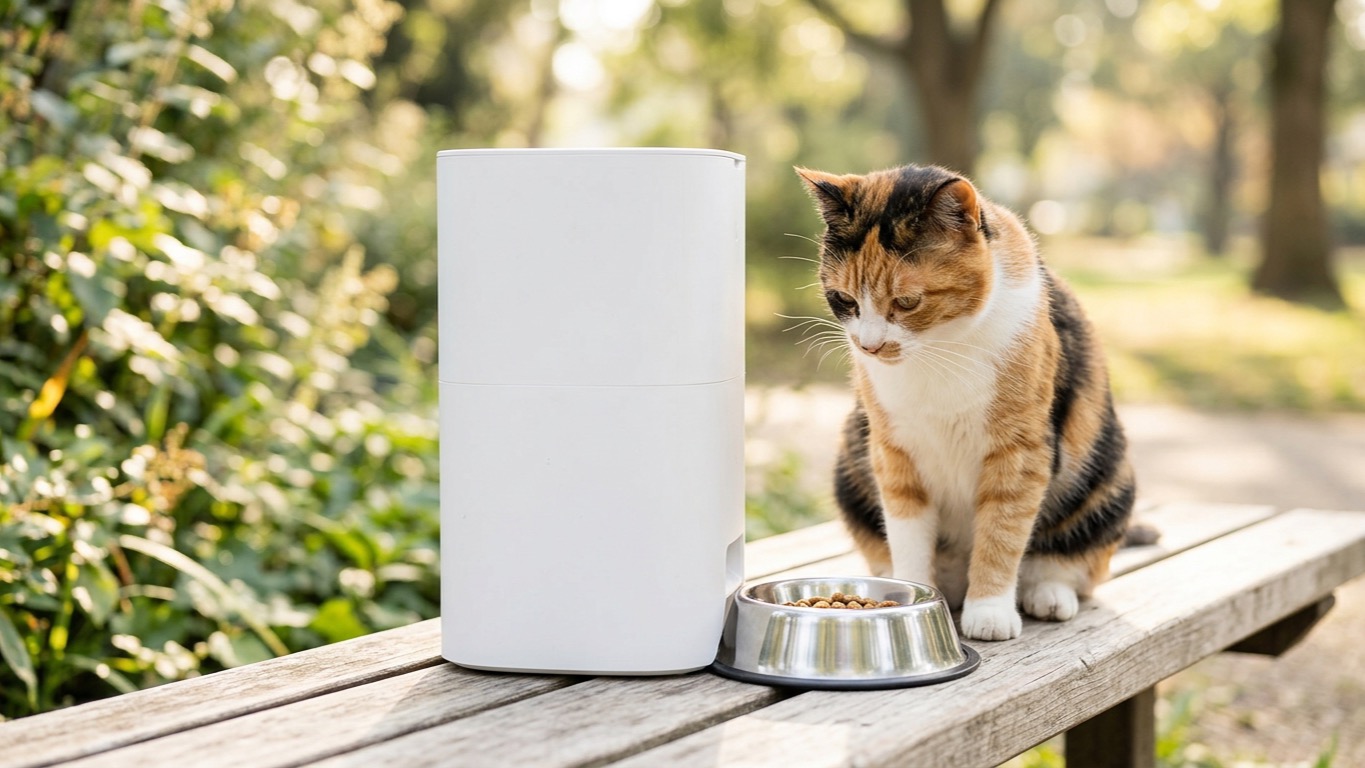
The best cat food and water dispenser is two jobs glued into one footprint: a food hopper that either free-feeds or portions, plus a water reservoir that is either still gravity or a moving fountain. Cornell Feline Health Center: cats often drink little on their own; wet food and a clean water station both matter; food left out for grazing should be replaced every day. AAFP’s 2018 feeding-program consensus: cats prefer to eat often and alone; feeding stations should be visually separated and not next to the litter box. A combo tower that keeps kibble in the bowl all day is a buffet. APOP’s 2022 U.S. survey put about 61% of U.S. cats in the overweight or obese band. Gravity food is how that number happens.
PetBench Combo Dispenser Desk (listing-page tally, August 2026): we mapped the six cards on this URL onto three mechanisms we could actually name from listing language. Three are gravity food + gravity water (HWONMTE, ZOMISIA, Amazon Basics). Three are programmable / app / hybrid class (CORGOTE, iPettie FW54, ROJECO). Zero of the six print an RFID or microchip lock. Zero are wet-food machines. Stainless shows up as a bowl upgrade on the HWONMTE card; plastic is the Amazon Basics watch-out. Capacities we could load from listing blurbs: HWONMTE ~6 lb food / 1 gal water; ZOMISIA 0.8 gal water; CORGOTE up to six meals/day language.
A combo unit is a footprint. It is not two independently locked diets. Two-cat theft is the two-cat feeder page.
Our guides are reader-supported. This article may contain affiliate links. As an Amazon Associate we may earn a commission if you buy through links, at no extra cost to you.
Quick picks at a glance
- Steel-bowl gravity: HWONMTE Automatic Cat Feeder & Waterer — listing: stainless bowl, ~6 lb food, 1 gal water. Hand-wash. No portion clock.
- Programmable + fountain: CORGOTE Automatic Feeder & Water Fountain — meal schedule language, multi-stage filter pitch, dual-power class. Setup is fiddly on owner reports.
- App remote: iPettie FW54 WiFi Automatic Feeder & Waterer — Wi-Fi schedule, sealed-ring / desiccant alerts on the listing. Needs a stable radio.
- Rotatable gravity: ZOMISIA Gravity Cat Feeder & Waterer — 180° footprint trick, 0.8 gal water. Refill more often.
- Hybrid schedule + siphon: ROJECO 2-in-1 Automatic Feeder & Waterer — transparent barrels, BPA-free pitch, siphon can be slow.
- Budget gravity: Amazon Basics Gravity Feeder & Waterer — cheap, transparent hopper, plastic bowl that holds odor.
If you only need moving water, skip the food hopper and use a dedicated pet water fountain or stainless steel cat fountain. If you only need a clock for two cats, a combo gravity tower is the wrong machine: best cat feeder for two cats. Wet pâté is not a hopper job: automatic wet-food feeders.
What best cat food and water dispenser setups actually include
Three mechanisms, not six winners.
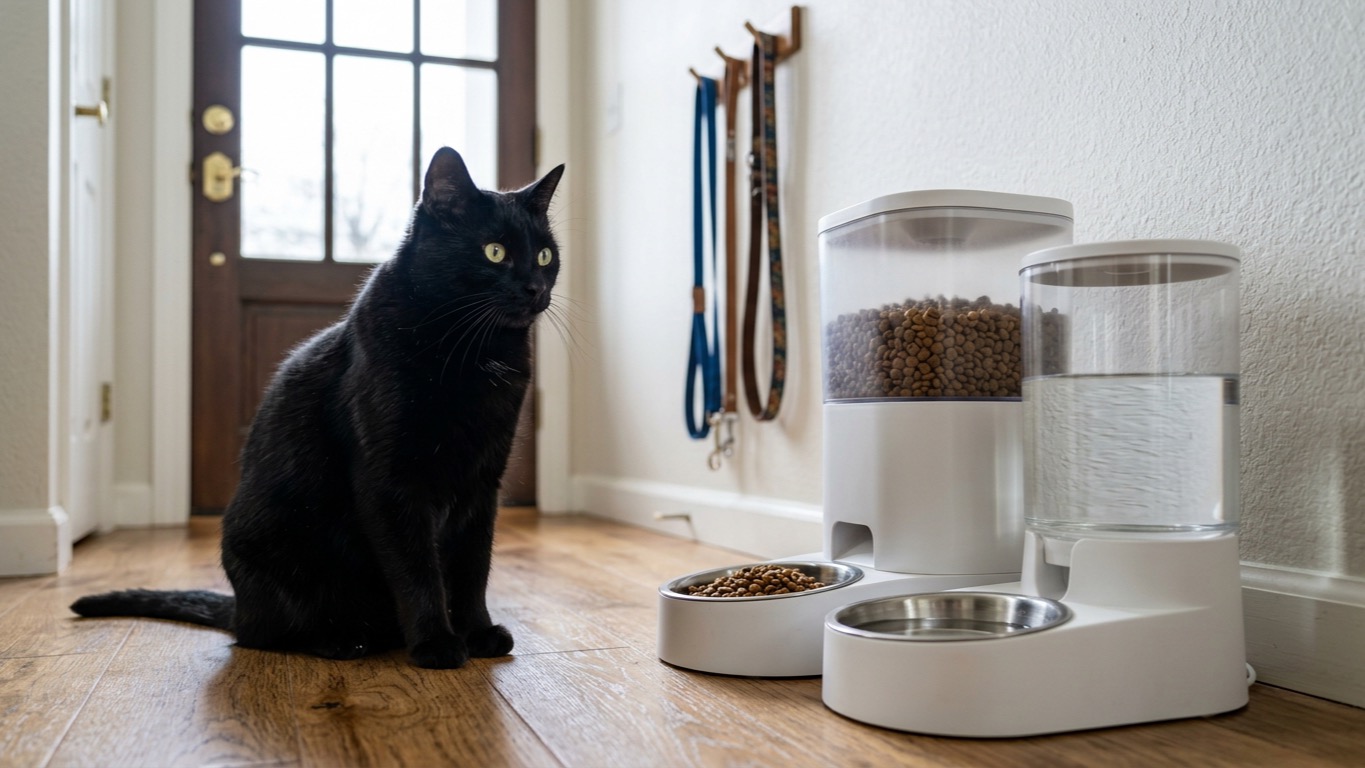
Gravity food uses a reservoir and a bowl. As the cat eats, more kibble slides down. There is no calorie target. The hopper is a buffet with a lid. Cornell’s grazing rule still applies: replace stale food daily. A sealed hopper slows staleness. It does not stop overeating.
Timed / app food uses a rotor or auger. CORGOTE and iPettie FW54 listings put meals on a clock. That is the only mechanism on this card set that can hit a written kcal number — and only if you weigh the portion, not if you trust a “click.” Dual power (mains + battery) is the outage rule. A Wi-Fi drop is not a feeding failure if the schedule is stored on the unit; it is a feeding failure if the unit needs the cloud to motor.
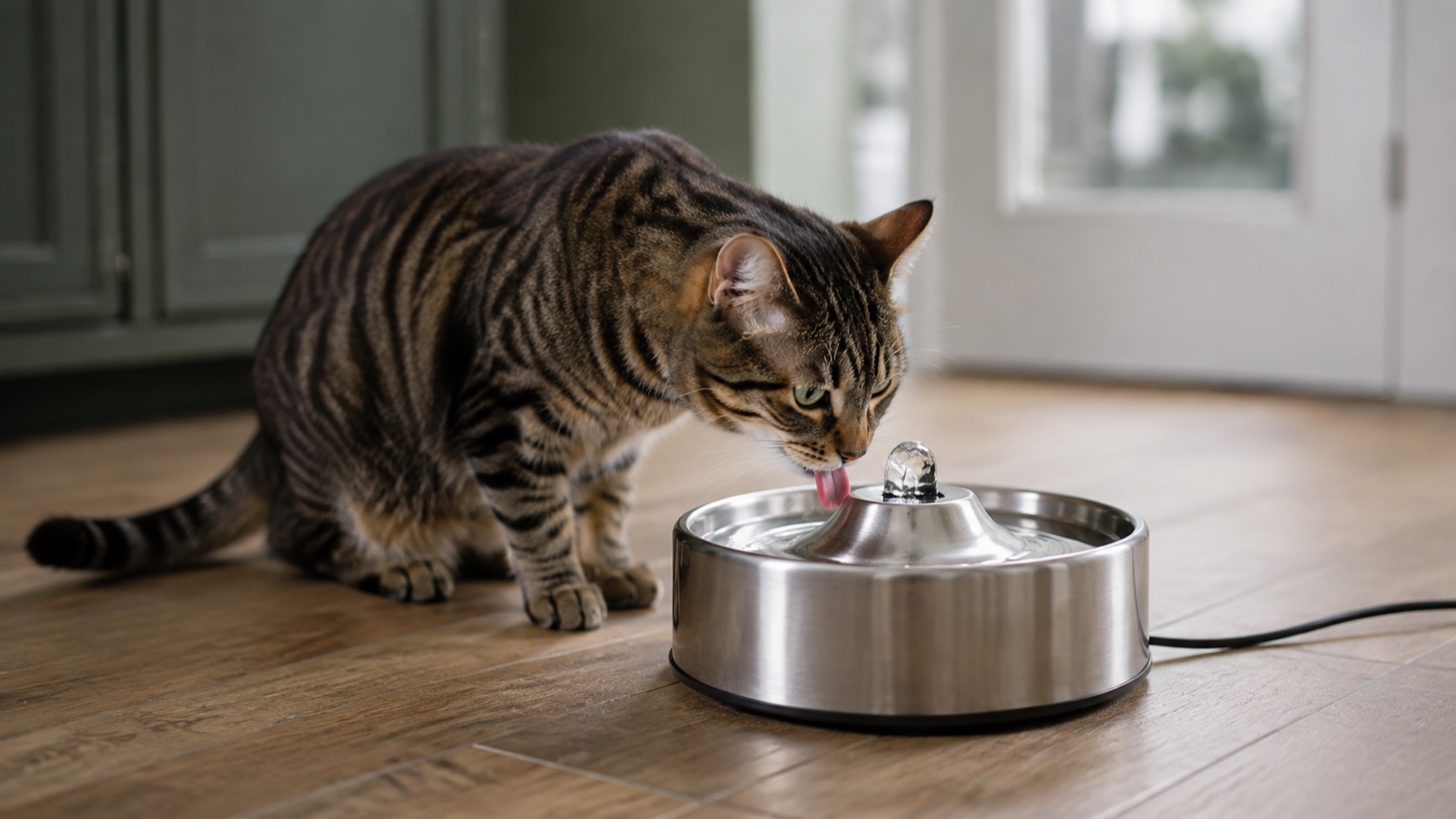
Water is either still gravity or a pump fountain. Moving water is an owner-preference tool for cats that ignore a bowl. It is not a medical device. Filters clog. Pumps die silently. AAFP and Cornell both want a plain bowl backup when you take a fountain apart. Cats habituated to a stream sometimes refuse still water after a dry pump — keep a bowl in another room during filter day.
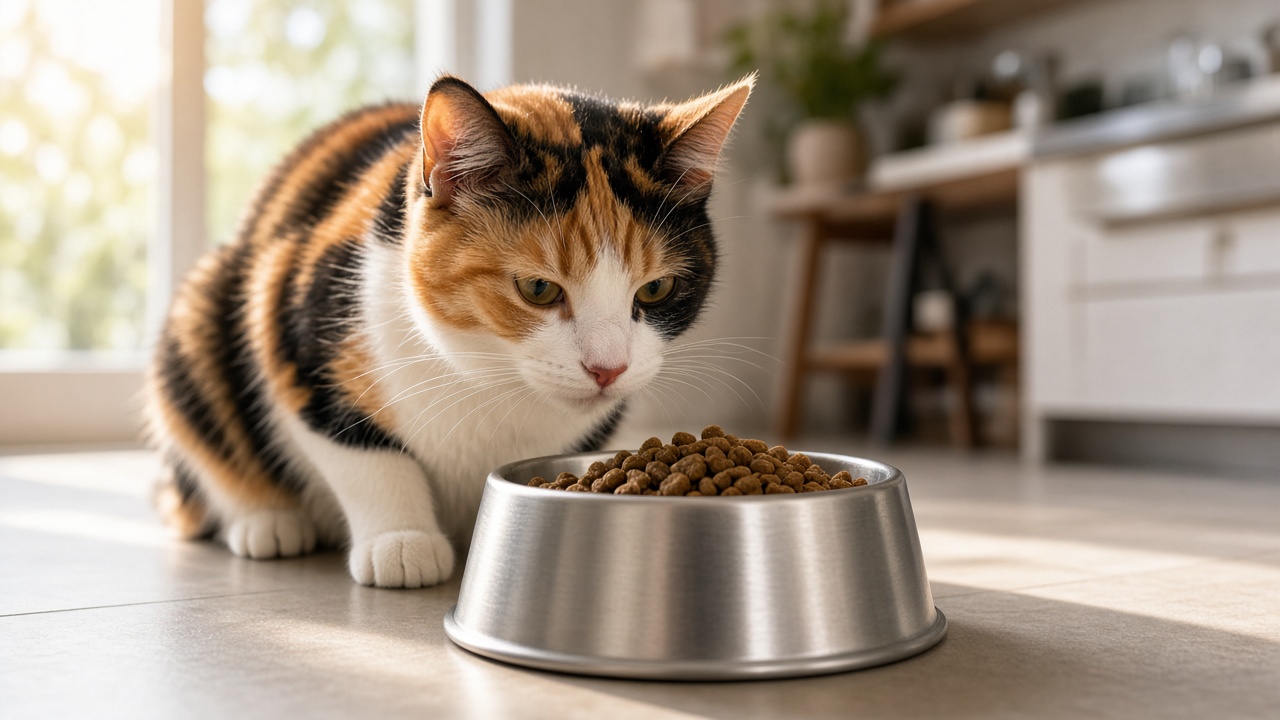
Bowl height is posture, not branding. Low wide bowls reduce whisker-cram themes in owner reports and suit seniors with neck pain better than a deep plastic well. Match the lip to the cat you have, not the listing photo.
What ”
Combo Dispenser — August 2026
These tables are desk compilations from the six product cards and the listing blurbs we could load. Capacities and prices move. A number we could not load is not a desk fact.
Table 1 — Six cards vs mechanism
| Product | Mechanism | Food control | Water type | Listing capacity language | Desk fit |
|---|---|---|---|---|---|
| HWONMTE Automatic Cat Feeder & Waterer | Gravity + gravity | Buffet | Still reservoir | ~6 lb food / 1 gal water; stainless bowl | One cat, you will weigh elsewhere or accept free-feed |
| CORGOTE Automatic Feeder & Water Fountain | Clock + pump | Up to 6 meals/day language | Fountain + filter pitch | Dual-power class | Owners who will clean a pump weekly |
| iPettie FW54 WiFi Automatic Feeder & Waterer | App clock + reservoir | Remote portions | Sealed / desiccant alerts on food side | Dual-power class | Homes with boring-stable Wi-Fi |
| ZOMISIA Gravity Cat Feeder & Waterer | Gravity + gravity | Buffet | Still, 0.8 gal | 180° rotatable footprint | Tight corners; refill twice in busy homes |
| ROJECO 2-in-1 Automatic Feeder & Waterer | Hybrid schedule + siphon | Programmable meals language | Siphon water | Transparent barrels | Owners who watch the LED / level line |
| Amazon Basics Gravity Feeder & Waterer | Gravity + gravity | Buffet | Still | Transparent hopper; anti-skid feet | Lowest cash outlay; plastic bowl hygiene watch-out |
Desk stat: 3 of 6 cards are pure gravity food. Those three cannot enforce a weight plan. If the household problem is obesity, a combo tower is a footprint upgrade on a buffet. Start with cat food for weight loss and a scale.
Table 2 — Daily cost of the habit, not the plastic
The plastic is cheap. The habit is the bill. Planning sheet uses one indoor cat at ~200 kcal/day and grocery dry at a midpoint ~$0.25–$0.45/day, fountain filters at maker intervals.
| Setup | Hardware band (this card set) | Food control | Water chore | Failure mode |
|---|---|---|---|---|
| Gravity + still | Amazon Basics / ZOMISIA / HWONMTE | None | Dump and refill 1–2×/day | Biofilm in the water well; stale kibble in the bowl |
| Clock + fountain | CORGOTE / iPettie class | Portions if you weigh clicks | Filter + pump wash weekly | Silent pump death; Wi-Fi drama |
| Hybrid siphon | ROJECO | Schedule language | Siphon lag | Manual top-off; power loss if no backup |
| Dedicated fountain + separate feeder | Not one SKU | Choose the feeder page | Choose the fountain page | Two footprints, fewer jammed 2-in-1 seams |
Desk rule: a 2-in-1 saves counter space. It couples two failure modes. When the water side grows slime, people delay washing the food side “because it is one unit.” Wash both.
Table 3 — Hygiene interval (Cornell + maker-class chores)
| Surface | Cornell / AAFP frame | Desk interval we would print | Skip this and you get |
|---|---|---|---|
| Grazing dry in the bowl | Replace leftover food daily | Empty the bowl lip daily; hopper is not the bowl | Stale fat smell; refusal |
| Wet food | Same-day surface | Do not load pâté in these hoppers | Jammed auger; spoiled meat |
| Fountain / reservoir | Biofilm is normal in standing water | Full wash weekly; filter on the maker card | Slimy pump; cat walks away |
| Stainless bowl (HWONMTE) | Non-porous vs scratched plastic | Dishwasher or hot soapy water | Fewer odor holds than Basics plastic |
| Plastic bowl (Basics) | Porous when scratched | More frequent wash; replace when cloudy | Feline acne themes in published notes |
| Desiccant / silicone ring (iPettie listing) | Moisture claim is a freshness pitch | Refresh when the alert says so | Soft kibble, mold risk in humid kitchens |
Table 4 — Power, radio, and the weekend-away test
| Unit | Everyday power (listing class) | Backup | Radio | Weekend test this desk would run |
|---|---|---|---|---|
| HWONMTE / ZOMISIA / Basics | None — gravity | N/A | None | Fill water; look at kibble level; leave a plain bowl anyway |
| CORGOTE | Mains + dual-power language | Battery class | Optional app | Confirm tomorrow’s meals are stored on-device |
| iPettie FW54 | Mains + dual-power language | Battery class | Wi-Fi | Pull the phone off Wi-Fi; did the motor still fire on a test meal? |
| ROJECO | Electrical on the listing | Confirm before you fly | — | Siphon primed? LED honest? |
A gravity tower does not miss a meal when the grid dies. It also does not stop a meal. That is the trade.
Named examples on this URL (not a ranking)
Search links are Amazon queries with the site tag. Specs are listing language. They change.
HWONMTE Automatic Cat Feeder & Waterer — steel bowl, gravity both sides
Listing job: dependable gravity, stainless bowl, ~6 lb food and 1 gal water. Hand-wash. Larger cats or two cats empty it faster — that is volume math, not a defect. Spiral / spring valve language on older blurbs is a leak-mitigation pitch, not a trial we ran.
Check HWONMTE Automatic Cat Feeder & Waterer on Amazon
CORGOTE Automatic Feeder & Water Fountain — clock plus moving water
Listing job: programmable meals, multi-stage filtration, dual-spiral anti-jam pitch, dual power. Setup is more complex than a gravity jug. App glitches are an owner-report theme. A fountain filter is a consumable. Budget the replacement, not just the SKU.
Check CORGOTE Automatic Feeder & Water Fountain on Amazon
iPettie FW54 WiFi Automatic Feeder & Waterer — remote schedule
Listing job: app control, 360° sealed silicone ring, desiccant alerts, dual power. Radio dependence is the honest con. If your apartment Wi-Fi dies at 2 a.m., you want the schedule on the unit, not in the cloud. Confirm that before you travel.
Check iPettie FW54 WiFi Automatic Feeder on Amazon
ZOMISIA Gravity Cat Feeder & Waterer — rotate the footprint
Listing job: 180° rotatable design, non-toxic materials pitch, 0.8 gal water. Modest water means more refills in a drinking household. No portion control. Use the rotate trick to keep the station off the litter-box wall — AAFP’s placement rule, not a styling tip.
Check ZOMISIA Gravity Cat Feeder & Waterer on Amazon
ROJECO 2-in-1 Automatic Feeder & Waterer — see the levels
Listing job: programmable meals, siphon water, BPA-free, transparent barrels. Siphon lag is the watch-out — owners top off by hand. Electrical. Confirm backup if you need one.
Check ROJECO 2-in-1 Automatic Feeder & Waterer on Amazon
Amazon Basics Gravity Feeder & Waterer — lowest cash outlay
Listing job: transparent hopper, anti-skid rubber feet, simple gravity. Plastic bowl holds odor — wash more often or graduate to the HWONMTE steel tray. No clock. No fountain. Honest grocery-aisle hardware.
Check Amazon Basics Gravity Feeder & Waterer on Amazon
Want the wider combo shelf? Browse cat food and water dispensers on Amazon
Is a combo dispenser the right machine?
For a single indoor cat on one complete dry food, a gravity tower is a footprint. It saves you from filling a bowl twice a day. It does not save the cat from extra calories. CORGOTE / iPettie class is the fork if you need a written meal count.
For two cats, a shared gravity food well is one resource. AAFP still wants visual separation. A combo unit does not become two stations because the plastic is molded as a pair. Put water in a second room if one cat guards. Theft and prescription bags live on the two-cat feeder page.
For wet food, stop. These hoppers are dry machines. A refrigerated wet feeder is a different URL.
For travel, gravity wins on grid failure and loses on obesity. Clock units win on portions and lose when the owner never confirmed on-device memory. Run the weekend test in Table 4 before you book the flight.
An automatic system should not replace the check that the cat ate. AAFP still wants a person in that loop. Voice-record features (CORGOTE listing class) are a cue. They are not a health exam.
How to choose the best cat food and water dispenser
- Do you need a calorie cap? If yes, skip gravity food. Use CORGOTE / iPettie / ROJECO class and a kitchen scale. Or use a dedicated feeder and a separate fountain.
- Does the cat ignore still water? If yes, a fountain side (CORGOTE) or a dedicated fountain beats a still jug. Keep a plain bowl during filter changes.
- Is the bowl plastic or steel? Steel (HWONMTE) washes. Scratched plastic (Basics) holds odor and is the acne-theme surface in published notes.
- Where will it sit? Not beside the litter box. ZOMISIA’s rotate trick is for corners, not for parking on the litter mat.
- Will you wash a pump weekly? If no, do not buy a fountain combo. Buy gravity water and dump it.
- Two cats or two diets? Combo towers do not lock. Leave this aisle.
- Wet meals? Leave this aisle.
Gravity vs clock: the calorie argument in plain numbers
NRC / AAHA conversations for many indoor neutered cats land near 180–250 kcal/day. A “light” cup that is actually a heaped scoop is often 15–25% heavy — that is a kitchen-scale problem owners report, not a lab we ran. A gravity well erases the scoop entirely. The cat decides the day’s calories.
| Planning scene | Gravity combo (HWONMTE / ZOMISIA / Basics) | Clock combo (CORGOTE / iPettie / ROJECO) |
|---|---|---|
| 10 lb indoor cat, ideal BCS, measured wet + dry | Food side is a leak if kibble is always in the bowl | Set dry remainder; weigh a click once |
| 12 lb cat on a written cut | Wrong machine | Possible if clicks map to grams |
| Two cats, one hopper | Dominant cat owns the well | Still one diet unless you add a second station |
| Weekend, 48 hours | Fill water; accept buffet | Confirm on-device meals; leave a scoop |
WSAVA’s diet-history form and calorie worksheet put food first, gadget second. A combo tower cannot invent a kcal statement the bag did not print. If the bag has no usable kcal/cup, you cannot portion it honestly in any machine. That paperwork test is the same one we use on the weight-loss food page.
Water: fountain pitch vs still-bowl physics
Cats have a low thirst drive relative to dogs in many clinic teaching pages (Cornell; AAFP hydration notes). Wet food is still the reliable moisture input. A fountain is an interest tool. It is not a prescription for kidney disease. We will not print a fountain as treatment.
What a fountain side actually does:
- Moving water can attract a cat that ignores a still dish. Owner-report theme. Not a trial.
- A filter card (CORGOTE multi-stage language) is a consumable. Carbon and foam clog. A clogged filter is still water — just dirtier.
- Pumps fail quietly. The surface looks wet. The flow is dead. Cats habituated to a stream may refuse the still backup if you never practiced it.
- Stainless or ceramic basins (dedicated fountain aisle) beat scratched plastic for odor. The HWONMTE steel food bowl does not automatically make the water well steel. Read the listing.
Still gravity water (HWONMTE, ZOMISIA, Basics, ROJECO siphon) is a jug. Dump it. Do not “top off” a week-old reservoir. Evaporation concentrates whatever was already growing.
Multi-cat water guarding is real. AAFP wants more than one station. A combo unit is one station. Add a second bowl in another room. Dedicated hardware: fountains for multiple cats.
Materials, feline acne, and the wash you will skip
Published feline-acne notes treat the chin as a contact surface. Plastic that scratches holds oils. Stainless and ceramic wash. That is why the HWONMTE card’s steel bowl is the hygiene upgrade in this set, and why Amazon Basics’ plastic bowl is the watch-out. We are repeating a materials rule, not a culture result.
2-in-1 seams are biofilm hotels. Food dust and water mist meet at the mold line. Owners delay a full teardown because “it is one appliance.” The desk rule: if you will not pull it apart weekly, do not buy a fountain combo. Buy a gravity jug you can dump in the sink and a feeder you can wipe.
BPA-free (ROJECO listing) is a plastic marketing line. It is not a sterility claim. Non-toxic material language (ZOMISIA) is the same class. Wash anyway.
Capacity math for one cat vs two
| Reservoir language on cards | One 10 lb cat, typical drink | Two cats sharing the well | Desk refill guess |
|---|---|---|---|
| HWONMTE 1 gal water | Comfortable multi-day if they drink | Shared; still one station | Check daily anyway — biofilm clock ≠ empty clock |
| ZOMISIA 0.8 gal | Tighter | Listing blurb already says busy homes refill more | Plan twice-daily glances |
| HWONMTE ~6 lb food | Week-plus of dry if they eat ~1/2–3/4 cup/day | Two cats empty it faster | Gravity means the bowl is never “done” |
| Clock units, meal count | Up to 6 meals/day language (CORGOTE) | Six shared meals is still one diet | Split rooms if one cat is a thief |
A 6 lb hopper is not “set and forget for a holiday” if the food side is gravity. The cat can finish the interesting kibbles and leave the dust, or eat the week in three days. A clock at least fails in a visible way: the bowl is empty at the wrong hour.
If a listing appears in search for “automatic wet food feeder,” it is a different machine.
Listing literacy for the best cat food and water dispenser
Read mechanism, bowl material, water liters, meal count, and dual power before star averages. PetBench discards “#1 automatic” badges. Two reservoirs in one mold are not two locks. Snapshot prices move.
Related pages
- Two-cat locks: best cat feeder for two cats
- Dedicated fountains: pet water fountain and stainless steel cat fountains
- Camera hoppers: automatic cat feeder with camera
- Wet machines: automatic cat feeder wet food
- The bag: cat food for weight loss
Frequently asked questions
What should best cat food and water dispenser setups include?
A food path you can actually control (buffet or clock), a water path you will wash, a bowl material that sanitizes, and — for fountains — a filter interval plus a plain water backup. AAFP placement: not next to the litter box.
How often should I clean the water side?
Weekly full wash is the desk default for any reservoir or fountain. Filters follow the maker card. Biofilm is normal. It is not a brand defect. CORGOTE-class multi-stage filters still need the plastic pulled apart.
Can these dispensers handle wet food?
No. HWONMTE, iPettie FW54, and the rest of this card set are dry-hopper class. Pâté is a wet-food feeder job.
What if my cat is afraid of the dispenser?
Leave it unplugged next to the old station. Put a few familiar kibbles in the bowl. Voice cues (CORGOTE class) are optional. Refusal past a day is a clinic question, not a gadget question. We are not veterinarians.
Gravity or smart — which is more “reliable”?
Gravity does not miss a meal when the grid dies. Smart units miss meals when the owner never confirmed on-device memory. Dual power (CORGOTE, iPettie listings) is the outage rule for clocks. Reliability is the chore you will actually do.
The combo that belongs in the house is the one whose food mechanism matches the calorie plan, whose water mechanism matches the wash interval, and whose footprint is not parked on the litter box. A 2-in-1 is a footprint. It is not a lock.
Placement, noise, and the cat who will not approach
AAFP’s feeding-program page puts food away from the litter box and away from the other cat’s stare. A combo tower is large. People park it where the floor is free — often the laundry corner next to the box. That is the wrong corner. Use ZOMISIA’s rotate pitch to fit a kitchen corner, not to justify the litter-mat wall.
Noise is an owner-report split. Gravity is silent until kibble avalanches. Fountain pumps hum. App feeders click a rotor. Sensitive cats may eat only after the motor stops. That is a placement and schedule problem: put the unit where the cat already eats, run a test meal while you are home, and do not debut a whirring fountain the morning you leave town.
If the cat will not approach:
- Power off. Old bowl beside the new lip, same food.
- Move a few familiar kibbles onto the new bowl. Do not fill the hopper yet.
- After they eat from the lip, add the reservoir.
- Fountain last. Flow is the scary part.
- Refusal past 24 hours is a clinic question. Hepatic lipidosis risk in overweight cats that stop eating is an AVMA / AAFP educational theme. We are not veterinarians. We will not “wait it out” as advice.
Camera hoppers (different aisle) answer “did they eat.” A combo tower without a lens does not. If you need a witness, that is the camera feeder page plus a separate water bowl — not a six-in-one gadget.
Filter, desiccant, and the consumable stack
| Consumable | Which cards mention it | Desk buy rule |
|---|---|---|
| Fountain filter | CORGOTE multi-stage language | Price the replacement pack before you price the SKU |
| Desiccant / moisture pack | iPettie FW54 alerts | Refresh when the app nags; humid kitchens die faster |
| Silicone seal | iPettie 360° ring language | A cracked ring is a stale-kibble machine |
| Batteries (dual power) | CORGOTE / iPettie class | Alkaline where the maker says so; test before a trip |
| Plastic bowl | Amazon Basics | Replace when cloudy; or move to HWONMTE steel |
A “premium” combo that needs a $12 filter every four weeks is not cheaper than a $25 gravity jug and a $20 steel bowl. Do the year math. That is the same unit-price habit we use on the cat food deals page.
Decision checklist — food path, water path, wash path
- Need a calorie cap? Gravity food is out.
- Need moving water? Fountain side or a dedicated fountain. Keep a still backup.
- Need steel on the chin? HWONMTE food bowl. Confirm the water well material separately.
- Need two cats isolated? Leave this aisle. Two-cat feeder.
- Need wet meals? Leave this aisle. Wet-food feeder.
- Will you wash weekly? If no, still gravity water only. No pump.
- Weekend grid risk? Gravity food keeps flowing (buffet). Clock units need dual power plus a scoop.
Worked weekend scripts (one cat vs two)
One indoor cat, gravity HWONMTE or Basics. Fill the water well the night before. Look at the kibble lip — if it is a mound they have been sorting, dump the fines and let the hopper refill a clean bowl. Leave a still ceramic bowl in another room. You are not “away for two weeks.” Gravity food is a buffet. Check a neighbor or a camera if you need a witness.
One indoor cat, CORGOTE or iPettie clock. Tonight: run a test meal with the phone in airplane mode (or the SSID off). Did the rotor fire? Fill tomorrow and the next day’s scheduled meals. Confirm battery cells if the listing is dual-power. Fountain: wash now, not at the airport. Leave a still bowl.
Two cats, any combo on this URL. You do not have two diets. You have one well. If one cat is a thief, this aisle cannot help. Put water in room B and food clocks in two rooms, or buy locks: best cat feeder for two cats. A 1 gal HWONMTE well shared by two drinkers is still one station. AAFP wants more than one.
Wet-food household. Do not load pâté. Morning wet by hand. Dry remainder in a clock if you must. Wet machine: automatic wet-food feeder.
Kibble size matters on clock units. Maker pages in this class often print a 2–15 mm dry-only window (PETLIBRO hopper language on sibling URLs). Dental shapes and large “hairball” kibbles jam cheap augers. If the bag does not flow in a hand funnel, it will not flow in CORGOTE / iPettie / ROJECO. Gravity wells jam less and they still never portion. Hairball kibble that is too large belongs on the hairball food page, not forced through a 2-in-1 rotor.
- August 2026 — . No ranked winners. No house trial.