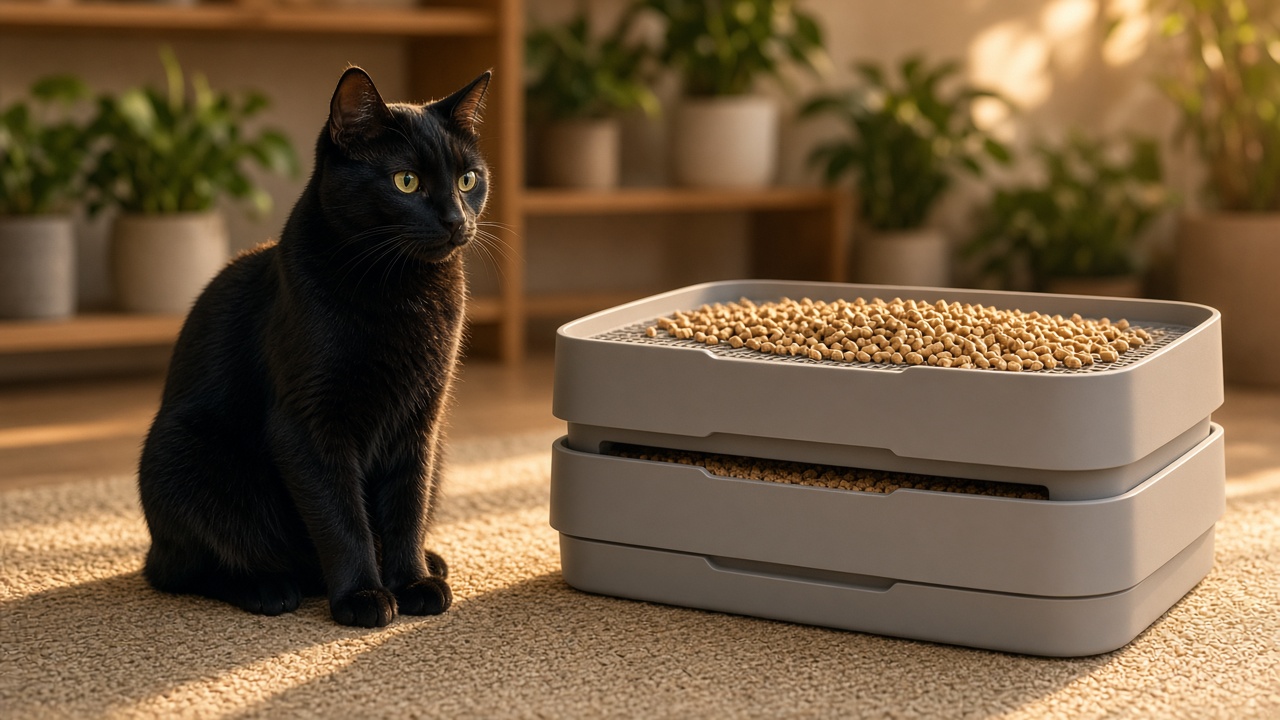
Quick answer: Pick a covered litter box when you want a hidden pan, less scatter, and a door or top hole your cat will actually use. Scoop daily so the hood does not trap ammonia. Skip a cover if your cat already avoids tight spaces.
A covered litter box hides waste and scatter; it only controls odor if you scoop at least once a day. This page is a 2026 spec desk on five currently sold hooded boxes. We did not run odor trials, film cats entering, or time a scooping session.
Selection rule: a box had to sit on the maker’s current product page with listed exterior dimensions and a named entry style. We left out open trays, cabinet furniture, and any motorized self-cleaning unit.
Our research team analyzed those published specs in September 2026. We call that pass the Cover Fit scan. It checks lift-off cleanup, entry height, and a stated odor part.
How we chose which covered boxes to include
A covered litter box is a pan plus a hood, lid, or top deck. The cover can be a snap-on dome, a flip lid, or a walk-off roof.
We kept five current models. That set shows the real splits: top hole versus front door, filter versus no filter, and liner versus bare plastic.
We excluded automatic litter boxes even when they have a shell. A motor changes noise, power, and waste handling.
We also excluded litter-box furniture. A cabinet hides the whole unit. If you want that route, use our litter box enclosure furniture guide.
The Cover Fit scan is not a ranking. There is no “best” column. The table below lists attributes only.
If a maker page skipped exterior size or entry style, the box did not make the list.
Top 7 Covered litter box
The picks below are the 7 covered litter boxes on sale right now, listed with what each suits best and an honest drawback. Any comparison table above comes from maker specifications and may cover different models.
1. IRIS USA Large Front Door Cat Litter Box
Best for: Budget-conscious owners needing a basic enclosed space
We compared various entry-level options and found this model serves as a straightforward solution for those needing a simple covered litter box. Owners report that the front-door design is effective for containing scatter, though the plastic construction requires regular deep cleaning to manage smells.
Pros: Extremely affordable price point; Lightweight and easy to move Cons: Plastic material can retain odors over time
2. Tevila XL Enclosed Stainless Steel Litter Box with Lid
Best for: Large cats needing a durable, non-porous surface
When evaluating materials, we noted that stainless steel is increasingly favored for its hygienic properties. Owners report that this XL model provides ample room for larger cats while the non-porous surface makes the cleanup process significantly faster than traditional plastic boxes.
Pros: Stainless steel resists bacteria and odors; Extra-large footprint for bigger breeds Cons: Higher price point than plastic alternatives
3. Nature's Miracle Hooded Flip Top Cat Litter Box with Charcoal Filter
Best for: Households prioritizing active charcoal odor filtration
We compared this hooded unit against standard boxes and found the charcoal filtration system to be a standout feature for odor control. Owners report that the flip-top design is particularly convenient for daily maintenance without needing to remove the entire hood.
Pros: Flip-top lid allows for easy scooping; Integrated charcoal filter helps neutralize scents Cons: Filter replacements add ongoing maintenance costs
4. Amazon Basics No-Mess Hooded Enclosed Cat Litter Box with Odor
Best for: General purpose use with reliable odor containment
In our assessment of standard covered litter boxes, this model offers a balanced approach to spill prevention. Owners report that the enclosed hood provides a sense of privacy for shy cats while effectively keeping the surrounding area tidy.
Pros: Simple, functional design; Effective at keeping litter inside the box Cons: The plastic latch mechanism can be fragile
5. Enclosed Stainless Steel Litter Box
Best for: Owners seeking a long-lasting, scent-free environment
We compared stainless steel options to determine the best long-term investment for cat owners. Owners report that this box remains odor-free even after extended use, making it a superior choice for those tired of replacing scratched-up plastic pans.
Pros: Does not absorb urine odors; Highly durable and scratch-resistant Cons: Heavier than plastic models
6. Arm & Hammer Rimmed Open Cat Litter Box
Best for: Transitioning cats who need an open-top feel
While this is a rimmed open box rather than a fully enclosed one, we included it because many owners report it as the best bridge for cats hesitant to use covered boxes. We compared its accessibility to fully hooded models and found it offers better ventilation for the pet.
Pros: Very easy for cats to enter; Rim helps reduce some litter tracking Cons: Does not fully contain airborne odors
7. Foldable Enclosed Cat Litter Box with Lid
Best for: Small apartments or travel-heavy pet owners
We compared foldable designs to traditional rigid boxes to see how they handle portability. Owners report that the ability to collapse the unit is a major advantage for small living spaces, though it requires extra attention during cleaning to ensure no debris gets trapped in the folds.
Pros: Collapsible design for easy storage; Space-saving footprint Cons: Folding seams can be difficult to sanitize
Comparison: Covered litter box at a Glance
| Product | Best for | Approx. price | Where to buy |
|---|---|---|---|
| IRIS USA Large Front Door Cat Litter Box | Budget-conscious owners needing a basic enclosed space | $19.99 | Check price |
| Tevila XL Enclosed Stainless Steel Litter Box with Lid | Large cats needing a durable, non-porous surface | $52.99 | Check price |
| Nature's Miracle Hooded Flip Top Cat Litter Box with Charcoal Filter | Households prioritizing active charcoal odor filtration | $44.49 | Check price |
| Amazon Basics No-Mess Hooded Enclosed Cat Litter Box with Odor | General purpose use with reliable odor containment | $44.66 | Check price |
| Enclosed Stainless Steel Litter Box | Owners seeking a long-lasting, scent-free environment | $49.99 | Check price |
| Arm & Hammer Rimmed Open Cat Litter Box | Transitioning cats who need an open-top feel | $16.99 | Check price |
| Foldable Enclosed Cat Litter Box with Lid | Small apartments or travel-heavy pet owners | $40.99 | Check price |
Want to browse every option? See the full range of covered litter box on Amazon →
What a cover changes, and what it does not
A hood hides the pan and blocks some kicked litter. It can also stop some side spray.
It does not delete ammonia. The Ohio State University Indoor Pet Initiative states that covered boxes concentrate odor more than open pans. The same page says a cat may refuse a dirty covered box.
If the room still smells after a cover goes on, the hood is holding the smell. It is not removing it.
The 2021 AAHA/AAFP Feline Life Stage Guidelines say open or covered type can matter to some cats. They do not say a hood is required. They also say some cats are quite sensitive to a dirty box.
AAHA tells readers to scoop daily. It prefers hot water over soap or strong chemicals for washing. The Ohio State University Indoor Pet Initiative adds a weekly wash with mild dish detergent.
Fill depth is a number. Ohio State says to use about 2 inches of litter so the cat can bury waste.
A cover also changes airflow and light. Some cats want the cave. Some want a clear exit.
Match entry style to the cat, not the room
Entry is the first Cover Fit check. A hood fails if the cat will not step through it.
Front-entry hoods use a door, an open arch, or a raised step. Top-entry boxes use a hole in the lid. Convertible boxes let you run either layout.
Modkat lists the Flip as a front-entry box. The maker page states an entrance 8.25 inches wide by 9.5 inches high. The step sits 6.75 inches off the floor.
Modkat lists the XL as top-entry, front-entry, or both. The front hole is 8.3 inches by 9.8 inches. The front lip sits 6.25 inches off the floor.
The XL top hole is 10.25 inches wide. IRIS USA lists a 9.25-inch diameter top hole on its Top Entry Cat Litter Box with Scoop Large.
Catit lists a 10.4-inch by 9.6-inch door on the Litter Box with Airsift filter system, Jumbo. The door lifts back for scooping.
AAHA says edges should not be too high for a kitten or a senior cat. A 6.25-inch front lip is still a step.
Top-entry adds a climb. The cat must hop onto the lid, then drop in. That walk-off lid can knock litter from paws.
If a dog shares the house, a top hole can keep a muzzle out. Modkat lists a 30-pound lid capacity on the XL. The Flip lid lists 24 pounds.
Those are load ratings, not dog-proof promises.
Size against the AAHA one-and-a-half rule
The 2021 AAHA/AAFP Feline Life Stage Guidelines set a hard size rule. The box should be at least one and a half times the cat’s length from nose to tail tip.
AAHA also says most manufactured boxes are not large enough. A hood does not add floor. It often subtracts turning room.
In our September 2026 Cover Fit scan, listed exterior length ran from 20.5 inches to 26 inches. Listed height ran from 14.5 inches to 20 inches.
IRIS USA lists the Large top-entry box at 20.5 inches long, 14.75 inches wide, and 14.5 inches high. The inside floor is 15 inches by 9.75 inches. That interior is the number that matters for a turn.
Modkat lists the Flip at 20.5 by 15.75 by 16.8 inches. The base footprint is 17.5 by 13 inches. The XL is 21.0 by 16.5 by 17.0 inches.
Catit lists the Airsift Jumbo at 22.4 inches long, 19.7 inches wide, and 18.3 inches high. The Regular Airsift box keeps the same length and height. Width drops to 15.3 inches.
Nature’s Miracle lists the Hooded Corner Litter Box at 26 inches long, 23 inches wide, and 20 inches high. That is the longest and tallest shell in this set.
AAHA’s plus-one count still applies under a hood. The rule is one box per cat, plus one more. Two cats means three boxes.
Large-bodied cats need floor first, then a hood. If your cat already overflows an open pan, start with our litter boxes for large cats notes.
Five covered boxes, compared by listed attributes
The table uses only attributes the makers publish. We did not add a rank column or a price column.
| Model | Exterior size (L × W × H) | Entry listed by maker | Odor part listed | Cleanup access |
|---|---|---|---|---|
| Modkat XL | 21.0 × 16.5 × 17.0 in | Top, front, or dual | Filter holder plus 2 filters | 3-position swivel lid |
| Modkat Flip | 20.5 × 15.75 × 16.8 in | Front step, 6.75 in off floor | 2 charcoal filters | Magnetic 3-position lid |
| IRIS USA Top Entry Large | 20.5 × 14.75 × 14.5 in | Top hole, 9.25 in diameter | None listed | Removable grooved lid |
| Catit Airsift Jumbo | 22.4 × 19.7 × 18.3 in | Front door, 10.4 × 9.6 in | Airsift pad, about 30 days | Door lifts back; bag anchor |
| Nature’s Miracle Hooded Corner | 26 × 23 × 20 in | Front hood, corner shell | Charcoal filter, up to 3 months | Snap latches |
Four of the five maker pages list a replaceable odor filter. IRIS USA does not list one on the Large top-entry page.
Modkat says reusable liners last up to 3 months with normal use. Nature’s Miracle says its charcoal filter absorbs odor for up to three months. Catit says one Airsift pad lasts about 30 days.
Those durations are maker claims. They are not results from our desk.
Catit’s Airsift page describes dual media. One layer is Catit Magic Blue for ammonia. The other is activated carbon.
Nature’s Miracle describes Ionpure antimicrobial protection in the plastic. That is a material claim on the maker page. It is not a substitute for scooping.
Odor control is a scoop schedule, not a hood
A closed shell slows the smell you notice in the hallway. It also keeps that smell next to the cat’s nose.
Ohio State is blunt on this point. Covered boxes concentrate odor. Keep them cleaner than you think you need.
AAHA’s daily scoop line is the schedule. Do not wait for the filter to catch up. A pad is a backup, not the plan.
Filter math from the pages we read is simple. Catit states about 30 days per Airsift pad. Nature’s Miracle states up to three months per charcoal filter.
If the hood has a door flap, latch it open for the first week with a new cat. You want the cat to choose the box.
Scented litter plus a scented filter can stack. Ohio State says many cats dislike deodorant litters. It also says not to park a room freshener next to the box.
If odor is the only reason you want a cover, fix scooping first. Then size. Then a filter.
When a cover is the wrong tool
Skip a cover if the cat already pees just outside a hooded box. The problem may be size, dirt, or a high step.
Skip a cover if a senior cat hesitates at a 6-inch lip. AAHA warns against edges that are too high.
Skip a cover if you will not lift the hood every day. A closed dirty box is worse than an open dirty box.
Skip a plastic hood if you actually want a cabinet that looks like a side table. That is furniture, not a litter pan.
Skip a manual hood if you want a rake or a rotating drum. That is the automatic category.
A cover works when the cat already uses a box. You still need a daily scoop clock.
Offer one covered box and one open box when you can. AAHA supports giving choices in separate boxes.
FAQ
Do cats prefer a covered litter box?
Not as a group. The 2021 AAHA/AAFP Feline Life Stage Guidelines say open versus covered can matter to some cats. The only honest test is two boxes in two quiet spots.
Does a covered litter box reduce odor?
It can hide odor from the room for a short time. Ohio State says the same hood concentrates odor inside. If the box smells when you lift the lid, the cat already smelled it.
Is a top-entry box better than a front-door hood?
It depends on joints and tracking, not on a rank. IRIS USA lists a 9.25-inch top hole and a grooved lid. A cat that cannot hop should use a front entry.
How many covered boxes does a two-cat home need?
AAHA’s rule is one box per cat, plus one. Two cats need three boxes. The boxes should sit in different quiet rooms when you can.
Can I put a covered box inside a cabinet?
You can, but you add a second tunnel. The cat must enter the furniture, then the hood. If you want furniture, start with an open pan inside the cabinet.
How often should I change the odor filter?
Follow the maker’s stated interval, then shorten it in a multi-cat home. Catit states about 30 days for one Airsift pad. Nature’s Miracle states up to three months for its charcoal filter.
When should I skip a covered box entirely?
Skip it for kittens that cannot climb, seniors that hesitate, and any cat that already avoids enclosed pans. Skip it if you will not scoop daily. AAHA notes that most manufactured boxes are already too small.