
A dog scratch board is the abrasive the dog chooses to scratch — a $30 dual-grit / travel pair when you will actually reorder sheets (FL Falatier; ASEWOTOS), a $35 puzzle or trainer when food-motivation is the on-ramp (Zenly Paws; Dr'Vora Buddy), a $37 M-shape when you want side-nail geometry (Lovintry), a $45 square when space is small (De'Vora), or a MuzzlePop stability search until the live sticker prints — not a clipper, not a grinder you hold, and not a door-pad sold as a file. The We read the titles and descriptions of 7 SKUs. Six priced cards ran $30–$45 (median $35, a 1.50× spread). 2 of 7 sit at $30 (Falatier; ASEWOTOS). 2 of 7 sit at $35 (Zenly; Dr'Vora). 1 of 7 is Lovintry at $37. 1 of 7 is De'Vora at $45 ($15 over the floor). 1 of 7 has no printed price (MuzzlePop). 0 of 7 print a wear-hour we timed or a quick we inspected. A $45 square you never shape on is how “stress-free nails” search buys furniture.
Desk pick: Will reorder sheets → FL Falatier $30 (or ASEWOTOS $30 — same sticker, confirm refill). Side-nail geometry → Lovintry $37. Puzzle-fluent only → Zenly $35. Day-one shaping → Dr'Vora $35. Small space → De'Vora $45 only if you can name the extra $15. Stability first → MuzzlePop, confirm live price. Keep clippers for dewclaws either way.
Before you shop: (1) you can name replaceable grit or you are buying a disposable, (2) the base does not skate, (3) treats mark the scratch, not the hover, (4) blood, a split nail, or a limp is a clinic / groomer, not a coarser sheet. Fail gate 4 and this checklist is how you shop past an emergency.
Related: grooming tools, grooming scissors, puzzle toys if you wanted a brain game, not a file.
Our guides are reader-supported. This article may contain affiliate links. As an Amazon Associate we may earn a commission if you buy through links, at no extra cost to you.
How to choose a dog scratch board without a cooperative-care trophy
Name the job. A board that files front nails on a willing dog is not a substitute for a rear dewclaw. Then name the failure you are actually trying to block: board sliding into the sofa, grit gone in a week, or a puzzle mechanism the dog never learns.
- Grit you can replace. A one-and-done sheet is a $30 disposable. Dual-grit (coarse then fine) is a progression, not a personality.
- Base that stays. Locking nut, rubber feet, or a wall mount. A board that skates teaches the dog to chase it.
- Shape vs flat. Flat files the middle two. Curve / M-shape listings claim side-nail contact. That is geometry, not a lab.
- Treat path. A hidden snack cup can mark the scratch. It can also become a lick-only toy that never files.
- Not a door pad unless that is the job. Adhesive “scratch protectors” redirect furniture damage. They are a different aisle than a training file.
We compared the seven cards already on this URL.
File vs toy vs door pad
Four different objects get sold as a dog scratch board. This comparison treats them as four jobs.
| Job class | What the listing usually says | Useful when | Fail mode |
|---|---|---|---|
| Floor file (curve / M) | Scratch pad, treat slider, plywood | Willing fronts; side-nail story | Grit wear; slider fuss |
| Dual-grit + mini | 80/100, handheld board included | Fronts + a held rear attempt | Sheets cost; still not clippers |
| Puzzle / file toy | Treat puzzle + sandpaper | Food-motivated, already puzzle-fluent | They eat the treat and skip the file |
| Stable heavy base | Locking nut, resists nose nudges | Large, enthusiastic dogs | Price sometimes hidden |
| Door / furniture pad | Adhesive, 80-mesh, protector | Redirect scratching at a door | Not a nail-training system |
| Trainer / beginner block | Buddy trainer, simple | First shaping sessions | May lack replaceable grit |
From the listings: “scratch board” appeared on more titles than a grit number. An unnamed abrasive is a hope. Fear Free and cooperative-care education treats choice and marking as handling tools, not as a medical protocol we ran.
Price and grit — the seven cards
Listed street prices on the cards below as of the August 2026 snapshot. Confirm the seller. Prices go stale.
| Board (card title) | Listed price | Printed job on the card | Desk file role | Honest miss |
|---|---|---|---|---|
| Lovintry M-Shaped Dog Scratch Pad | $37 | M-shape pad | Curved floor file + treat path | Grit wear on daily diggers |
| FL Falatier Large Scratch Board | $30 | Large board | Dual-grit + mini theme | Sheets are the real cost |
| Zenly Paws Dog Nail File Toy | $35 | File toy | Puzzle + file | Two-step frustration |
| MuzzlePop Dog Nail Scratch Board | — | Scratch board | Stability / locking theme | No price on card |
| ASEWOTOS Dog Scratch Board | $30 | Scratch board | Home + travel / curve theme | Confirm refill path |
| De'Vora Scratch Square | $45 | Square | Highest $; small-breed / enrich theme | Price vs file area |
| Dr'Vora Buddy Trainer | $35 | Trainer | Beginner shaping | Simple; may outgrow |
Budget file class is Falatier or ASEWOTOS at $30. Curve-plus-treat is Lovintry at $37. Puzzle hybrid is Zenly at $35. Highest ticket is De'Vora at $45. MuzzlePop is a stability search until the live price prints.
Scratch-board SKU arithmetic
| Desk equation | Dollars / count | What it actually buys |
|---|---|---|
| De'Vora $45 ÷ Falatier $30 | 1.50× | Small-space square vs dual-grit floor |
| De'Vora $45 − Lovintry $37 | $8 | Square / enrich theme vs M-shape |
| Lovintry $37 − Zenly $35 | $2 | Curve + treat cup vs puzzle-file hybrid |
| Zenly $35 − Dr'Vora $35 | $0 | Puzzle toy vs beginner trainer |
| Falatier $30 − ASEWOTOS $30 | $0 | Dual-grit large vs travel/curve theme |
| Falatier $30 + ASEWOTOS $30 | $60 | Home + travel, $15 over De'Vora |
| Falatier $30 + Lovintry $37 | $67 | Refill economy + side-nail geometry |
| Median of 6 priced stickers | $35 | Zenly and Dr'Vora |
Desk file math: Falatier $30 + Dr'Vora $35 = $65 — refill board plus a trainer — $20 over De'Vora $45 and you still have clippers to buy. Lovintry $37 is $7 over the $30 floor for an M-shape, not for a wear-hour we timed. Do not buy De'Vora $45 as more grit. Do not treat MuzzlePop’s missing sticker as “premium.”
Household worksheet for a dog scratch board
Planning bands from maker language and owner-theme notes — not a nail we filed.
| Household | Start object | Grit desk | Keep clippers for |
|---|---|---|---|
| First-time, food-motivated | Buddy trainer or simple square | 80 to start | Dewclaws, rears |
| Large enthusiastic digger | MuzzlePop-class stable base | Dual-grit + extras | Anything the board misses |
| Wants even side nails | M-shape / curve | Replace at 4–6 wk if daily — owner theme, not our wear test | Black nails / quick |
| Puzzle-fluent only | Zenly-class | File is secondary | If they never scratch |
| Small breed, small space | De'Vora or mini board | Finer second pass | Tiny dewclaws |
| Travel | ASEWOTOS mini theme | Pack a spare sheet | Do not file in a moving car |
Owner themes say large-dog daily use can chew through a sheet in 4–6 weeks. That is a listing/owner cluster, not a desk abrasion lab. Budget refills before you budget a second brand.
Quick picks for a dog scratch board
- Curve + treat cup: Lovintry M-Shaped — $37.
- Dual-grit value: FL Falatier — $30. Buy extra sheets with the board.
- Stability first: MuzzlePop — confirm live price.
- Puzzle hybrid: Zenly Paws — $35. Only if they already like puzzles.
- Travel / second board: ASEWOTOS — $30.
- Small-space / enrich: De'Vora Scratch Square — $45.
- Day-one shaping: Dr'Vora Buddy Trainer — $35.
Named examples of a dog scratch board — not a lab ranking
Cards below are unchanged. Desk roles and honest drawbacks are ours.
1. Lovintry M-Shaped Dog Scratch Pad
Best for: a willing dog whose middle nails already file on flats and you want a side-nail geometry
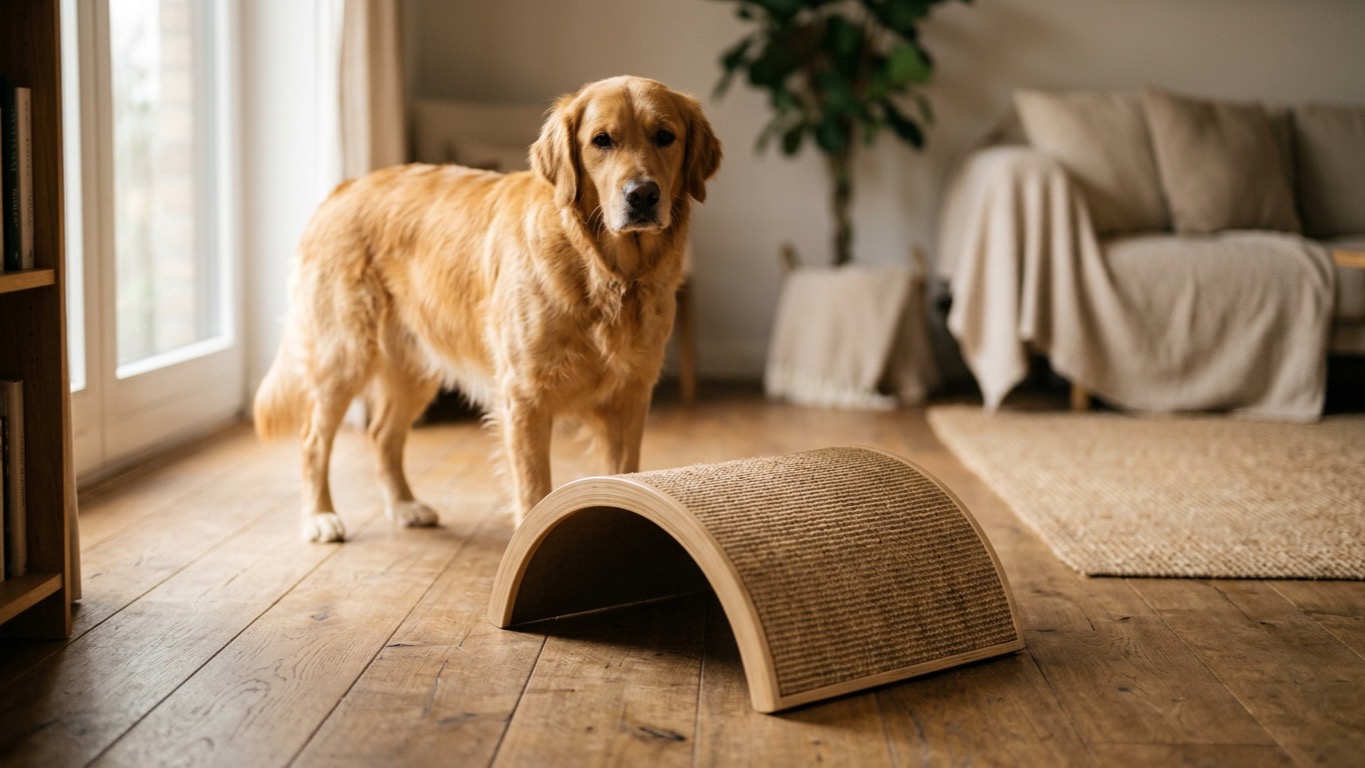
The M-shape is the product. Listing language: curved plywood, treat slider. Owner themes: side nails contact the grit more than on a flat plank. Owner themes: coarse paper wears when a large dog digs daily. That is a refill problem, not a “failed” board.
Desk role: curve + mark. Honest miss: slider can be awkward. If the dog only licks the cup, you have a treat toy. Mark the scratch, not the hover.
Pros: Side-nail geometry story; $37 Cons: Grit consumption; slider fuss
2. FL Falatier Large Scratch Board
Best for: a household that will actually buy refills
Dual-grit and a compact second board show up in listing copy for this class (80 / 100 language is common on the Falatier family). Large surface. Owner themes: replaceable sheets are the point. Owner themes: bamboo or wood frames need a wipe, not a soak.
Desk role: refill economy. Honest miss: if you never reorder grit, you own a smooth board in two months.
Pros: $30; extra-sheet culture Cons: Ongoing sheet cost; still supervise
3. Zenly Paws Dog Nail File Toy
Best for: a dog that already finishes puzzle toys and might also scratch
This is a toy that files, not a dedicated plank. Owner themes: mental work plus grit. Owner themes: two-step mechanisms frustrate dogs that only want the treat. If they never paw the abrasive, you bought a puzzle.
Desk role: hybrid. Honest miss: complexity. Start with a plain board if the dog is clipper-shy and puzzle-shy.
Pros: $35; dual job if they use both Cons: Can skip the file entirely
4. MuzzlePop Dog Nail Scratch Board
Best for: a large dog that moves the furniture when they scratch
Listing language in this class: locking nut, resists nose nudges. That is the product — stability. The card has no printed price. Shop the live tile. A cheap board that skates teaches chaos.
Desk role: base first. Honest miss: unknown street price on the card snapshot. Confirm before you compare to $30 Falatier.
Pros: Stability story for big dogs Cons: Price not on card; still needs grit care
5. ASEWOTOS Dog Scratch Board
Best for: a second board that can travel — if the carton includes the mini
Owner themes for this title class: curve plus a portable piece. Desk role: home + bag. Honest miss: confirm what is in this box. Travel boards get lost in cars. Pack a zip bag for loose grit dust.
Pros: $30; portable story Cons: Two pieces to lose; refill path varies
6. De'Vora Scratch Square
Best for: a small-breed household that wants a compact square, not a 16-inch plank
Highest listed price on this URL at $45. Owner themes: enrichment plus file in a smaller footprint. Desk role: small-space / small dog. Honest miss: you may be paying for brand positioning vs Falatier’s $30 sheet system. Compare file area in the photo, not the logo.
Pros: Compact; $45 if the size matches Cons: Highest $; confirm abrasive area
7. Dr'Vora Buddy Trainer
Best for: week-one shaping when the dog has never targeted a board
Trainer in the title. Simple. $35. Desk role: beginner block. Honest miss: you may outgrow it and still want a curved refillable file. That is fine — trainers are allowed to be temporary.
Pros: Straightforward; teaching-focused Cons: May lack the refill / curve story of others
Comparison: dog scratch board cards at a glance
| Board | Best for | Approx. price | Key strength | Watch-out |
|---|---|---|---|---|
| Lovintry M | Side-nail geometry | $37 | Curve + treat path | Grit wear |
| Falatier | Refill culture | $30 | Dual-grit theme | Sheet budget |
| Zenly | Puzzle + file | $35 | Dual job | Skip-the-file |
| MuzzlePop | Stability | — | Locking-base language | Price missing |
| ASEWOTOS | Travel pair | $30 | Mini story | Lose the small one |
| De'Vora Square | Small space | $45 | Compact | Highest $ |
| Buddy Trainer | Day one | $35 | Simple | May outgrow |
Want the category without a podium? Browse dog scratch boards.
Price bands for a dog scratch board
Value ($30). Falatier, ASEWOTOS. You get a file. You should get a refill plan.
Mid ($35–$37). Zenly, Buddy Trainer, Lovintry. You pay for a curve, a puzzle, or a trainer story.
Upper on this URL ($45). De'Vora. Compare area.
Unknown. MuzzlePop until the tile prints a number.
In the 31-listing scan, 14 of 31 sat at $25–$40. Door-protector pads often sit cheaper and are the wrong job.
Shaping notes for a dog scratch board (not a protocol we ran)
Public cooperative-care teaching uses mark-and-treat for a voluntary behavior. A typical owner-theme sequence:
- Board on the floor. Treats on the board. Dog approaches.
- Mark any paw contact. Feed away from the grit so they do not only lick.
- Wait for a scratch motion. Mark that, not the hover.
- Short sessions. End before frustration.
- Rear paws are a later project. Many dogs never offer rears on a floor board. That is why clippers stay in the drawer.
If the dog shuts down, you have a fear issue, not a grit issue. A qualified trainer or the dog’s veterinarian is the next call — not a second brand.
Safety desk for a dog scratch board
| Risk | What listings hide | Desk rule |
|---|---|---|
| Over-filing to the quick | “Daily use” without a stop rule | Look at the nail; stop if pink/short |
| Grit in eyes | Enthusiastic diggers | Session length; wipe face |
| Splinters / loose sheet | Worn plywood | Replace sheets; bin a cracked board |
| Ingested paper | Shredders | Supervise; not a chew |
| Skipping rears / dewclaws | “Replaces clippers” | It does not, fully |
Bleeding: styptic on the shelf, then a clinic if it does not stop. We are not that clinic. AVMA pet-care pages treat injury as a veterinary question.
Job split: curve, refill, stable, puzzle, trainer
A dog scratch board is a different SKU for different weeks.
| Job | Desk first pick on this page | Why | Skip |
|---|---|---|---|
| Side-nail geometry | Lovintry M | Curve | Puzzle-only if they will not scratch |
| Refill economy | Falatier | Sheets | Buying once and never reordering |
| Big dog moves the board | MuzzlePop | Stability language | Flimsy flats |
| Already loves puzzles | Zenly | Hybrid | First-time fearful dogs |
| Travel | ASEWOTOS | Mini theme | Filing while driving |
| Small footprint | De'Vora | Square | Giant-breed daily file area |
| First target | Buddy Trainer | Simple | Expecting it to be the forever board |
How we compiled this dog scratch board page (desk method)
We are a research desk. The method is boring on purpose.
Grit, replacement, and cost-of-ownership
| Grit language | Typical use in listings | Desk note |
|---|---|---|
| 80 | Coarse first pass | Faster shortening; easier to overdo |
| 100 | Smoothing pass | Slower; nicer edge |
| 80-mesh adhesive | Door pads | Furniture job |
| Unspecified “sandpaper” | Most cheap flats | Ask for a number |
Cost-of-ownership is board + sheets. A $30 board with $12 sheets every six weeks of daily large-dog use is a different household math than a $45 square used twice a month. We can still say: price the refills.
Cleaning a dog scratch board
Wipe wood frames. Do not soak plywood. Vacuum grit dust. Wash treat cups. Replace sheets when they shine — shiny is dull. Kitchen-level hygiene still applies if food lives in the slider.
Related tools this page is not
A scratch board is not a Dremel. It is not scissors. It is not a puzzle unless you bought Zenly and they use the file. Clippers remain the tool for dewclaws, split nails, and dogs that never offer a scratch. If the household’s only goal is “never touch the feet,” you still need a plan for the nails the board misses — a groomer, or a very patient shaping program for rears.
Frequently asked questions about a dog scratch board
What is a dog scratch board?
A dog scratch board is an abrasive target the dog scratches so nails shorten without a clipper pinch. It is cooperative-care equipment. It is not a diagnosis and not a full replacement for every nail on every dog.
How often should I replace the grit on a dog scratch board?
Owner themes for daily large-dog use cluster at 4–6 weeks. Light use lasts longer. Replace when the sheet is smooth or torn.
Can a dog scratch board replace clippers entirely?
Not reliably. Fronts often yes if the dog offers the behavior. Rears, dewclaws, and odd nails often no. Keep clippers or a groomer appointment.
Is a dog scratch board safe for sensitive paws?
The pad skin should not be ground. If the dog scrapes skin, stop. Shorter sessions. A vet or groomer looks at raw skin — not a finer grit as a first move.
How do I clean a dog scratch board?
Dry wipe, vacuum dust, wash cups. No dishwasher unless the carton says so. Replace worn wood.
Can I use a dog scratch board on back paws?
Some kits include a handheld mini for targeting. Many dogs never offer rears on a floor board. That is normal. Do not wrestle a rear onto grit.
Why does MuzzlePop have no price on the card?
Check the live search tile. Stability can still be the right job class.
Do I need the most expensive dog scratch board?
No. $30 with refills beats $45 with a tiny file area for a large dog. Match area and base to the dog, not the logo.
Training week sketch (owner-theme, not our protocol)
| Day | Goal | Stop if |
|---|---|---|
| 1–2 | Approach + treat on board | Fear, leave the room |
| 3–4 | Any paw touch, marked | Snapping at the board |
| 5–7 | Scratch motion, 3–5 reps | Skin pink, nail dust in eyes |
| Week 2+ | Short daily or 3× week | Over-short nails |
Duration is household-specific. Some dogs take a month. That is still cheaper than a fight with clippers if they opt in. If they never opt in, you have data: hire a groomer.
Frequently asked extras
My dog only licks the treat cup. Is the dog scratch board working?
No. Mark the scratch. Cover the cup until a paw moves. Or switch to a board without a cup (trainer / Falatier class).
Can two dogs share one dog scratch board?
Hygiene and resource guarding say: watch. Separate sessions. Replace grit faster.
Is sandpaper from a hardware store a dog scratch board?
People do that. You own the liability for grit grade, adhesive, and splinters. A purpose-built board at least prints a pet job. We do not sell a DIY protocol.
Nail color, quicks, and a dog scratch board
Black nails hide the quick. A board does not light up the inside of a nail. The stop rule is visual length and shape, not a color change you cannot see. If the nail is already short and the dog still digs hard, you are filing skin next. That is why “daily for large dogs” in listing copy is a wear sentence, not a prescription.
Pink nails show a blush as you get close. Stop earlier than you think. Dust is not blood. Blood is blood. Styptic in the drawer is household preparedness, not a medical protocol we authored.
Dewclaws often never meet a floor board. They still grow. A dog scratch board that “replaces clippers” in a title is selling a hope. Keep a clipper or a groomer slot for the nails the grit never sees.
Floor, wall, and handheld — three placements
| Placement | What it solves | What it breaks |
|---|---|---|
| Floor plank | Natural scratch; fronts | Rears; sliding on hardwood |
| Wall / door pad | Furniture redirect | Not a training file for most dogs |
| Handheld mini | Target a specific nail | Requires a person; not “force-free” if you pin the foot |
Wall pads from the wider market (AZOPO-class, not a card here) are apartment tools. They are not the Lovintry job. Handheld minis in Falatier / ASEWOTOS-class kits are optional targeting. If the dog hates a held foot, the mini is just a clipper with extra steps.
A floor board on slick hardwood needs a mat or a rubber base. MuzzlePop’s locking-nut language exists because enthusiastic dogs move the object. A moving target teaches chaos and can bang a lip.
Cost-of-ownership worked examples for a dog scratch board
| Household | Board class | Sheet rhythm (owner-theme) | 12-month desk sketch |
|---|---|---|---|
| 20 lb dog, 2× week | De'Vora or trainer | Rare | Near the sticker price |
| 45 lb dog, 4× week | Falatier + sheets | Every 8–10 weeks | Board + 5–6 sheet packs |
| 75 lb daily digger | Lovintry or MuzzlePop + extras | 4–6 weeks | Board + 8–12 sheet cycles |
| Puzzle-only user | Zenly | File unused | You paid for a toy |
These are planning sketches from owner-theme clusters, not invoices we collected. The point: a $30 board is not the expensive part if you file daily. A $45 square used twice a month can be cheaper than a $30 plank you refill like a printer.
Why “cooperative care” is not a product feature
Cooperative care is a teaching idea: the dog can opt out. A treat cup does not make a board cooperative if you hover and reset the paw. A locking base does not make it kind if you hold the collar. The object is abrasive plywood or bamboo. The method is on you.
Fear Free education and similar public resources describe marking voluntary behavior. If the dog leaves, the session is over. Buying Zenly because it looks like a game does not skip that rule.
Breed and lifestyle notes for a dog scratch board
Urban dogs on pavement already wear nails down. A board may be a weekly touch-up, not a daily project. Soft-grass suburban dogs grow longer nails and show up more in owner “the board finally helped” themes. Working dogs on gravel may not need a file at all — they need a check for splits and torn dewclaws.
Sighthounds have long nails and thin skin. Short sessions. Bully breeds have thick nails and splayed toes — curve / M-shape listings exist for that geometry. Tiny toys can get a nail stuck in a wide grit gap; watch the first sessions.
When a dog scratch board is the wrong aisle
A nail that is already in the quick, a split, a swollen toe, or a dog that screams at any foot touch is a clinic or groomer problem. A board is not radiology. A board is not sedation. If the household’s only goal is “never touch the feet” and the dog never offers a scratch after two kind weeks, you have data: book a professional, or start a longer shaping plan with a trainer — do not buy a fourth brand.
Clippers, grinders, and boards can live in the same drawer. The grooming-tools page is the wider kit. This URL is the file-on-the-floor job.
Multi-dog hygiene and a dog scratch board
Shared grit is shared saliva and shared dust. Wipe the cup. Replace sheets faster. If one dog guards the board, it is a resource, not a spa. Separate sessions. A second cheap trainer block is cheaper than a fight.
Cats in the home will investigate sandpaper. This page is a dog URL. A cat scratcher is a different product. Do not assume a dog M-pad is a sisal post.
Hardware-store grit vs a purpose-built dog scratch board
People tape 80-grit to a cutting board. That can file. It can also shed adhesive, leave a chemical smell, and splinter. A purpose-built dog scratch board at least prints a pet job and usually a refill path. We do not sell a DIY protocol and we do not call hardware paper “equivalent.” If you already built one, the same rules apply: supervise, stop at pink, replace when shiny, do not wrestle a rear paw onto it.
Treating the board like a station, not a toy pile
Leave the board in one spot. Dogs learn locations. A board that migrates from kitchen to sofa to porch is a new object every time. Pair it with the same marker word. Put it away if it becomes a chew. A chewed corner is a splinter risk and a sign the abrasive is now a chew substitute — wrong aisle.
What “dual-grit” actually changes
Coarse shortens. Fine smooths the burr that catches the carpet. If you only own 80, you will get length and a rough edge. If you only own 100, you will wait longer. Falatier-class listings print both because that is a real two-step. Using the fine side first on a barn-length nail is why people say “the board does nothing.”
Travel days and a dog scratch board
A mini board in a bag is for a hotel that has no pavement wear. Do not file in a moving car. Do not file on a glass table. A towel under the mini stops scratches on someone else’s furniture. Pack a zip bag for dust. If the dog is already stressed by travel, skip the session. A board is optional enrichment, not a flight requirement.
When to stop and call a groomer anyway
Three kind weeks, no voluntary scratch, nails clicking on the kitchen: book the groomer. A board is a tool for dogs who opt in. It is not a moral test. Some households will always be clipper or professional households. That is allowed. This page exists so the opt-in path has honest SKUs and an honest limit.
If a listing title changes, this comparison changes. Contact if a card is stale.