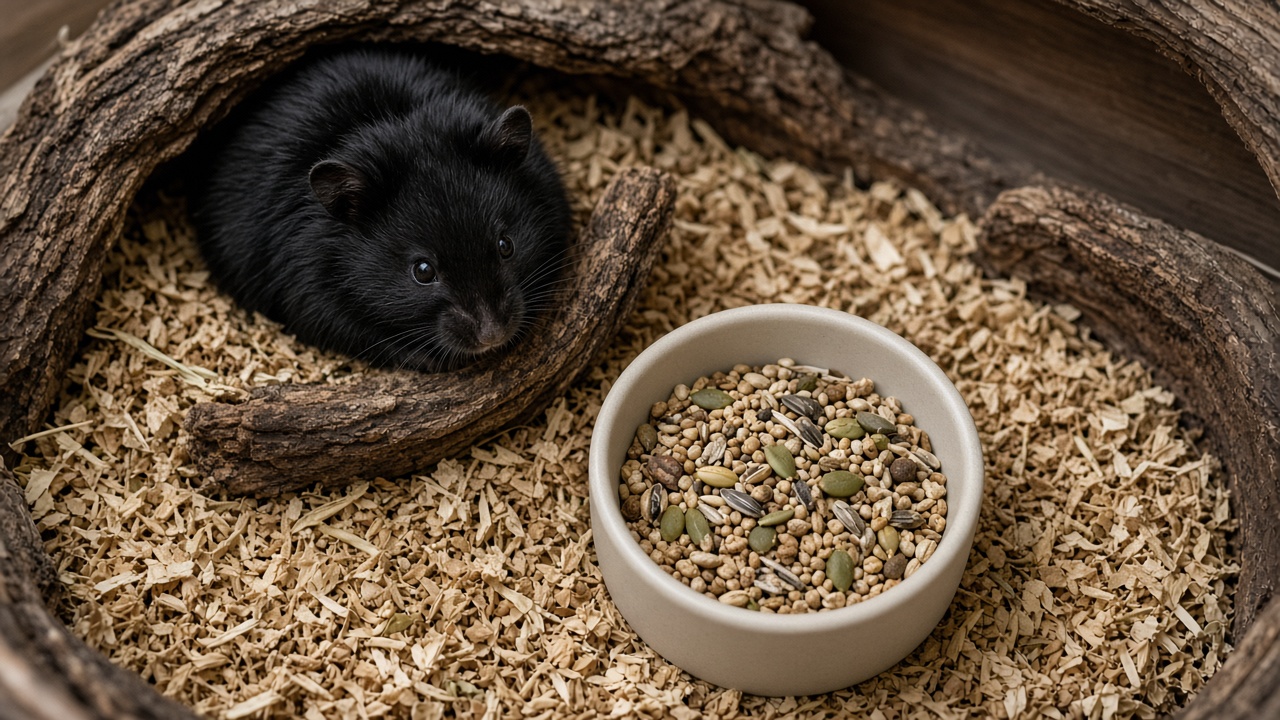
Quick answer: A black bear hamster is a Syrian color morph, not a separate breed. Keep one animal in a floor-first enclosure, not a starter kit. Plan on two to three years of night-active, mostly hands-off care.
Black bear hamsters are Syrian color morphs that the Merck Veterinary Manual lists at 170–180 mm long. That line is the species fact most search pages blur. This page is a research-desk brief on size, lifespan, and temperament. We did not house a colony, run a feeding trial, or time any animal on a wheel.
Our selection rule is simple. A product had to be currently sold for Syrian-sized hamsters. The maker page also had to publish a numeric footprint or a guaranteed analysis.
We left out dwarf-only kits, tube add-ons, wheels sold alone, treats, and listings that hid dimensions.
A black bear hamster is a Syrian color morph
The Merck Veterinary Manual names the common pet hamster as the golden, or Syrian, hamster, Mesocricetus auratus. It doesn’t list “black bear” as a species.
The same chapter records at least 20 coat-color mutations in Syrian hamsters. Most of those mutations are simple recessives.
Pet shops use “black bear,” “teddy bear,” and “fancy” as coat labels. The Merck Veterinary Manual uses “teddy bear” only for longhaired Syrians.
Hair length in longhaired Syrians is influenced by testosterone. Adult males grow substantially longer hair than females after sexual maturity.
The Merck chapter traces captive Syrian lines to a litter of eight animals collected near Aleppo, Syria, in 1930. Three animals remained after escapes and a killing.
A black coat doesn’t change the body plan. It doesn’t change the solitary habit or the two-to-three-year clock. Treat the name as a paint job on a Syrian hamster.
Published size and weight
The Merck Veterinary Manual gives Syrian head-and-body length as 170–180 mm. The tail is listed at 12 mm.
Weight is listed at 110–140 g. Females are larger than males.
Those figures sit on a 6.7–7.1 inch body, plus a short tail. That is a handful, not a pocket pet.
Dwarf species sit under 100 g in the same Merck chapter. They are harder to restrain. A black bear hamster is the larger Syrian form.
Cheek pouches open inside the lips and run past the shoulders. When packed, they can more than double the width of the head.
Diet, sex, and age move weight around. The published 110–140 g range is the ruler.
The two-to-three-year lifespan
The Merck Veterinary Manual lists a Syrian lifespan of 2–3 years. The PDSA hamster page, published in December 2024, uses the same window.
The PDSA also notes that larger species, including Syrians, tend to outlive smaller Russian dwarfs. Color marketing doesn’t add a year.
Young are weaned at about 20 days, per the Merck Veterinary Manual. They can reproduce at 7–8 weeks. Gestation is 16–19 days.
Litters run from 2 to 16 young, with an average of 9. Syrian females can produce 3–5 litters a year.
Those breeding numbers explain why two “friends” in one box is a fight risk.
Cold, lean diets, and low body weight in pregnancy raise cannibalism risk in the Merck account. Disturbing a nest does the same. A pet home should not be a breeding rack.
Temperament: solitary, nocturnal, easily startled
The PDSA is blunt. Most hamster species prefer to live alone. They don’t get lonely.
Shared housing often leads to fighting, stress, and injury. Syrian hamsters meet others in the wild only to mate or to defend a territory.
The Merck Veterinary Manual matches that picture. Both sexes can be aggressive toward other hamsters.
Females are generally aggressive toward other hamsters. Nonestrous females can kill young males.
A single Syrian, kept away from others, is not normally aggressive toward people. The same chapter says a hamster can bite if startled, awakened, or handled roughly.
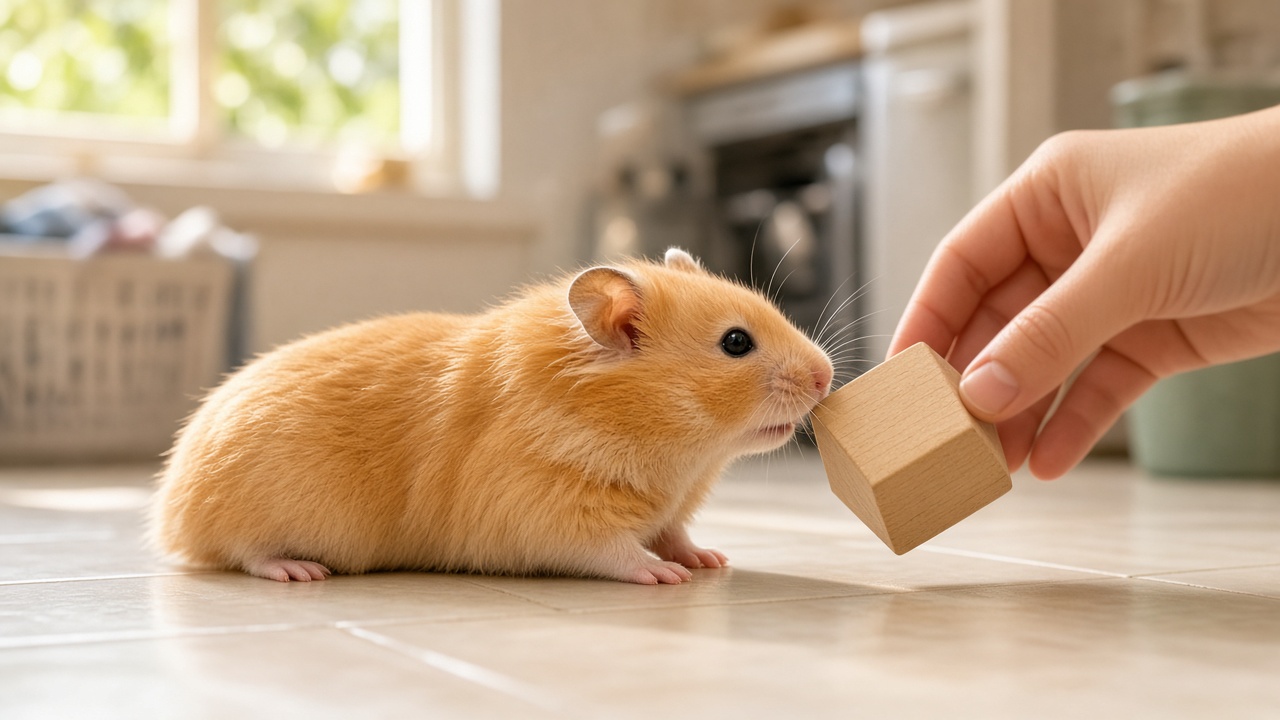
Scooping with a cup is often safer than a grab. Sit on the floor if you lift.
Hamsters sleep by day, per the PDSA. They wake in the evening and at night.
The PDSA also says they are not the cuddliest pets. They’re better watched than squeezed.
Children should be supervised. The PDSA prefers treats and gentle strokes in the cage over lifting.
A “calm black bear” story is a temperament rumor. Coat color is not a personality test. Night noise and a wish to be left alone are the published pattern.
Floor-first housing, with current maker specs
The PDSA says most shop cages are too small. It cites Germany’s Veterinary Association for Animal Welfare at a minimum of 100 × 50 cm.
That is 5,000 cm², or about 775 sq in, of floor. The PDSA calls that a minimum.
One wide level beats a tall stack. Hamsters have poor eyesight and fall.
The Merck Veterinary Manual doesn’t give a floor rectangle. It does ask for deep bedding of 40–80 cm, about 15–30 inches.
PDSA bedding is milder: at least 25 cm, or 10 inches. Our research team did not pick a winner between those two depths.
We compared five maker-listed footprints with that 775 sq in bar. In our Floor Check, only the Niteangel Bigger World Large inner floor cleared it.
| Product | Maker-listed size | Continuous floor (L × W) | Build note from the maker page |
|---|---|---|---|
| Niteangel Bigger World, Large | Inner 47.2 × 19.7 × 23.6 in | 930 sq in | MDF and PVC; Niteangel lists height over 17.7 in for deep bedding |
| Prevue 528 Universal Small Animal Home | 32 1/2 × 19 × 17 1/2 in | 618 sq in | 3/8 in wire; 6 1/4 in base; page lists Syrian hamsters |
| Ferplast Duna Fun Large | 71.5 × 46 × 41 cm overall | 510 sq in external | Inner 69.5 × 44 cm; three floors; opening roof |
| Prevue Hamster Haven Large SP2005GRAY | 21 5/8 × 13 3/8 × 14 1/4 in | 289 sq in | 1/2 in wire; bi-level; includes a wheel |
| Kaytee Crittertrail Extreme Challenge Habitat | 20 × 11.5 × 18 in | 230 sq in | 0.29 in bar spacing; Kaytee also flags it for dwarfs and mice |
Those floor numbers are our calculations from each maker’s published length and width. They are a gap check, not a rank order.
Niteangel lists the Bigger World Large inner floor at 47.2 × 19.7 in, or 930 sq in. The same page lists a Small inner floor of 30 × 15 in, or 450 sq in.
The other four listed rectangles sit at 618, 510, 289, and 230 sq in. The Ferplast Duna Fun Large is also a three-floor box. The PDSA prefers one wide level.
A black bear hamster also needs a solid wheel. The PDSA sets at least 30 cm, or 12 inches, for Syrian hamsters.
Slatted wheels can catch legs. A 6 inch kit wheel doesn’t become safe because the cage is colorful.
If the listed floor is 230 or 289 sq in, buy a wider box or tank. Tube add-ons don’t add continuous floor.
A DIY hamster cage is the honest path when kits fail the rectangle.
Food, bedding, and room temperature
The Merck Veterinary Manual wants a complete pelleted hamster diet. Some makers sell a hamster-and-gerbil pellet.
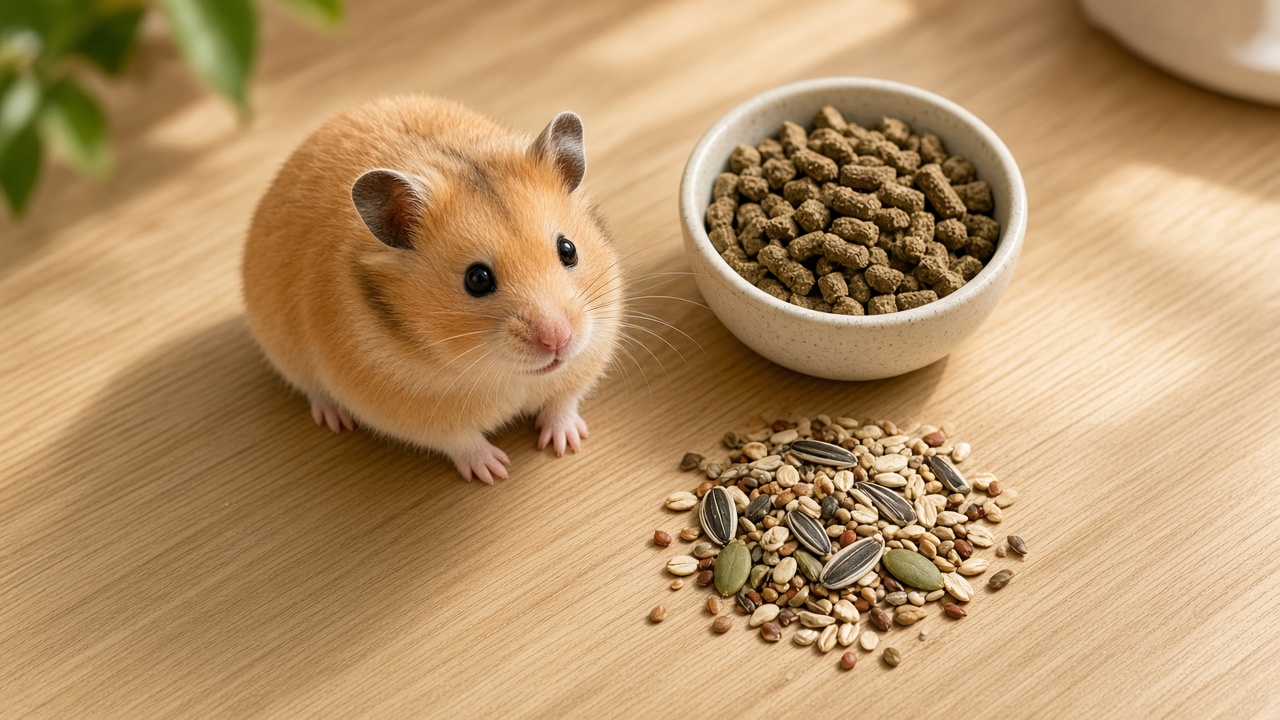
Generic seed mixes are a problem. Hamsters pick seeds and leave pellets.
Food should sit on the floor. Syrian muzzles are broad and often fail at hoppers.
The PDSA agrees on pellets. Each pellet is the same, so the animal cannot sort sugar from fiber.
A little muesli-style mix can add interest. It shouldn’t be the only food. The PDSA portion for fresh produce is a teaspoon or two a day.
Oxbow Animal Health publishes a guaranteed analysis for Essentials Hamster & Gerbil Food. Crude protein is 15.00% minimum, crude fat is 4.50% minimum, and moisture is 10.00% maximum.
Crude fiber is 10.00% minimum and 15.00% maximum. Calcium is 0.60–1.00%, and phosphorus is 0.40% minimum.
Vitamin A is 10,000 IU/kg minimum.
Oxbow’s feeding line for an adult large hamster is 1/3 cup a day. Young, pregnant, or nursing animals are listed as unlimited.
Those are maker directions, not a trial we ran. Females hide caches. Check the nest before you pour more.
The PDSA wants a steady room of 18–21°C, away from drafts and sun. Too hot risks heatstroke. Too cold can push a Syrian into torpor.
The Merck Veterinary Manual says exposure below 5°C, or 41°F, often triggers hibernation. Syrian hamsters don’t fatten first. They starve if they don’t wake to eat.
Water belongs in a bottle with a metal spout, per the PDSA. The Merck Veterinary Manual warns that Syrian hamsters bite through glass tubes. Use stainless steel sippers near the floor.
Bedding must hold a burrow. The PDSA accepts paper-based bedding, and aspen, spruce, or hemp mixed with paper.
It rejects dusty shavings, cotton wool, kapok, bamboo fluff, scented bedding, and inked newspaper. Soft hay can add structure.
The two depth figures still stand: 25 cm from the PDSA, and 40–80 cm from the Merck Veterinary Manual. A 6 1/4 in Prevue base cannot hold either depth.
Cleaning rhythm and when a homemade floor is the honest option
The PDSA splits cleaning into a daily spot pass and a fuller reset. Daily work is wet bedding, stale food, and dirty bottles.
Small cages need a full clean about once a week. Larger setups may wait a few weeks.
Keep a handful of dry, unscented old bedding. The PDSA says the home should still smell like the hamster. Put hides and bowls back in the same spots.
Clean while the animal is awake. A sleeping Syrian dumped into a bright bucket is the bite case the Merck chapter already flagged.
Follow a tight how to clean a hamster cage method. Rinse and dry fully. Prevue notes that plastic bases warp in hot sun.
If you are choosing weekly versus monthly, read how often to clean a hamster cage. Spot-cleaning 930 sq in isn’t the same job as dumping a 230 sq in kit.
A homemade bin is how you buy floor and bedding depth at once when kits fail the 775 sq in check.
Secure the lid. Syrian hamsters are, in both manuals, skilled escape artists.
FAQ
Is a black bear hamster its own breed?
No. It is a pet-trade color and coat label on a Syrian hamster. The Merck Veterinary Manual treats Mesocricetus auratus as the species and lists many coat-color mutations.
How big does a black bear hamster get?
Use the Syrian numbers. The Merck Veterinary Manual lists 170–180 mm of head and body and a 12 mm tail. Weight is 110–140 g, with females larger than males.
How long do black bear hamsters live?
Plan on two to three years. Both the Merck Veterinary Manual and the PDSA use that range. Color doesn’t add extra time.
Can two black bear hamsters share a cage?
Not as a default. The PDSA says Syrian hamsters fight, and injuries can be fatal. The Merck Veterinary Manual describes aggression in both sexes, so keep one hamster on one floor.
What cage size should I use?
The PDSA quotes a 100 × 50 cm minimum from Germany’s Veterinary Association for Animal Welfare. That is about 775 sq in of unbroken floor, plus at least 25 cm of bedding. Our Floor Check found one listing that cleared 775: the Niteangel Bigger World Large at 930 sq in.
Are they good pets for children?
They can be watched. They are a poor hold-and-cuddle pet. The PDSA prefers treats and in-cage strokes, and it wants an adult present for any lifting.
What should I feed a black bear hamster?
Start with a uniform hamster pellet, as both the Merck Veterinary Manual and the PDSA advise. Oxbow lists Essentials Hamster & Gerbil Food at 15.00% minimum protein and 1/3 cup a day for an adult large hamster.
Add a teaspoon or two of safe produce, per the PDSA.
A black bear hamster is a dark Syrian with a short clock and a wide-floor habit. The nickname sells the coat. Buy the floor first.