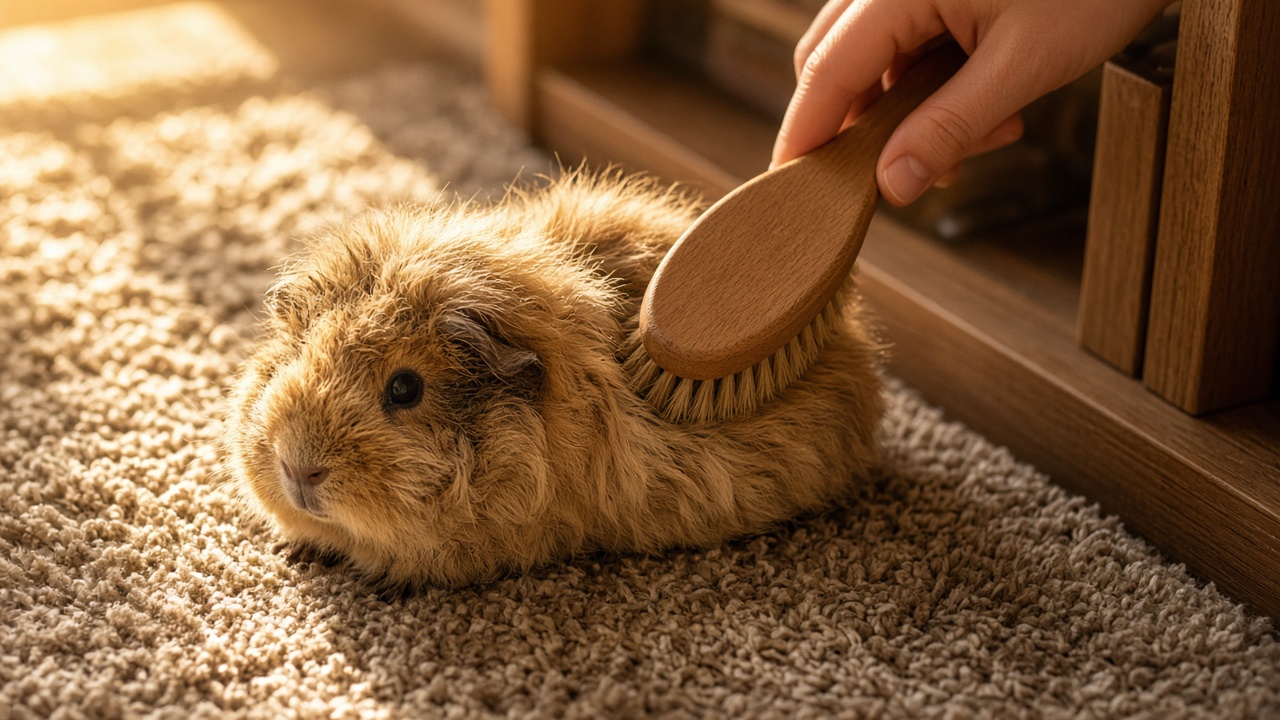
Quick answer: A fancy bear hamster is a Syrian hamster sold under a trade name. Keep one animal in a deep enclosure with a solid wheel and a uniform pellet diet. Skip starter cages whose listed length times width falls under 775 square inches.
A fancy bear hamster is a Syrian hamster that UC Davis lists as living 1.5 to 3 years. This page is a research-desk comparison of published care figures and current habitat labels.
What a fancy bear hamster is
Pet shops use “fancy bear hamster” as a sales label. The animal behind that label is the Syrian hamster, also called the golden hamster.
The UC Davis School of Veterinary Medicine names the golden, or Syrian, hamster as the most common pet hamster. Switzerland’s Federal Food Safety and Veterinary Office uses the same species under the name Goldhamster.
Those two offices do not use the phrase fancy bear. Our research team treated the phrase as a trade name, not a second species.
Syrian hamsters are nocturnal. The UC Davis page states they bite when startled. The Swiss office says they want to be left alone by day.
House one hamster. The Swiss office says even same-sex pairs or siblings rarely stay peaceful. Tight quarters can lead to wounds or death.
This desk’s selection rule is simple. We cover Syrian-bodied animals sold as fancy bear hamsters. We skip dwarf species, travel carriers, and tube-only add-ons.
We also skip color-standard lists.
Size and weight from published ranges
Do not guess adult size from a shop photo. Use the UC Davis weight bands.
That page lists adult Syrian males at 87 to 130 grams. It lists adult females at 95 to 130 grams.
Newborns on the same page weigh 1.5 to 3 grams. Gestation is 15 to 18 days. Litter size is 5 to 10 pups.
Males reach maturity at 8 weeks on that chart. Females reach maturity at 6 weeks.
Separate sexes before those ages. A six-week female is already mature on that chart.
Body temperature on the UC Davis chart is 100.6°F. Room targets sit lower. The same page sets the enclosure zone at 75°F to 85°F and humidity at 40% to 60%.
Hamsters lack sweat glands, per UC Davis. They also cannot pant. Heat stress is a real risk in a sunny window.
Coat types this page covers
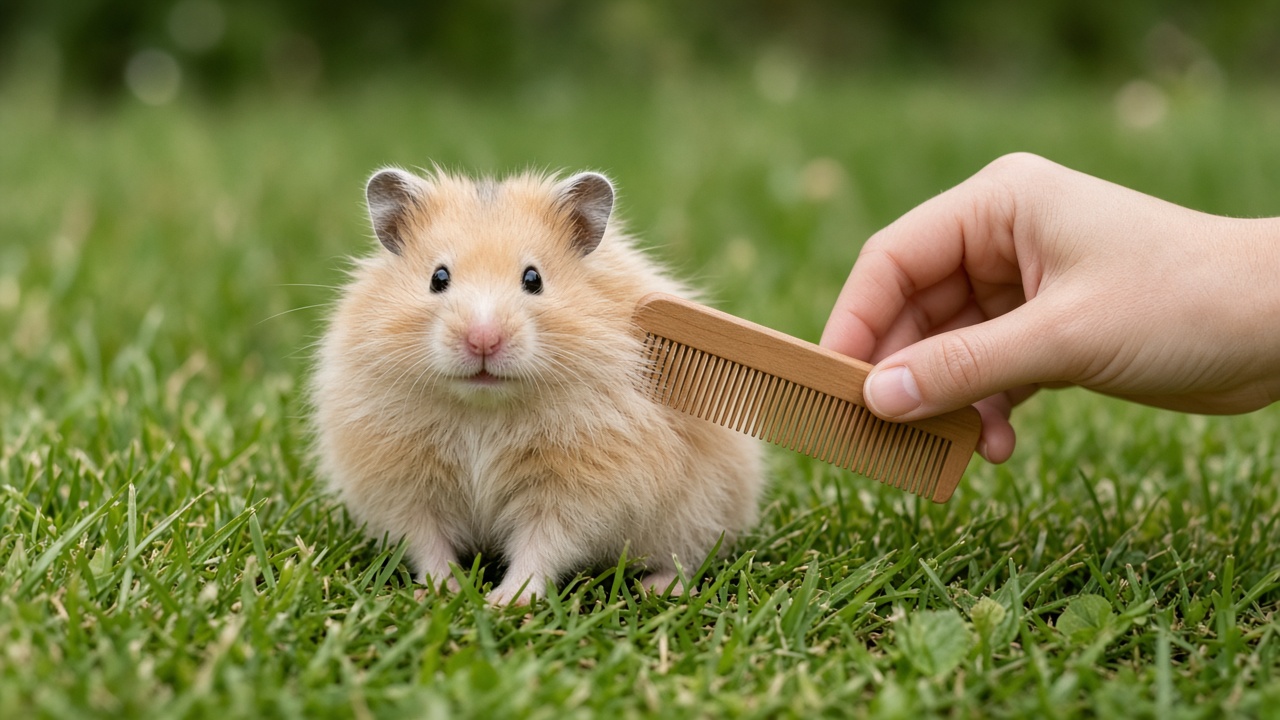
Fancy bear and teddy bear are shop words for coat length. Both still point to the Syrian body.
We cover short-coat care as the default fancy bear case. We mention long coats only where the same body size applies.
UC Davis warns that long hair can catch in a wheel. Trim that hair if it snags. Check metal wheels for sharp points.
The Swiss office tells owners to watch coat quality. A dull, rough coat sits on its illness list with sore eyes and a dirty vent.
A short coat still needs a dry nest. Damp bedding mats fur and hides wet-tail signs.
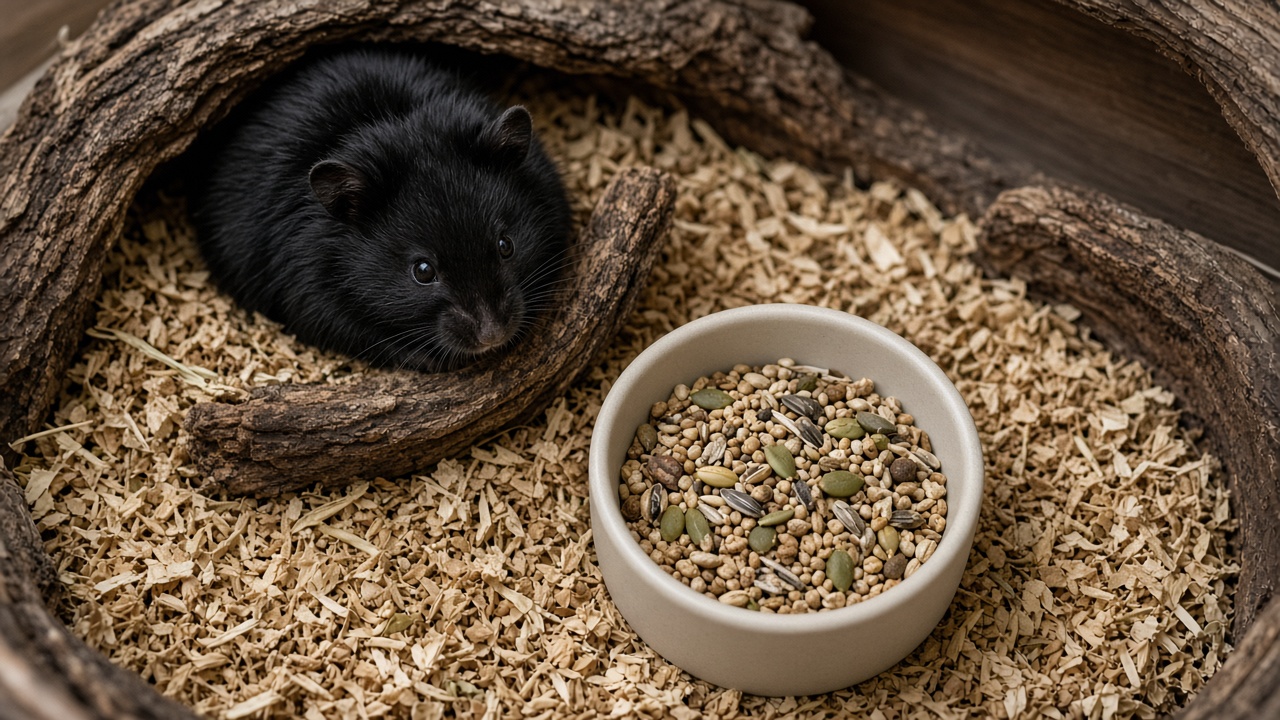
Do not use cedar, pine, or corncob bedding. UC Davis says those products can harm hamsters. Recycled paper is the bedding that page names as common and comfortable.
The Swiss office lists a sand bath in the Goldhamster setup. Use bath sand, not dust.
Cage floor space from listed dimensions
Cage size is the decision that fails most shop kits. We used one conversion and one rule.
The Swiss office sets a legal floor minimum of 0.18 square meters, or about 30 by 60 centimeters. Our research team converted that figure to 279 square inches.
The same office then says a better closed enclosure has at least half a square meter of floor. It wants a height of about 50 centimeters.
Half a square meter is 775 square inches. That 775-inch figure is our Floor-First Rule. A habitat meets that set only if maker length times maker width reaches 775.
We computed floor area from each maker’s published length and width.
The Swiss office also wants at least 15 centimeters of diggable bedding, about 6 inches. It calls 30 to 80 centimeters ideal, or about 12 to 31 inches.
It also names a solid-surface wheel of at least 30 centimeters, about 12 inches across.
Many U.S. starter cages miss both the floor rule and the bedding depth. A DIY hamster cage can hit 775 square inches when a store kit cannot.
| Product | Maker-listed dimensions | Computed floor (L × W) | Wall or bar spec | Maker-listed extras |
|---|---|---|---|---|
| Niteangel Vista Hamster Cage, size L | 47.1 × 22.7 × 26.9 in | 1,069 sq in | MDF aspen, oblique opening | Sold as S, M, and L sizes |
| Niteangel Vista Hamster Cage, size M | 40.7 × 22.7 × 22.9 in | 924 sq in | MDF aspen, oblique opening | Same Vista series as size L |
| Niteangel Vista Hamster Cage, size S | 32.9 × 17.2 × 21.1 in | 566 sq in | MDF aspen, oblique opening | Same Vista series as size L |
| Kaytee Crittertrail 2-Level Habitat | 11.5 × 20 × 16 in | 230 sq in | Wire, 0.29 in bar spacing | Wheel, dish, bottle, petting zone |
| Prevue Pet Products Hamster Haven Large SP2005GRAY | 21 5/8 × 13 3/8 × 14 1/4 in | 289 sq in | Wire, 1/2 in spacing | Platform, ramp, dome, wheel |
Only the Vista L and Vista M rows clear 775 square inches. Vista L is 1,069 square inches, or about 1.38 times the Swiss better-floor figure.
Vista S lands at 566 square inches. That is above the 279-inch legal floor. It is below the 775-inch better floor.
The Kaytee Crittertrail 2-Level Habitat lists 11.5 by 20 by 16 inches. Length times width is 230 square inches. That is about 30% of 775.
Prevue Pet Products lists the Hamster Haven Large SP2005GRAY at 21 5/8 by 13 3/8 inches. Height is 14 1/4 inches. Length times width is 289 square inches.
The Prevue page also lists 1/2-inch wire spacing. That 14 1/4-inch height cannot hold 12 inches of bedding plus a 12-inch wheel.
The Kaytee page lists 0.29-inch bar spacing and a 16-inch height. Levels and a lookout tower do not add unbroken floor.
The Niteangel Vista size L lists 26.9 inches of rear height. Size M lists 22.9 inches. Those walls can hold deep bedding that the wire kits cannot.
Place the enclosure out of bedrooms. The Swiss office says Goldhamster become loud after dark. UC Davis notes that wheel noise can keep people awake.
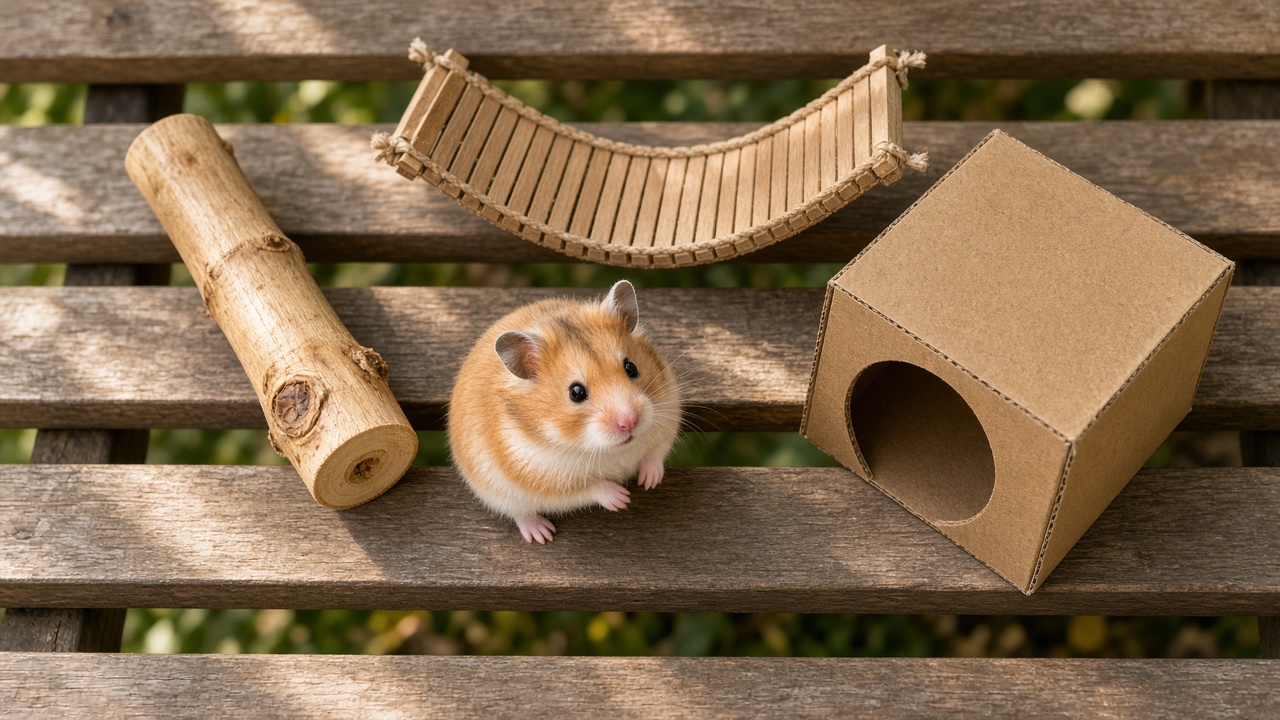
Give at least one hide. UC Davis says the house should hold bedding only.
Food amounts from maker labels
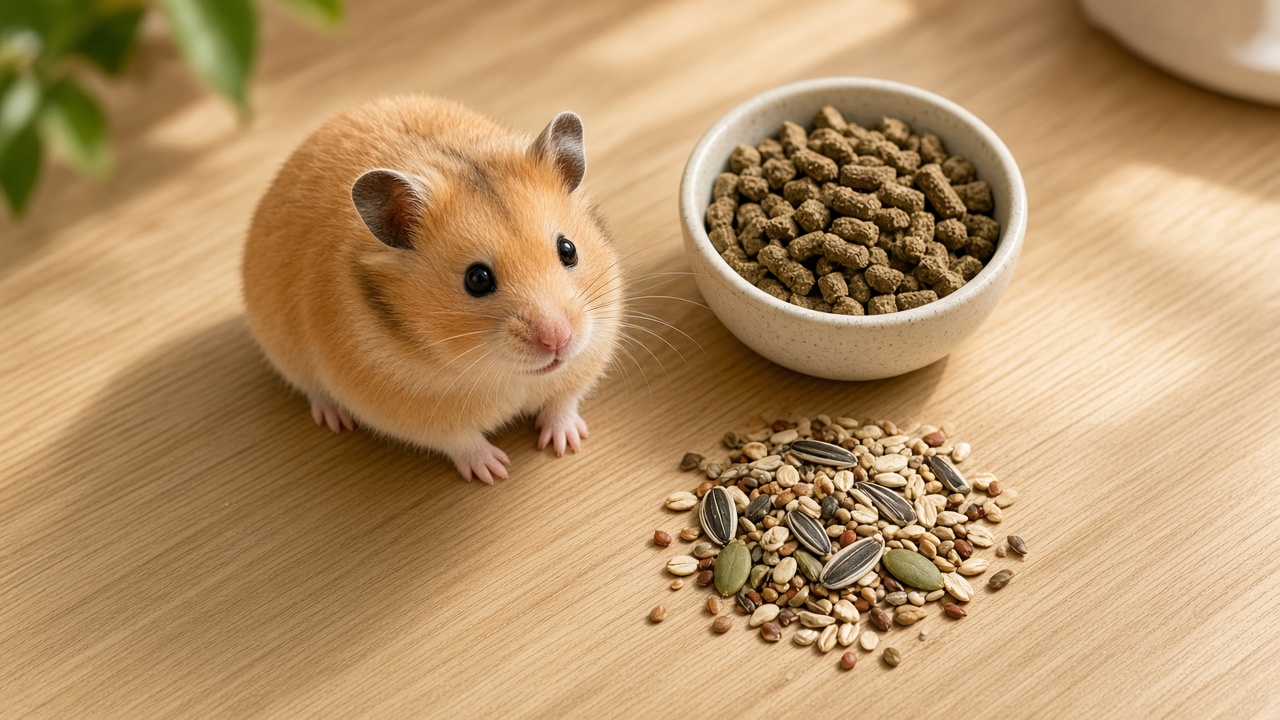
UC Davis rejects a seed-and-pellet mix. The hamster picks seeds and leaves the pellets. Use a uniform pellet as the staple.
Oxbow Animal Health prints feeding amounts on Essentials Hamster & Gerbil Food. An adult large hamster gets 1/3 cup a day after six months. An adult small hamster gets 1/8 cup.
Young, pregnant, or nursing animals on that label get unlimited pellets. A Syrian sold as a fancy bear hamster is the large hamster on that chart.
The same Oxbow label lists crude protein at 15.00% minimum. Crude fat is 4.50% minimum. Crude fiber is 10.00% minimum and 15.00% maximum.
Moisture is 10.00% maximum. Calcium is 0.60% to 1.00%. Phosphorus is 0.40% minimum.
Vitamin A is 10,000 IU/kg minimum. Vitamin D3 is 900 IU/kg. Vitamin E is 190 IU/kg.
Oxbow states a four-week switch. Move from one-quarter new food to the full bag by week four.
Check hoards. Oxbow notes that hamsters hide food, especially females. Cut the next scoop if a stash is growing.
UC Davis allows washed vegetables. It names carrots, squash, broccoli, cauliflower, cucumber, spinach, and other greens.
That page says hamsters do not handle high-sugar fruit well. Skip fruit as a daily extra.
UC Davis says to refill the water bottle every day. Clean bottles and dishes with soap, then bleach, once a week. Rinse until no bleach remains.
Lifespan, heat, and nightly running
UC Davis lists Syrian lifespan as 1.5 to 3 years. That range is the figure we use for fancy bear hamsters.
Plan the cage for that whole span. Some females run up to 10 kilometers a night, per UC Davis.
Use a quiet, solid wheel. UC Davis asks for a quiet wheel because the animal will use it often. The Swiss 30-centimeter minimum keeps the back flatter than a 5-inch shop wheel.
Keep the room in the 75°F to 85°F band from UC Davis. Stay inside 40% to 60% humidity.
Watch for wet tail. UC Davis defines that term as diarrhea in hamsters. Death may come as early as 24 hours after signs appear.
The Swiss office names high humidity, wet bedding, and broken rest as drivers of illness. Do not free-roam a hamster. UC Davis says they chew wires, carpet, and baseboards.
Handle slowly, and only after the animal is awake. UC Davis says hamsters are high-stress pets. Children should not clean a cage without an adult.
Cleaning the enclosure
The Swiss office says Goldhamster pick a toilet corner. Clean that corner every day. Replace all bedding at least once a month.
Deep bedding changes the job. You spot-clean the wet zone. You leave dry tunnels in place when they are clean.
For the full method, use our guide on how to clean a hamster cage. Match the interval to depth and odor with how often to clean a hamster cage.
UC Davis wants a weekly bleach wash on bottles and dishes. Scrub the sipper with a bottle brush. Mineral scale and hair block flow.
Prevue Pet Products tells owners not to dry a plastic tray in the sun. Sun heat can warp the base.
A tall bin is easier to spot-clean than a wire tray. That is another reason a DIY hamster cage often beats a 14-inch shop kit.
FAQ
Is a fancy bear hamster a different species from a Syrian hamster?
No. Fancy bear is a trade name. The UC Davis School of Veterinary Medicine describes the common pet as the golden, or Syrian, hamster.
The Swiss office uses Goldhamster for the same solitary species. This page treats fancy bear, golden, and Syrian as one body type.
How big does a fancy bear hamster get?
UC Davis lists adult Syrian males at 87 to 130 grams. Adult females are 95 to 130 grams.
Newborns weigh 1.5 to 3 grams on that chart. Shop age does not replace a scale check.
Can two fancy bear hamsters share a cage?
No. The Swiss office says Goldhamster are solitary and should live alone. Same-sex pairs and siblings still fight in small spaces.
Plan one enclosure per animal.
What cage size should I buy?
Use the Floor-First Rule. Convert the Swiss better-floor figure of 0.5 square meters to 775 square inches. Multiply the maker’s listed length by listed width.
In our spec comparison, only the Niteangel Vista Hamster Cage sizes M and L cleared 775 square inches. The Kaytee Crittertrail 2-Level Habitat computed to 230. The Prevue Hamster Haven Large SP2005GRAY computed to 289.
How long do fancy bear hamsters live?
UC Davis lists 1.5 to 3 years for Syrian hamsters. That is the range we apply to the fancy bear trade name.
Wet tail can end that span in 24 hours, per the same page. Heat, wet bedding, and a cage under 775 square inches add avoidable stress.
What should I feed a fancy bear hamster?
UC Davis wants a pellet staple, not a seed mix the animal can sort. Oxbow Essentials Hamster & Gerbil Food lists 1/3 cup a day for an adult large hamster.
That Oxbow label also lists 15.00% minimum protein and 4.50% minimum fat. Offer washed greens from the UC Davis list. Skip daily fruit.
How deep should bedding be?
The Swiss office sets a legal bedding depth of 15 centimeters, about 6 inches. It calls 30 to 80 centimeters ideal.
Wire cages 14 to 16 inches tall cannot hold that depth and a 12-inch wheel. Choose a deep box, then scoop the toilet corner daily.