Quick answer: Brief nest-and-settle scratching is normal. Watch for frantic, leftover, or destructive digging. Match slack covers to nesters, airflow to heat, and tough fabric to shredders.
Dogs scratch their beds mainly to nest, mark scent, and adjust temperature before they rest. This research brief compares published papers and maker specs; we did not run trials, time bouts, or examine a dog.
Stanley Coren at the University of British Columbia recorded circling in 62 pet dogs. On smooth carpet, 19 percent turned a full circle. On lumpy shag, 55 percent did.
That is the closest experimental number we found for the nest-first story.
The American Veterinary Medical Association’s 2025 Pet Ownership and Demographic Sourcebook counts 87.3 million dogs in the United States. Those dogs live in 42.6 percent of households. A lot of living rooms now host this ritual every night.
What this brief covers
Our selection rule is simple. We included a bed only if the maker’s page lists inches plus a weight or length cap. We left out crate pads under 2 inches, heated pads, and listings that hid dimensions.
We compared published specs. We did not rank models. We did not sort them by price.
The Six-Trigger Scratch Map is our frame. It covers nesting, heat or cold, scent, poor fit, leftover energy, and pain or itch.
If the bout ends in sleep, treat it as a settle routine. If it shreds foam, treat the bed as the wrong tool.
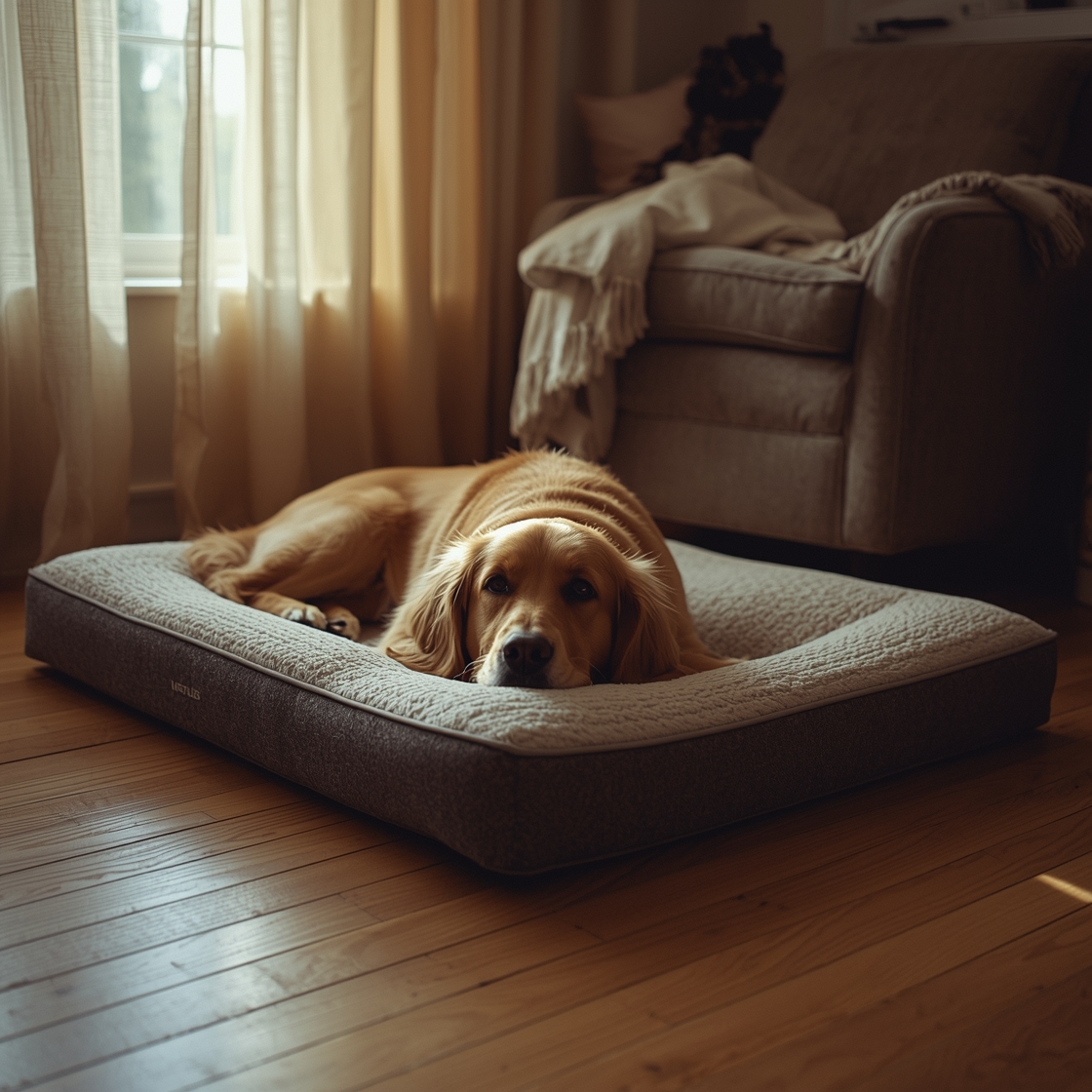
Nesting is a flattening ritual
Dogs inherited a ground-prep sequence from wild canids. They circle, paw, and drop. The bed is now the ground.
Coren’s 2016 write-up of that 62-dog trial is the rare measured test. Dogs on the uneven shag were nearly three times more likely to circle.
Some also poked or dug the shag. None did that on the smooth mat.
That does not prove every scratch is nesting. It does show a deformable surface turns the motor program on.
Casper’s own product page states the same instinct in design language. The Casper Dog Bed cover has extra material on top. The company says that slack is meant to mimic pawing at loose earth.
A short nest-and-flop is not a problem. A long remodel that never ends is a different signal.
Digging to cool down or warm up
The Merck Veterinary Manual lists a normal dog rectal range of 99.5 to 102.5 degrees Fahrenheit. That is hotter than a human core. A stuffed bed can feel like a heat trap.
Wild canids dug to cooler soil in summer. They piled debris in winter. Indoor dogs still run that script on fabric.
Kuranda’s Standard Almond PVC Dog Bed, sold since 1987, is an elevated cot. The maker’s page says airflow under the bed helps regulate body temperature. There is no stuffing to excavate.
K9 Ballistics lists the same idea in a tougher frame. Its Chew Proof Armored Ripstop Elevated Dog Bed in Large measures 41 by 27 by 6 inches. The sleeping surface is 39 by 25 inches.
The K9 Ballistics page also says the sling is 1200D ripstop ballistic polyester. The frame is 100 percent aluminum, including the corners. That surface cannot be fluffed, so heat-diggers get airflow instead of a hole.
If scratching rises only on hot afternoons, start with airflow. A thick nest bed may be the wrong season tool.
The American Kennel Club says most adult dogs sleep 12 to 14 hours a day. That is a long time on one surface. Temperature mistakes add up.
Scent left by the paws
Paw pads carry scent glands. Scratching rubs that odor into cloth. The bed then smells like the dog.
This is not spite. It is a claim. Multi-dog homes often show more of it.
The AVMA reports an average of 1.6 dogs per dog-owning household. Two dogs on one pad will restack that scent every night.
Washing the cover can reset the smell. Then the dog may scratch more for a night or two. That rebound is common.
Do not punish the pawing. You are scolding a marker, not a vandal.
If the dog also urine-marks nearby, treat the whole room as a scent problem. The bed is only one surface.
When the bed itself is the trigger
A bed can be too small, too slick, or too flat. The dog then “fixes” it all night.
Compare published footprints. Casper’s Large Dog Bed is 45 by 35 by 7.5 inches. The inner sleep area is 35 by 25 by 3.5 inches.
That is 10 inches of bolster on length and 10 on width.
Casper lists that Large size for dogs up to 90 pounds. A long sprawler can still run out of floor. The extra cover slack then becomes the only thing left to rearrange.
Big Barker’s Original Orthopedic Dog Bed in Large is 48 by 30 by 7 inches. The foam stack is a 2-inch base, a 3-inch support layer, and a 2-inch top. The Extra Large size is 52 by 36 by 7 inches.
The maker’s 10-Year No-Flatten Warranty requires the foam to keep at least 90 percent of its original shape. Flattened foam is a common reason dogs keep digging the same spot.
If your dog is a large sprawler, a thin pad invites endless pawing. See our best orthopedic dog beds for large breeds guide.
Kuranda’s size rule is length, not weight. A dog up to 36 inches nose to tail base gets the 40 by 25 inch frame. Measure before you buy.
K9 Ballistics uses a different length rule. Measure nose to tail base, then add 10 inches. The sleeping area is 2 inches smaller than the listed frame on each side.
Collapsed fill is another trigger. Best Friends by Sheri says AirLoft in The Original Calming Donut keeps loft up to three times longer than most fluffy beds.
The 30 by 30 inch size is listed for dogs up to 45 pounds.
A lumpy donut still gets remodeled. Replace fill that has gone flat.
Anxiety, boredom, and leftover energy
Scratching can be a soothe loop. It can also be leftover motor energy.
Watch the clock. If digging starts when you pick up keys, the trigger is departure. If it starts after a silent afternoon, the trigger is underwork.
The American Kennel Club says puppies often sleep 18 to 20 hours a day. The awake hours are intense. An overtired puppy may shred a bed instead of settling.
Do not buy a plush nest for a teething puppy. The AKC’s puppy-sleep page even warns that new pups often chew expensive beds. Puppy naps may last 30 minutes to two hours.
For a worried adult, a high rim can help. Best Friends by Sheri’s 30 by 30 inch donut uses a raised rim for head support.
The cover is a removable zipper shell. Wash it on a gentle cycle and tumble dry on low.
Our calming dog bed guide covers nest shapes.
Exercise first. Then offer the bed. A wired dog will treat stuffing as a toy.
Pain, itch, and restless older dogs
Sudden, frantic scratching is not a cute ritual. It can track with itch, joint pain, or a broken sleep-wake cycle.
The AVMA’s 2025 sourcebook is based on 7,519 survey responses. It does not measure bed scratching. It does show how many homes now share sleep space with dogs.
Average veterinary spending is $598 per dog-owning household per year. Use that care budget when the ritual changes.
Older dogs may paw because they cannot get comfortable. They may also try to climb your mattress and stall at the edge. A dog ramp for the bed reduces that scramble.
Do not guess at skin disease from a shredded cover. A licensed clinician can check ears, paws, and joints.
Night pacing plus bed ripping is a different pattern than a brief nest. Treat the whole night, not the fabric.
Beds matched to the scratching pattern
We built this table from maker pages only. Columns are attributes. There is no rank and no price.
| Model | Form | Listed example size | Core or frame | Maker size rule | Wash or warranty note |
|---|---|---|---|---|---|
| Casper The Dog Bed | Bolstered foam mattress | Large 45 x 35 x 7.5 in; inner 35 x 25 x 3.5 in | Two-layer memory foam and polyurethane | Large listed for dogs up to 90 lb | Removable nylon, polyester, and olefin cover; 1-year limited warranty |
| Big Barker Original Orthopedic Dog Bed | Flat orthopedic mattress | Large 48 x 30 x 7 in | 2 in + 3 in + 2 in foam | Extra Large listed at 52 x 36 x 7 in | 10-year no-flatten; foam must keep 90% shape |
| Best Friends by Sheri The Original Calming Donut | Round bolster nest | 30 x 30 in | AirLoft poly fill | Listed for dogs up to 45 lb | Removable zipper shell; gentle cycle, low dry |
| Kuranda Standard Almond PVC Dog Bed | Elevated cot | 40 x 25 in frame | PVC frame, replaceable fabric | For dogs up to 36 in long | 1-year warranty; made in Glen Burnie, Maryland |
| K9 Ballistics Chew Proof Armored Ripstop Elevated | Armored elevated cot | Large 41 x 27 x 6 in; sleep 39 x 25 in | 100% aluminum frame; 1200D ripstop sling | Large listed for 50 to 80 lb | 120-day chew-proof warranty |
Pick by trigger. Nest scratchers often like Casper’s extra cover slack or Sheri’s burrow crevices.
Heat diggers often do better on Kuranda or K9 Ballistics airflow. Joint-sore large dogs often need Big Barker’s 7-inch stack.
A shredder needs a bed that cannot spill foam. K9 Ballistics says the ripstop model has no padding. Elevated armored fabric fails safer than a stuffed pillow.
Casper’s cover care is cold water, gentle cycle, and a low tumble dry. The company also lists a 1-year limited warranty and a 30-day unused return window. Those are care facts, not a score.
K9 Ballistics asks for at least a quarter inch of crate wiggle room. The legs must stay on. The maker says the sling needs about 3 inches of ground clearance to cradle the dog.
FAQ
Why does my dog scratch the bed and then lie down?
That short sequence is the nest program. Coren’s 62-dog trial found more circling on a lumpy surface than on a smooth one. If the dog sleeps after the last scratch, the job is done.
Why does my dog scratch my bed more than their own?
Your mattress is larger, warmer, and already full of household scent. It also has more loose bedding to rearrange. Give them a legal nest with slack fabric if you want that energy off your sheets.
Is bed scratching a sign of fleas or allergies?
It can be, when the dog also chews paws, licks skin, or cannot settle. Isolated pre-sleep pawing is a weak clue. Look at the skin and the rest of the night, not the bed alone.
How long should the scratching last?
We did not time bouts in this brief. A sequence that ends in rest is the usual pattern. Digging that runs for many minutes without sleep is the flag.
What if my dog destroys every stuffed bed?
Stop buying loose fill and use an elevated cot with a listed chew policy. K9 Ballistics offers a 120-day chew-proof warranty. Kuranda lists a one-year warranty.
Should I stop my dog from scratching the bed?
Do not punish a brief nest. Redirect only when fabric is failing or the dog is distressed. Change the bed type before you change the dog.
When should I get clinical help?
Get help if scratching is new, frantic, or paired with limp, itch, or night pacing. A research desk cannot diagnose that mix. A licensed clinician can.