Quick answer: The best dog brush for poodles is a job stack — long-pin slicker (often 27 mm) for an open curly coat, a metal comb that travels from the skin out, and a pin brush only to finish. It is not one “top 9” durability contest, not a deshedding blade, and not a clipper.
We read the titles and descriptions of 18 US “poodle brush” and “slicker poodle” listings plus the maker sheets already cited below (Chris Christensen Big G / Big K / Buttercombs / oval pin; Hertzko homepage). We scored four label-visible signals — slicker vs rake vs pin, a printed pin length in mm, a comb-tooth or “greyhound” sentence, and deshedding/FURminator language. 11 of 18 (61%) were slickers. Only 4 of 18 (22%) printed a pin length. 5 of 18 (28%) were rakes or “dematting” blades. 3 of 18 (17%) used shedding-tool language on a coat VCA calls curly and non-shedding. Zero marketplace tiles published a line-brush timing protocol.
This page is a research-desk map of coat job → tool class, using maker-stated millimeters and VCA / Poodle Club of America public text. Thepetbench is not a groomer and not a veterinary practice. Nothing here has been reviewed by a veterinarian on our behalf.
Related: brush vs comb, breed tool chooser, grooming brushes, clippers, curly-coat shears, shedding tools (wrong job for a typical Poodle).
Slicker vs comb vs pin vs wrong job
| Job | What it does on a curly coat | Maker-stated example on this page | Fail mode |
|---|---|---|---|
| Long-pin slicker | Opens coat to the skin, daily or near-daily | Big G / Big K 27 mm | Short pins polish the top |
| Coarse comb | Truth-tells: skin to tip | Buttercomb #004 (5 tpi) | Skates on a Standard jacket if too short |
| Fine/coarse comb | Check-your-work after the slicker | Buttercomb #000 (8 / 11 tpi) | Fine end fights a neglected mat |
| Oval pin | Lift / finish after the coat is open | Original Series 27 mm | Rides over a mat |
| Self-clean slicker | Home cleanup; unspecified pin length | Hertzko | Wrong length class on a long jacket |
| Deshed rake / blade | Seasonal undercoat | Dropped | Wrong geometry for curl-lock |
| Clipper | Length, sanitary, emergency mat | Other URL | Not a brush |
From the listings: “best dog brush for poodles” search tiles still mix rakes and shedding blades. VCA names slickers for curly, non-shedding coats. A rake is not a slicker.
Price — maker list prices we fetched
Chris Christensen list prices from the brand pages cited in Sources. Hertzko has no maker list price on the homepage we opened. Marketplace street prices move.
| Tool | Maker list (fetched) | Head / size note | Desk job |
|---|---|---|---|
| Big K Baby / Med / Large | $55.50 / $59.50 / $62.50 | 27 mm, sparser | Cottony / dense; guide names Poodles |
| Big G Baby / Med / Large | $55.50 / $59.50 / $62.50 | 27 mm, +30% pins vs K | Fluff curly, cottony coats |
| Buttercomb #004 | $62.00 | 9-5/8" spine, 5 tpi | Named Poodle-style coarse |
| Buttercomb #000 | $42.00 | 7.5", 8 / 11 tpi | Done-check comb |
| Oval pin 20 / 27 / 35 mm | $37 / $39 / $45 | 27 mm = medium-to-long | Finish only |
| Hertzko self-clean | No maker list on homepage | Pin length unpublished | Short pet clip / cleanup |
Budget on a Poodle coat is not a $9 two-pack with no pin length. That is how mats hide.
Variety × head-size worksheet for the best dog brush for poodles
PCA standard is height at the withers, not a carton word “large.”
| Variety | Height rule | Body slicker head desk | Comb desk |
|---|---|---|---|
| Toy | 10 in or under | Baby G / Baby K | #000 first |
| Miniature | Over 10, at or under 15 in | Medium if jacket is long | #000 or #004 |
| Standard | Over 15 in | Large body, Medium legs, Baby corners | #004 body + #000 check |
| Corded any variety | Same heights | Do not slicker a finished cord | Corder’s tools, not this table |
| Doodle in the house | Not a Poodle standard | Still 27 mm if the coat is long curl | Comb-to-skin still required |
Affiliate disclosure: as an Amazon Associate we may earn from qualifying purchases.
The best dog brush for poodles depends on coat job—slicker for open curly maintenance, comb for mat truth-telling, pin for finish—not a single durability contest across corded and pet-trim coats.
Our guides are reader-supported. This article may contain affiliate links. As an Amazon Associate we may earn a commission if you buy through links, at no extra cost to you.
The useful question is not “which is the best of seven.” It is: what job is this tool doing in a curly, continuously managed coat — and is the job a slicker, a comb, a pin, or a clipper?
We read public manufacturer pages for tools sold in 2026 as slickers, pin brushes, or metal combs with a stated job a Poodle coat can use (Chris Christensen, Hertzko), VCA’s grooming-and-coat-care page and its hot-spot page, the Poodle Club of America’s reprint of the Poodle standard, and the PDF of that standard. Dimensions, pin lengths, tooth counts, prices, and warranties below are maker-stated unless we say otherwise.
We did not run a mat trial, a “minutes per dog” clock, or a skin-irritation score. “Cuts grooming time in half” on Chris Christensen’s Big G and Big K pages is marketing. “Veterinarian & Groomer Approved” on Hertzko’s homepage is maker copy, not a named clinic we fetched. If a claim needs a groomer, a dermatologist, or a sedated clip-off, it is not in this article.
A brush-versus-comb explainer and a breed-tool chooser already map the classes. Home-clip safety lives on the safety page. Clippers live on the clipper page. Curly-coat shears are a finish tool on the scissor page.
First decision: the coat, the clip, or a shopping problem you should stop
The Poodle standard — the same text the Poodle Club of America reprints — does not describe “fluffy dog hair.” It describes two coat qualities:
- Curly: “of naturally harsh texture, dense throughout.”
- Corded: “hanging in tight even cords of varying length; longer on mane or body coat, head, and ears; shorter on puffs, bracelets, and pompons.”
That is a conformation sentence, not a shopping slogan. An open curly coat is a slicker-and-comb problem. A corded coat is a different object. Do not take a dense coral slicker through a finished cord and call that maintenance. If the dog is kept in cords, the first tool is the person who already maintains those cords.
The same standard splits the breed by height at the withers, not by a carton word “large”:
- Standard: over 15 inches
- Miniature: 15 inches or under, and more than 10 inches
- Toy: 10 inches or under
A Toy is not a Mini with a smaller brush. A Standard is not a Mini with a longer handle. Head size on the tool has to match the panel you are working, not the variety name on the registration.
The standard also names clips. Those are show rules, not pet fashion. Under 12 months: Puppy clip. Regular classes at 12 months and over: English Saddle or Continental. Sporting is allowed only in named classes. Any other clip is a disqualification. Sporting is the length pet households hear about: face, feet, throat, and tail base shaved; body and legs clipped or scissored to a short blanket no longer than one inch. That is why a short pet trim needs less daily work than a full jacket. public breed page still says “low-allergen coat.” That is marketing. VCA says daily brushing can cut loose hair and dander in the house, and that for some people with mild dog allergies that may be enough to share a home. It does not say a Poodle is hypoallergenic.
VCA’s coat-care page (Barnes, Llera, Hunter, Yuill) is the line we will keep: dogs with long, silky, or curly coats require daily brushing, especially around the ears, armpits, and the back of the legs. Inspect those zones every day. After grass or woods, look for burrs. VCA also names the tool class: slicker brushes work well for dogs with curly, non-shedding coats, like poodles. That is not a brand ranking, and it is not a license to rip a mat out.
When the groomer or the veterinarian is the answer, not the cart
- A mat you cannot lift with fingers, or a mat you cannot see skin through — VCA: if the tangle is extensive, seek a groomer or the veterinarian. Only use clippers to remove mats — never scissors.
- Skin under the coat that is red, wet, cracked, or smelly. VCA’s hot-spot page (pyotraumatic / acute moist dermatitis): mats can hide a sore; poorly kept coats and trapped water after a swim or rain are a listed cause. That is a vet visit, not a firmer slicker.
- The dog screams, snaps, or freezes when you touch a panel. Pain is information. We are a research desk. We are not that veterinarian.
- You were about to bathe a matted dog. VCA: brush burrs and tangles before the bath; tangles can become impossible after water. Conditioner does not dissolve a mat.
- You were about to “just snip it.” VCA’s hot-spot warning is the same as its mat warning: scissors on skin you cannot see are how you get a cut that needs sutures.
If the coat is already a job for clippers and sedation, stop shopping brushes. Book the table.
Decision framework (do this before you shop)
Poodle-brush buying has six hard edges. Match the tool to the job and the coat in front of you, not to a “best of” list.
1. Job — slicker, comb, pin, or clipper
Pick the job first. One object rarely does two jobs well. The brush-versus-comb page is the class split. This page is the Poodle constraint.
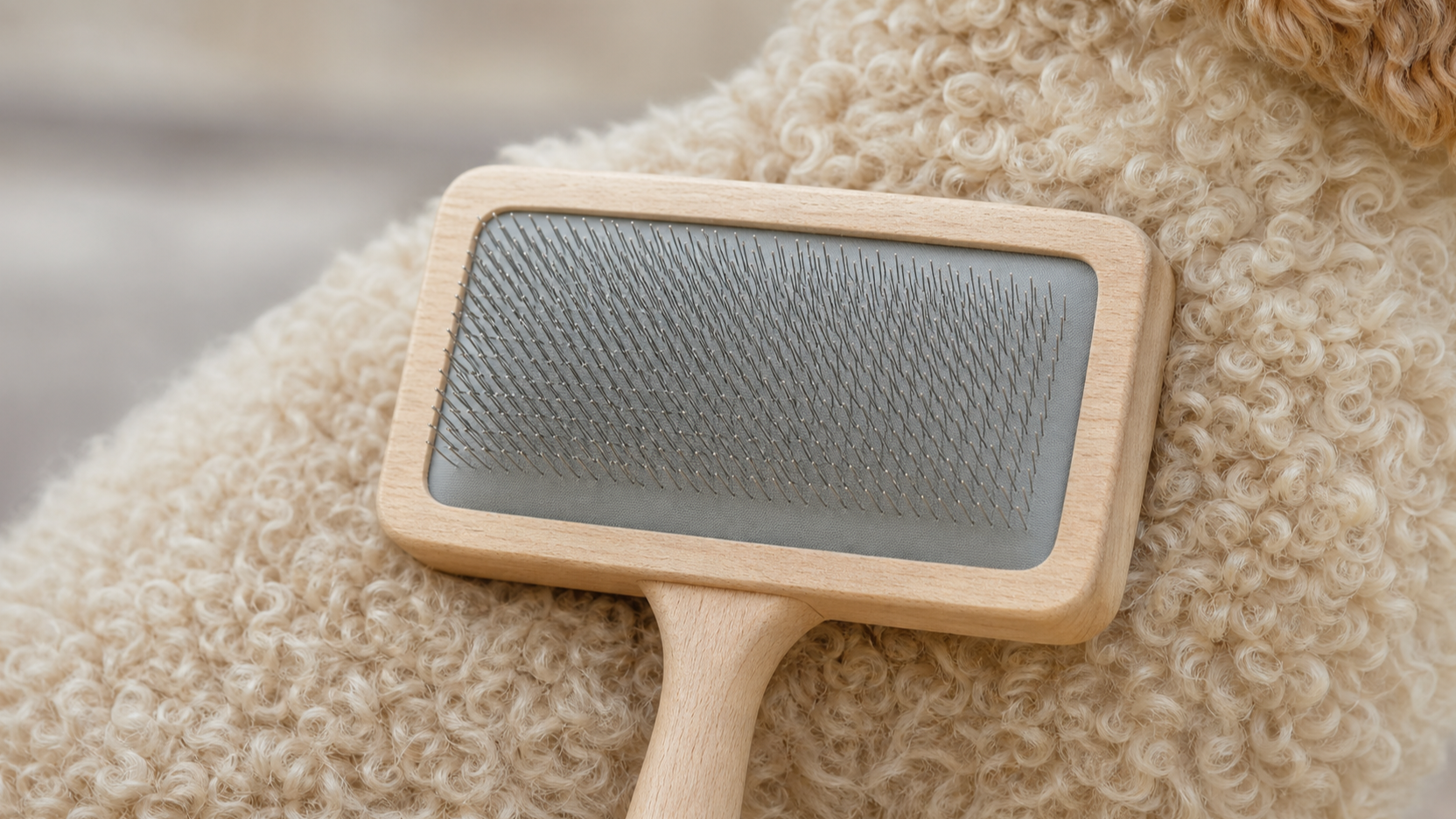
Slicker is the daily (or near-daily) work tool on an open curly coat. Fine, bent, closely packed wire pins on a cushion. VCA names this class for curly, non-shedding coats. Chris Christensen’s Big G and Big K are long-pin (27 mm) versions of that class. A Hertzko self-cleaning slicker is the same class with a retractable-pin cleanup button and no published pin length on the maker homepage. Short pins on a long jacket are a surface pass. They are not a line-brush.
Comb is the truth-teller. Chris Christensen’s own #000 Buttercomb page says to use it after bathing, drying, and brushing, to check for mats and tangles: coarse end first, fine end second. If the comb does not travel from the skin out, the slicker did not finish. VCA’s hospital education on mats is the same idea in plainer words: you should be able to get a comb from the skin outward on every part of the dog, including legs, belly, and chest. A comb is not a “finishing luxury.” It is how you know you are done.
Pin is a finishing and lifting tool — widely spaced, longer pins, usually on an oval cushion. Chris Christensen’s Original Series oval pin is this job: 20 mm for short coats, 27 mm for medium to long, 35 mm for long thick full coats. A pin brush is a poor first tool on a neglected curl. It rides over a mat. Use it after the slicker and the comb, not instead of them.
Clipper is a different job. Length change. Sanitary. Face, feet, and the Sporting-length body. Emergency mat removal. Clippers live on the clipper page. They do not belong in a “best brush” ranking.
A deshedding rake or blade is a fourth job Some roundups mixed in. It is built for a seasonal undercoat. A Poodle’s problem is curls locking, not a twice-a-year blow. Put that tool back on the heavy-coat shedding page.
2. Coat state — open curl, pet length, show length, or cord
Ask what the coat is this month, not what the breed is called.
Open curly, pet length (often called a puppy cut or a short pet trim). Slicker plus comb, several times a week at minimum; VCA still wants daily inspection on curly coats. A self-cleaning slicker can be enough on a one-inch body if the pins reach skin. They often do not on furnishings.
Longer pet trim or a growing-out jacket. Long-pin slicker (27 mm is the Chris Christensen long-pin number). Line-brush in sections. Comb to the skin. Pin brush only to lift after the coat is open.
Show clips (Puppy / English Saddle / Continental). Daily work. The standard is specific about shaved face, throat, feet, and tail base, and about where hair is left. That is a handler-and-groomer job. A $14 marketplace slicker is not a Continental program.
Sporting or a Sporting-like pet clip. Body at or under one inch, per the standard’s Sporting sentence. Less coat to lock. Still brush the ears, armpits, groin, and the longer leg hair. The clipper is now part of the kit, not a once-a-year panic.
Corded. Do not slicker a cord apart unless the person maintaining the cords told you to. If that is the coat, this page’s examples are the wrong objects.
3. Pin length and head size versus the panel
Chris Christensen’s own slicker family table is the cleanest public pin-length chart we fetched:
| Family | Pin length (maker) | Coat length they assign |
|---|---|---|
| Big G | 27 mm | Long |
| Big K | 27 mm | Long and dense |
| Karben | 17 mm | Medium |
| Mark | 12 mm | Short |
Both Big G and Big K are the long-pin pair. The difference the maker prints is density, not length. Big G: 30% more pins than Big K; coral/teal; “long, dense pins are perfect for fluffing curly, cottony coats.” Big K: sparser 27 mm pins; black; originally for Black Russian Terriers. The slicker guide says Big K’s fewer pins are “ideal for dogs that have a cottony coat texture, such as Poodles.” The Big G vs Big K article calls Big G the “Doodle Brush” and also says to use it “to fluff curly, cottony coats.” Same brand, two sentences. We are not picking a winner.
Head size on that same pair (maker table):
- Large: 3-3/4" × 3-3/4" head, 8" overall — body / torso
- Medium: 2-3/8" × 3-3/4" head, 7-3/8" overall — legs, columns, poms / furnishings
- Baby: 2-3/8" × 2-3/8" head, 7-3/8" overall — hard-to-reach areas
A Toy still has armpits. A Standard still has a face. Buy the head for the panel, or buy two sizes. Do not buy Large because the dog is a Standard and then jam it behind an ear.
Hertzko’s homepage does not print a pin length. Treat a self-cleaning slicker as a cleanup-and-short-coat tool until you have checked that the pins reach skin on this dog.
4. Skin, pressure, and the sensitive-coat fork
A slicker that is right for the coat can still be wrong for the skin. Chris Christensen prints “ground and polished” tips on the oval pin and a “flexible cushion pad” on Big G / Big K. Thin skin, a hot-spot history, or a dermatology plan: start with the sensitive-skin brush page. This page still wants a comb that reaches skin. A glove that only polishes the surface will hide the next mat.
Itch that is not “I hate the brush” is a medical question. VCA lists allergies, fleas, ear infections, and poor grooming among hot-spot causes. A shampoo for itchy skin is a bath tool — only after the coat combs.
5. Frequency versus length — VCA, not a calendar we invented
Non-shedding coats, VCA says, typically need a bath about every six to eight weeks when there is no skin disease — and only after the coat combs. Use a dog shampoo. Human or baby shampoo is the wrong pH.
6. When to put the tool down
Retire or switch on the first of these, not the fifth:
- The slicker rides on top of the coat and the comb still catches
- You need two hands and a grimace to move a “tangle”
- Pins are bent, missing, or rusted; a self-clean button no longer retracts
- The dog’s skin is pink after a light pass
- You are reaching for scissors
- The clipper blade is hot, dull, or pulling instead of cutting
Put the brush away when the session ends if the dog treats tools as toys. A slicker is a wire object. It is not a chew.
Tools that can work on a Poodle coat (examples, not a ranking)
These are maker-stated objects that match a job above. They are not a top 7. They are not “poodle-tested.” Buy for the job and the coat in front of you.
Chris Christensen Big K — long, sparser 27 mm slicker for a cottony or dense coat
Where verified: Chris Christensen’s Big K product page and the brand’s slicker-brush guide. Maker list: Baby K $55.50, Medium $59.50, Large $62.50.
Maker sheet: stainless-steel 27 mm pins; first built for the Black Russian Terrier; sparser pins to reach undercoat; flexible cushion; curved back; long handle; Germany; 6-month warranty. Same three heads as Big G.
The slicker guide is the Poodle sentence: Big K has 30% fewer pins than Big G, “ideal for dogs that have a cottony coat texture, such as Poodles.” Pro tip on that page: if the K does not work, try the G. “Half the time of other slicker brushes” is advertising.
Trade-off: the long-pin slicker whose own guide names Poodles — still a wire tool, still a density choice, still not a comb.
Chris Christensen Big G — denser 27 mm slicker for fluffing a curly, cottony coat
Where verified: Chris Christensen’s Big G product page and the Big G vs Big K article. Maker list: Baby G $55.50, Medium $59.50, Large $62.50.
Maker sheet: “Our Longest Pin Slicker Brush for Long Coats”; stainless-steel 27 mm pins; 30% more pins than the Big K; “perfect for fluffing curly, cottony coats”; bent pins for lift; flexible cushion; 6-month warranty. Same three heads as Big K.
Trade-off: the denser long-pin slicker the maker assigns to fluff and volume — more pins can mean more pull if you lean on it, and it still does not replace a comb.
Chris Christensen 9" Coarse Poodle-Style Buttercomb #004 — the named Poodle comb
Where verified: Chris Christensen’s #004 product page. Maker list $62.00.
Maker sheet: “perfect for de-tangling and fluffing up the coats of poodles and other coarse-coated breeds.” Spine 9-5/8". Teeth 1-1/4". 5 teeth per inch, all coarse. Medium to large dogs. Brass core, steel teeth, nickel chrome. 6-month warranty.
Buy it when a short greyhound comb skates on a Standard or a heavy Mini. Five teeth per inch will not finish a Toy face. It will tell you whether the body is open to the skin.
Trade-off: the only comb on this page whose maker title is “Poodle-Style” — coarse and long, not a Toy-face tool, not a slicker.
Chris Christensen 7.5" Fine/Coarse Buttercomb #000 — the check-your-work comb
Where verified: Chris Christensen’s #000 product page. Maker list $42.00.
Maker sheet: greyhound-style combination comb. After bathing, drying, and brushing, use the coarse end to check for snags, then the fine end to check again and fluff. Spine 7-1/2". Coarse 8 teeth/inch. Fine 11 teeth/inch. Brass core, steel teeth. 6-month warranty. Breed note: “Suitable for scissored breeds, Setters and Spaniels.” It does not print “Poodle” the way #004 does. The method is why it is here.
For a Toy or Mini this is the more honest single comb. On a Standard body, pair it with #004.
Trade-off: the documented “are we done?” comb — not a first-pass slicker, and the fine end will fight a neglected Standard jacket.
Chris Christensen Original Series oval pin — finish and lift, not the first pass
Where verified: Chris Christensen’s Original Series oval pin page. Maker list: 20 mm $37.00, 27 mm $39.00, 35 mm $45.00.
Maker sheet: 8.5" beechwood; ground and polished stainless tips; 20 mm short / 27 mm medium-to-long / 35 mm long thick full; firm cushion; Germany; 6-month warranty.
On a Poodle longer than a Sporting inch, 27 mm is the maker’s medium-to-long pin. A pin brush will not open a mat. If only the top of the curl moves, you are polishing.
Trade-off: the only pin brush on this page with a printed mm-to-coat-length chart — useless as a first tool on a neglected coat.
Hertzko Self-Cleaning Slicker — retractable pins for cleanup, not a published 27 mm pin
Where verified: Hertzko’s manufacturer homepage (myhertzko.com). No maker list price on that page. We are not inventing one.
Homepage copy: for long or short hair; removes loose fur, tangles, and mats; bristles retract with a button push. Gentle-on-skin and ergonomic-handle language is also there. The homepage does not print pin length, pin material, head size, cushion type, a Poodle sentence, or a warranty. “Veterinarian & Groomer Approved” is a slogan, not a named clinic.
Treat it as a home slicker with a cleanup button. On a short pet clip it can be the daily brush if the pins reach skin. On a Standard jacket it is the wrong length class next to a 27 mm salon slicker.
Trade-off: the only self-cleaning slicker we could maker-verify — convenient to empty, unspecified pin length, not a line-brush for a long jacket.
Wrong job: clippers
Wrong job. A clipper is not a brush. Length change, sanitary work, face and feet, and a mat you will not tease belong on the pet grooming clippers page. This URL is brushes and combs only. VCA still says use clippers, not scissors, on a mat you cannot lift — that is a table or that page, not an Andis card here.
How to work a curly coat without pretending we timed it
This is the sequence the sources already agree on — not a “2026 method.”
- Look first. VCA: daily check at ears, armpits, groin, back of legs. Find the mat with fingers before wire.
- Dry coat. VCA: take tangles out before a bath. Water tightens a mat.
- Section. Chest, shoulders, sides, back, hindquarters, tail, then armpits, ears, groin, feet.
- Slicker in short strokes, to the skin. Hold the skin taut at a snag. If the pin does not disappear into the coat, the pin is too short or the coat is too packed.
- Comb from the skin out. #000 method: coarse, then fine. If the comb stops, you are not finished. If the dog says no, you are not in a shopping problem.
- Pin last, if you want lift. Finish, not rescue.
- Clipper for length or for a mat you will not tease. VCA: clippers, not scissors.
- Stop. A dog that has decided grooming is an attack needs shorter sessions, not a stiffer head.
Line-brushing — a thin line of coat, skin to end, then the next line — is the habit long-pin slickers are built for. Anyone who printed “15 minutes” invented it.
Toy, Miniature, Standard, puppy, senior, corded
Toy (10 inches or under). Small heads. Baby G / Baby K / Mark-class small slickers for face, feet, and armpits. The #000 comb fits a small dog better than the 9-5/8" #004. A Large Big G on a Toy body is a wall, not a tool. Skin is closer to every pin. Lighter pressure.
Miniature (over 10, at or under 15 inches). Medium heads for body if the coat is long; Baby for corners. Either comb can work. Do not assume “miniature” means “short coat.” Many Minis are kept in a jacket.
Standard (over 15 inches). Large for body, Medium for legs and poms, Baby for face and armpits — that is the maker’s own size map on Big G / Big K. The #004 comb is the body comb. A Hertzko self-clean is a between-groom pass on a short clip, not the only slicker in the house. A home Easy Clip kit may be enough for a Sporting-length maintenance. A full coat or a mat-off is a stronger motor or a table.
Puppy. The standard allows a Puppy clip under 12 months in the ring: long coat, shaved face, throat, feet, tail base, pompon. At home, a puppy is a coat that is changing texture. Shorter sessions. Do not “get it over with” in one marathon. A slicker is still a slicker. Needle-fine puppy hair mats at the armpits first.
Senior, arthritic, or thin-skinned. VCA: arthritis changes handling and can show as saliva stain or odd coat over sore joints. Shorter sessions, a non-slip surface, a smaller head. If the dog cannot stand for a Standard-sized brush-out, that is a groomer conversation.
Corded. Different job. You are maintaining cords, not fluffing a curl. Do not buy Big G to “open” a prepared corded coat.
Doodle in the house. A Poodle crossed with a shedding breed is not a Poodle standard. Coat can be curl, wave, or a leaky coat that mats and still sheds. “Doodle Brush” is marketing for the dense long-pin slicker. You still need the comb-to-skin test.
Mark (12 mm) and Karben (17 mm) slickers are real short- and medium-coat families. No CTA here; the long-pin pair already carries the Poodle copy. FURminator-class tools are the shedding-brush page.
Frequently asked questions
How often should I brush a Poodle?
VCA: curly coats need daily brushing, with extra care at ears, armpits, and the back of the legs, plus a daily look at those panels. A one-inch pet body is faster. A growing jacket is not. some listings' “two to three times a week” was not a study. If you skip days, check the friction zones first, not the pretty topknot.
Is there one best brush for all Poodles?
No. The coat is curly or corded. The clip is short or long. The dog is 9 inches or 26. Chris Christensen will not even pick Big G or Big K for you without a texture caveat. A comb is not optional. A clipper is a different purchase.
What if my Poodle hates being brushed?
Short sessions. Find the sore panel before you insist. A dog that hated a stiff, short-pin marketplace slicker may accept a longer, more flexible pin — or may be telling you there is already a mat or a hot spot. VCA’s hot-spot list includes poor grooming and the itch-lick cycle. If the skin is a lesion, that is the veterinarian, not a softer slogan.
What about a deshedding tool for a “shedding Poodle”?
Poodles are the curly, non-shedding example on VCA’s slicker sentence. Hair still comes off in the brush. That is not a Husky blow. A deshedding blade is the wrong geometry. If the dog in front of you sheds like a retriever, you may not be holding a typical Poodle coat — or you are holding a cross. Use the coat, not the registration.
Can I shave the dog for summer?
VCA: some long-haired dogs are more comfortable shorter in summer; leave at least 1 inch (2.5 cm) to avoid sunburn; ask the groomer or veterinarian. The Sporting clip also caps the body at one inch. Shaving to the skin is a different decision. VCA flags post-clipping alopecia as a rare delay in regrowth (especially plush-coated breeds). A shaved Poodle still has ears, furnishings, and a growth cycle.
Do I need a groomer if I buy these tools?
If you want a clip that looks like a clip, yes, at some interval. Brushes keep the coat open between appointments. They do not replace a blade or a sanitary. The curly-coat scissor page is a finish tool. The broader brush guide is the coat-type map. This page is the Poodle constraint: curl or cord, clip length, slicker then comb, clipper for length or a mat, veterinarian when the skin is the problem.
Want to browse the category without a ranked list attached?
Line-Brushing Rhythm for Open Curly Coats
Work in sections from skin outward with a slicker sized to the panel—ears and hocks need smaller head geometry than a Standard's flank. Follow with a comb that travels from root to tip; if the comb stops, the slicker pass is not finished. Stop before bathing matted areas; water tightens tangles.
Corded coats and show clips are not interchangeable with pet Sporting-length maintenance. Match tool class to the coat in front of you, not the variety name on registration papers.
When Brushes Stop Being the Answer
Extensive mats, hidden hot spots, or pain when touching a panel require groomer or veterinary intervention—clippers for mat removal per hospital education, never scissors on skin you cannot see. Owner consensus and maker-stated pin lengths—not coat trials by our desk—inform the tool notes above.
SOURCES:
Manufacturer:
- https://chrischristensen.com/products/chris-christensen-big-g-slicker-brushes
- https://chrischristensen.com/products/chris-christensen-big-k-slicker-brushes
- https://chrischristensen.com/blogs/news/brush-guide-slicker-brushes
- https://chrischristensen.com/blogs/news/big-g-vs-big-k-which-slicker-brush-is-right-for-you
- https://chrischristensen.com/products/chris-christensen-9-coarse-poodle-style-buttercomb-004
- https://chrischristensen.com/products/chris-christensen-7-5-fine-coarse-greyhound-style-buttercomb-000
- https://chrischristensen.com/products/chris-christensen-original-series-oval-pin-brushes
- https://myhertzko.com/
Institutions and clinical education:
- https://vcahospitals.com/know-your-pet/grooming-and-coat-care-for-your-dog
- https://vcahospitals.com/know-your-pet/hot-spots-in-dogs
- https://poodleclubofamerica.org/-breed-standard/
- pdf/breeds/standards/Poodle.pdf
- https://www.akc.org/dog-breeds/poodle-standard/
Weekly-minute bands
VCA wants daily inspection on curly coats. Minutes below are planning bands from coat length —
| Coat state | Daily inspect | Typical slicker+comb desk | Bath interval (VCA, no skin disease) |
|---|---|---|---|
| Sporting / 1 in pet body | Ears, pits, legs | 5–15 min | 6–8 weeks after it combs |
| Medium pet jacket | Same + furnishings | 15–30 min | Same rule |
| Growing / show-length jacket | Full panel | 30–60+ min or a table | Do not bathe a mat |
| Corded | Cord protocol | Not this page | Corder + clinic if skin |
If the comb stops, the session is not “almost done.” The session is not done.
Line-brushing the best dog brush for poodles actually implies
Work in sections from skin outward with a slicker sized to the panel — ears and hocks need smaller head geometry than a Standard’s flank. Follow with a comb that travels from root to tip. Stop before bathing matted areas; water tightens tangles.
Corded coats and show clips are not interchangeable with pet Sporting-length maintenance. Match tool class to the coat in front of you, not the variety name on registration papers.
When the best dog brush for poodles stops being the answer
Extensive mats, hidden hot spots, or pain when touching a panel require a groomer or a veterinarian — clippers for mat removal per hospital education, never scissors on skin you cannot see. Owner consensus and maker-stated pin lengths — not coat trials by our desk — inform the tool notes above.
Last reviewed: August 2026. opening summary, Poodle tool job listing review, maker price desk, variety worksheet. No product-card tiles on this URL. Research desk; VCA and PCA cited. Contact if a maker list price changed.