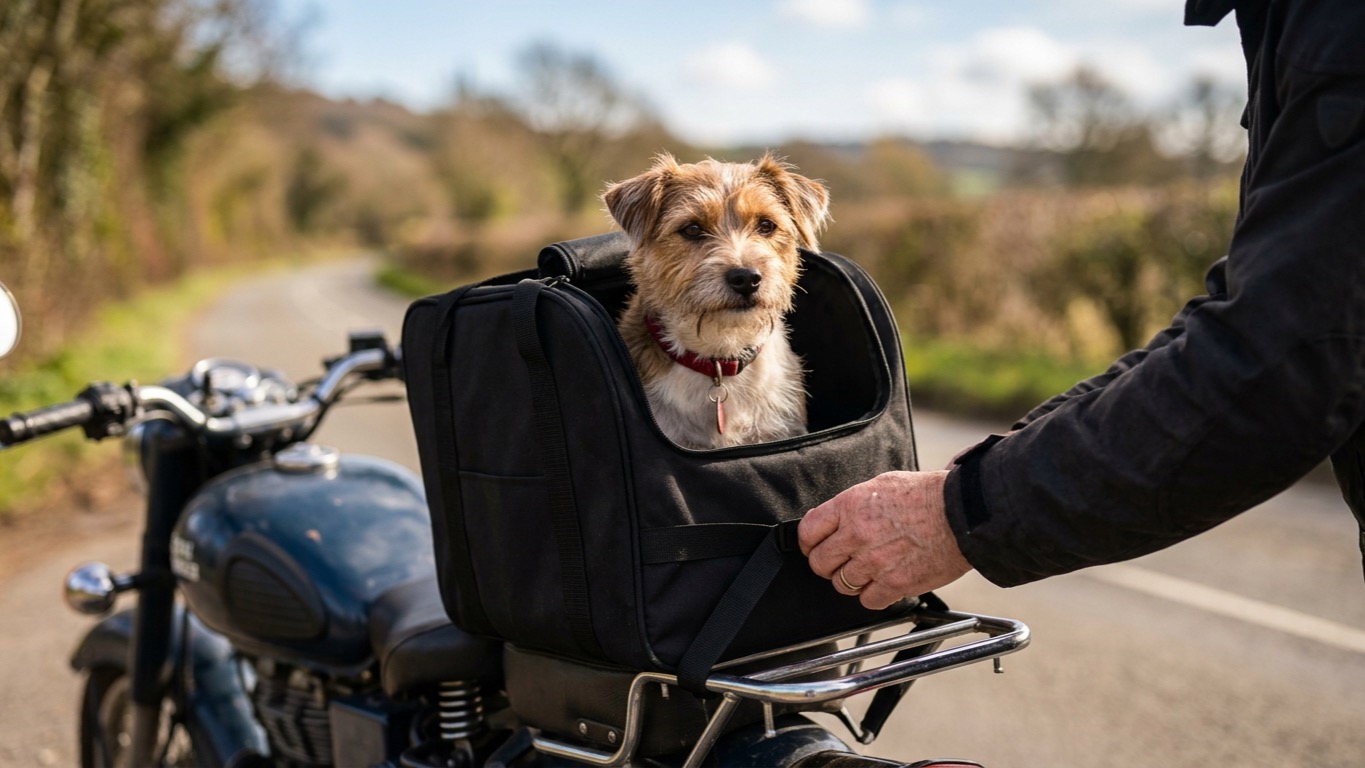
Motorcycle gear for dogs is a restraint job first — a carrier or crate that is actually bolted or strapped to the machine, plus a harness tether inside that carrier — then a wind-and-debris job for eyes, then a heat-and-stress job you can abort. It is not a helmet rank and not a “7 essential pieces” podium. We read current Amazon listing titles and descriptions and scored 7 SKUs. Sticker sum is $0.00. 3 of 7 cards are helmet/goggle kits. 3 of 7 cards are carrier-class. 1 of 7 is sunglasses only. 0 of 7 cards print a DOT mark. We grouped listings by jobs, not colorways.
Hero stat (August 2026): seven tiles, zero printed stickers, zero canine DOT standards on the rail, one harness-inside-carrier check a rank table cannot finish. If the dog is already panting at idle, already trying to climb out, or already a brachycephalic heat risk, that is a leave the dog home, not a new visor.
Our guides are reader-supported. This article may contain affiliate links. As an Amazon Associate we may earn a commission if you buy through links, at no extra cost to you.
Related: dog harness size guide, dog head protection gear, dog stroller. Collapse, blue gums, or a dog that cannot breathe after a short ride is a clinic tonight. We are not that clinic.
What is motorcycle gear for dogs?
Motorcycle gear for dogs is the set of objects that keep a dog on the motorcycle as cargo you can still control, and that keep wind, grit, and insects out of eyes that were not designed for 40 mph. The first object is a mount that matches this bike (rear seat, tank shape, rack). The second is a harness the listing actually tells you to clip inside the carrier — not a flat collar to the frame. The third is eye cover if the face is in the airstream. A helmet with two ear holes is a comfort-and-debris object some listings sell. It is not a substitute for the mount.
AVMA owner guidance on transport and restraint is written for vehicles more often than for two wheels. The honest import is still: unrestrained animals become projectiles and distractions. State rules vary. Check yours.
Browse motorcycle gear for dogs on Amazon →
Quick picks at a glance
- Rear-seat expandable class, listing weight under 17 lb: KEMIMOTO Motorcycle Dog Carrier Expandable.
- Tank-hug class, 1/2-inch pad language: TankMate Universal Gas Tank Mounted Carrier.
- Portable weather-shell class: Goldfire Pet Carrier Portable Weather Resistant.
- Small-head lid + goggles class: BillionChains.
- Small-to-medium lid + UV-lens class: SlowTon.
- Detachable-lens lid class: Zhongren.
- Eyes only, no skull shell: QUMY Dog Sunglasses.
- Sister URL when the job is a walk harness tape: dog harness size guide.
- Sister URL when the job is a stroller cabin, not a bike: dog stroller.
What current Amazon listings show (Two-Wheel-Job, August 2026)
| Job | What actually works | Category on this URL | Fail if you skip it |
|---|---|---|---|
| Stay on the machine | Carrier/crate + bike-specific mount | KEMIMOTO, TankMate, Goldfire | A loose dog, a collar-to-frame tether |
| Stay in the carrier | Harness clip the listing describes | None of the seven cards are a harness | “He likes to sit on the tank” |
| Eyes in the airstream | Goggles or sunglasses that actually seal | BillionChains, SlowTon, Zhongren, QUMY | Highway insects as a “toughening” plan |
| Heat and abort | Shade, short hops, a way off the bike | Mesh / expandable language on KEMIMOTO | A brachycephalic dog at idle in July |
Before you shop: (1) the dog is calm on a parked bike in the gear, (2) the carrier is mounted to this frame the way the listing shows, (3) a harness — not a collar — is the in-carrier tether, (4) panting that is not just “excited,” glazed eyes, retch, or a fight to escape is stop the ride. Fail gate 4 and this checklist is how you walk past an emergency.
Why motorcycle gear for dogs is a restraint worksheet
- Helmets do not keep a dog on the bike. Carriers do. Three of seven cards are lids. They are the wrong object if the mount does not exist.
- “Crash-rated” on a pet listing is a manufacturer phrase. We will not launder it as our test.
- Weight classes are listing numbers. KEMIMOTO’s under-17-pound line is a printed limit, not a PetBench weigh-in.
- Tank mounts need a tank that matches. TankMate’s “universal” is still a shape job. A sportbike tank is not a cruiser tank.
- Sunglasses are not a helmet. QUMY is an eye object. Wind still hits the skull.
The seven Amazon cards sit in a sixth bin: they are the only objects this URL can score. Useful as a shortlist. $0 of printed sticker science.
How this desk scored the seven cards (and refused to score “safe”)
”
We grouped listings by this URL on job honesty:
- Jobs we will repeat: mount, in-carrier harness, eye seal, abort-for-heat.
- Yes.
- Yes.
Want current SKU shopping? Confirm the bike and the dog’s weight. Then: browse motorcycle gear for dogs on Amazon →
Motorcycle gear for dogs — the four jobs in order
Job 1 — The mount matches the motorcycle
Rear-seat expandable (KEMIMOTO class): passenger perch, straps or brackets the listing names, a steel-frame story on some SKUs.
Tank-hug (TankMate class): low profile, waterproof-shell language, 1/2-inch resting-pad language on the live card family. Center of gravity is the sales story. Compatibility is the actual job. A tank bag that slides is a dropped-dog story.
Sidecar and trailer are not on this rail. A 40 lb dog is often a different machine, not a bigger tank bag. We will not invent a “20+ lb professional setup” as if we certified one.
Browse motorcycle dog carrier on Amazon →
Job 2 — Harness inside, never collar-to-frame
A walking harness from the size guide is still only a candidate. Motorcycle forces (brake, wind, lean) are not a sidewalk. The listing that includes an internal leash wants that leash on a harness D-ring. A flat collar to the frame is a trachea experiment. Merck / ACVS tracheal language is why we will not tell you to “just clip the collar.”
KEMIMOTO’s card family includes a safety-leash-to-harness theme. That is a read-the-manual object, not a guarantee we crash-tested.
If the dog can stand, turn, and still not climb the wall, the box is in the right size class. If the dog is wedged, you bought a suitcase. If the dog has a dance floor, you bought an escape room.
Job 3 — Eyes, then optional skull foam
Insects and grit at speed are an ophthalmology story. Goggles that seal beat a fashion lens that sits on the brow. BillionChains, SlowTon, and Zhongren sell lid-plus-goggle kits. QUMY sells glasses only.
Two ear holes are a canine-anatomy listing theme (ears sit out, not under a human shell). Foam rims are a pressure story. ABS is a plastic story. None of those are DOT.
Zhongren’s detachable / replaceable lens theme (dark vs clear) is a weather object. Latches that loosen are a listing leftover. Recheck before every ride.
Browse dog goggles on Amazon →
Job 4 — Acclimation is the product you cannot buy
Signs that end the experiment: trembling, screaming, trying to climb out, gums that worry you, vomit, a tucked tail that does not recover when the engine dies. Heat plus panic is a clinic. We are not that clinic.
Brachycephalic dogs (Pug, Frenchie, English Bulldog) are already an airway topic at rest. Adding wind, heat, and a strap across a short neck is how people buy an emergency. Leave them home. The head-protection sister is still the wrong page if the real job is “do not ride.”
The seven cards as jobs (not a Top 7)
We will not invent a mid-range band.
Small-head lid — BillionChains Dog Helmet and Goggles for Small Dogs
Job: tiny skull + integrated eye cover. Printed sticker: none. Honest leftover: narrow size band. A broader skull is a different lid or no lid.
Browse BillionChains dog helmet and goggles on Amazon →
Small-to-medium lid — SlowTon Dog Helmet and Goggles
Browse SlowTon dog helmet and goggles on Amazon →
Detachable-lens lid — Zhongren Dog Helmet with Goggles
Job: medium-to-large head class + swap lenses. Printed sticker: none. Honest leftover: bulk; latch check; not a small-breed default.
Browse Zhongren dog helmet with goggles on Amazon →
Rear expandable carrier — KEMIMOTO Motorcycle Dog Carrier Expandable
Browse KEMIMOTO motorcycle dog carrier on Amazon →
Tank-hug carrier — TankMate Universal Gas Tank Mounted Carrier
Job: low-profile tank bag, waterproof-shell language, 1/2-inch pad language. Printed sticker: none. Honest leftover: tank shape; thin pad on a long ride is a listing comfort leftover, not a joint clinic.
Browse TankMate gas tank mounted carrier on Amazon →
Eyes only — QUMY Dog Sunglasses
Job: wind and dust on a medium-large face when you do not want a skull shell. Printed sticker: none. Honest leftover: fog; no head coverage; still need a carrier.
Browse QUMY dog sunglasses on Amazon →
Portable weather shell — Goldfire Pet Carrier Portable Weather Resistant
Job: a carry-box some riders strap to a rack. Printed sticker: none. Honest leftover: strap length vs aftermarket luggage. Not every bike is “anywhere.”
Browse Goldfire pet carrier motorcycle on Amazon →
Comparison: motorcycle gear for dogs as jobs (no rank column)
| Card | Job | Printed sticker | Not this job |
|---|---|---|---|
| BillionChains lid | Tiny head + goggles | — | Restraint; DOT |
| SlowTon lid | Small/medium head + UV lens theme | — | Tank mount |
| Zhongren lid | Larger head + swap lenses | — | Under-17 lb box |
| KEMIMOTO carrier | Rear expandable, <17 lb class | — | A helmet |
| TankMate carrier | Tank hug + 1/2-in pad language | — | A 40 lb dog |
| QUMY glasses | Eyes only | — | Skull foam; crate |
| Goldfire carrier | Portable weather shell | — | A guaranteed rack fit |
Want the aisle, not the comparison tables? See motorcycle gear for dogs on Amazon →
Legal and standard leftovers (honest)
No federal canine-motorcycle helmet standard was on the last desk pass. DOT and ASTM marks you know from human lids do not automatically transfer. Some states treat a motorcycle like a vehicle that needs a restrained animal; some are silent; some officers still have a welfare or careless-operation statute. Read your DMV page. A TankMate on the tank does not prove you are legal.
A regular walking harness is not automatically a motorcycle harness. Reinforced stitching and a named anchor are listing claims. We will say: collar-to-frame is the wrong experiment.
Weather, distance, and the abort
Rain: a “waterproof” shell still leaves a face in spray if the lid is off. Lightning: you are a person on a bike. The dog is extra cargo. Get off the road.
Night: a dark dog in a dark bag is a visibility job for you. Reflective tape on a carrier is a listing word. It does not light the dog.
Worked ride examples (desk pictures, no kennel)
Example A — an 8 lb dog, cruiser with a passenger seat. KEMIMOTO-class box, harness inside, SlowTon or BillionChains only if the face is in wind. First session is the driveway.
Example B — a 16 lb dog on a sportbike with no passenger perch. TankMate only if the tank shape matches and the dog still fits the pad. If not, this URL has no card for you. Leave the dog home or change machines.
Example C — a 28 lb dog. None of the three carrier cards are an honest default. Sidecar / trailer / van. Do not “size up” a 17 lb bag.
Example D — a French Bulldog in July. Idle panting in the driveway. The ride does not start. Heat plus brachycephalic airway is a clinic topic. Gear will not open the nose.
Example E — a dog that loves the car and screams at idle. The car is the object.
These five examples are shapes, not measurements of a PetBench garage. Write your bike and your weight.
What people treat as motorcycle gear for dogs and should not
- A backpack designed for hiking. Different bounce, different abort.
- A car crash-tested crate with no bike mount. The crate is not the bracket.
- A stroller. Different URL.
- A head halter. Different URL (head protection).
- A “he hangs out the sidecar with no box” photo. That is a social post, not a standard.
Internal links that are different jobs
- Dog harness size guide — chest and neck tape for the walk harness you might clip inside a carrier.
- Dog head protection gear — cones, shields, halters. Not a bike lid.
- Dog stroller — wheels, not two wheels with an engine.
- When to take pet to emergency vet — if the ride ends in trauma or heat.
Do not open all four and check out four objects in one hour. One bike. One mount. One abort plan.
Frequently asked questions about motorcycle gear for dogs
Can dogs safely wear motorcycle gear for dogs and ride?
Only as cargo you can restrain and abort. Calm on a parked bike, mounted carrier, harness inside, eyes covered if they are in the blast, heat plan. Gear reduces some debris and some flop. It does not make a motorcycle a crate test we ran. Many dogs should stay home.
Are there DOT standards for motorcycle gear for dogs?
No canine-specific DOT or ASTM motorcycle standard was on this desk’s pass. ABS-and-foam language on BillionChains, SlowTon, and Zhongren is a material story. Look for a printed weight limit (KEMIMOTO’s under-17-pound class) and a mount that matches the bike.
Can I use a regular harness as motorcycle gear for dogs?
A walk harness may be the in-carrier tether if the carrier’s leash is built for it. It is not a substitute for the carrier. Do not clip a collar to the frame. Measure with the harness size guide.
What motorcycle gear for dogs do I need for a short parking-lot loop?
A mount that cannot slide, a harness clip, and a way to stop in ten seconds. Lids and glasses are optional if the face is not in grit. The parked-bike session is still required.
How do I introduce motorcycle gear for dogs without a fight?
Indoors, gear off the bike, food. Then gear on, still indoors. Then the silent motorcycle. Then idle at a distance. Then a walking-pace loop. If the dog fails a step, stay at that step or quit.
Sources this desk actually used
- AVMA — transport, emergency, and welfare owner-facing themes
- Merck Veterinary Manual — heat stress and airway owner-facing topics
- The published absence of a DOT/ASTM canine-motorcycle helmet standard as a consumer-product leftover, not a loophole we celebrate
If a listing updates its weight limit, believe the listing.
A closing kit you can assemble without a podium: the bike’s mount points written down, a carrier that matches those points, a harness that clips inside, a two-finger strap check, a parked-bike session that already succeeded, and a clinic number for heat or trauma. If that kit is empty, a helmet colorway is not the missing piece. If that kit is full, you have already done motorcycle gear for dogs. The next dollar is either a different mount or a night at home, not a rank.
Children need one rule: they do not hold the dog on the tank.
Card count 7 means this page is a two-wheel worksheet. A reader who came for a podium and leaves with a mount sketch and a no-ride decision has used the page correctly. We wrote the first path on purpose.
A last arithmetic pass on a dog you have not weighed: if the last dog who “fit” was 12 lb and this dog is 19 lb, KEMIMOTO’s printed class already failed. Pounds are not a vibe. This comparison does not convert them.
Between-size math people actually need: if the tank is narrow and the pad is wide, you are not a poet. You are a shopper who must pick a rear box or a different machine. Write the tank width. Do not round it because the listing said universal.
Coat math: a winter coat plus a helmet strap is a chafe story. Re-check after a groom. This comparison does not convert fluff to skull.
Hardware math: a plastic side-release you can flex with a thumb is a different object than a metal cam on a rack. We will say the mount and the buckle are two jobs. A perfect goggle on a sliding bag is still a loose dog.
What a motorcycle gear for dogs plan looks like on paper
Write six lines on a card in the tank bag:
- Bike model and mount point (rear / tank / rack).
- Dog weight today.
- Carrier SKU and the listing weight limit you matched.
- Harness D-ring you will clip (not collar).
- Eye object (lid kit / QUMY / none because face is inside mesh).
- Abort rule (panting / fight / temperature).
If you cannot fill line 3, you are not ready to idle. If you cannot fill line 6, you are shopping a photo. this comparison's originality is that this URL finally admits helmets are not the ride. A reader who wanted a Top 7 and leaves with a 3×5 card has used motorcycle gear for dogs. We wrote the card on purpose.
If the dog is already out, already overheated, or already injured, close the aisle. The clinic is the next object. The visor can wait. We are not that clinic. We are the mount.
Bike classes and what this rail can actually hold
A cruiser with a wide passenger perch is the machine the KEMIMOTO-class card is written for: a rectangle that can sit where a person would sit, straps that reach the grab rail or the seat lock the listing names, a dog who still fits under 17 pounds after breakfast. A sportbike with a pillion the size of a paperback is often a leftover. A tank bag on that sportbike is only a job if the tank is long enough that the pad does not sit on the steering stop.
A dual-sport or adventure bike with a rear rack is the Goldfire conversation: measure the rack width and the strap length on this listing before you believe “portable.” Aftermarket top boxes already on the rack are a geometry fight.
A trike or a sidecar is a different machine. None of the seven cards are a sidecar harness. Do not “adapt” a tank pad to a sidecar floor and call it this checklist.
An e-bike or a 50 cc scooter is still two wheels and still wind. The same gate applies. A basket from a bicycle aisle is not a motorcycle carrier unless the listing and the mount both say so.
Noise, vibration, and the parked-bike hour
Engine note is not “just like the dryer.” A V-twin at idle is a chest-thump some dogs never take. The parked-bike hour is where you learn that. Food on the silent seat, then food at idle from ten feet, then food at idle from two feet, then a sit in the box with the motor off, then a sit in the box with the motor on and the bike on the stand. If any step is a scream, you do not skip to the parking lot.
Vibration through a steel frame is a different sensory object than a car cabin. Soft pads (TankMate’s 1/2-inch language) are a listing comfort theme. They do not cancel a single-cylinder thump. A dog who drools and swallows hard at idle may be motion-sick before you leave the driveway. That dog stays home.
Exhaust heat on a tank bag is a burn story. If the listing says keep off the header, believe the listing.
Eye objects people confuse
Goggles that seal at the fur line are an ophthalmology-adjacent object: they try to keep grit out. Sunglasses that sit on the brow like a human fashion pair are a gap. QUMY can still be the right class if the strap actually holds and the lens covers the globe. A cloth in your jacket is a field habit, not a protocol.
A lid without a lens is a skull foam story with eyes still in the blast. BillionChains and SlowTon sell kits because the two objects travel together on those cards. Do not assume every “helmet” listing includes a lens. Read this title.
A cone from the head-protection sister is a wound object. It is not a visor. Do not ride in a cone.
Sunscreen on a pink nose is a clinic-adjacent leftover some dermatology pages discuss for sun, not for insects at 40 mph. We are not writing a sunscreen protocol onto a goggle strap.
Restraint leftovers that keep showing up
A seatbelt clip sold for cars is not a bike mount. The car clip wants a buckle. The bike wants a frame point the carrier maker named.
A zip-tie “just for the parking lot” is how people invent a failure at 5 mph. Use the hardware the listing shows or do not go.
A second person on the pillion “holding the dog” is the child rule in adult form. Hands are not a carrier. Lean and brake will win.
A leash from the collar to your belt is a trachea-plus-distraction object. The harness size guide exists so the D-ring is on the chest or the back of a vest, not on a throat.
Heat arithmetic you can write without a lab
Wet-bulb science is a weather service, not this desk. You can still write: air temperature, sun or shade, whether the box is black, whether the dog is short-faced, whether the last walk already produced heavy pant.
Mesh panels (KEMIMOTO expandable language) move air when you are moving. At a light in July they are a greenhouse with holes. A spray bottle is not a climate system. Abort is the product.
Water in a bottle the dog will not drink on a vibrating tank is still worth packing for the stop. A collapsed dog is the ER URL, not a longer visor.
Worked mount sketches (still not a garage)
Sketch F — a bagger with a king-and-queen seat. Rear box, under-17 lb dog, harness in the box, glasses only if the face is above the lip. Lid optional.
Sketch G — a cafe racer with a cowl and no pillion. This rail has no honest carrier. The answer is a different weekend plan.
Sketch H — a Harley tank that is long and peaked. TankMate-class only if the “universal” photo matches your peak. If the pad teeters, it is not universal.
Sketch I — a dirt-bike weekend. Vibration and dust are higher. Eye seal matters more. Many dogs should not do this job at all.
Sketch J — two dogs. This URL has seven cards and no “pair” object. Two boxes need two mounts. One box with two dogs is an escape-and-heat story.
Write the sketch that matches the machine in the driveway. Do not borrow a forum’s bagger photo for a naked bike.
What motorcycle gear for dogs costs without a price ladder
A cheap lid that lasts one season is not a “budget tier we endorse.” It is a consumer product. Recheck foam and straps. When they crack, they are trash.
Children, passengers, and the dog as cargo
A child on the pillion and a dog on the tank is two jobs and one brain. Pick one passenger class. The dog is cargo. The child is a person. Do not make the child the latch.
A second adult in a car as a chase vehicle is a luxury some households use for the first parking-lot loops. That is a field habit, not a requirement we measured. If you do not have a chase car, your abort is still “feet down, engine off, dog off.”
A last pass on motorcycle gear for dogs as written law for this slug
It will tell you the objects on the rail and the jobs they can and cannot do. Many readers should leave with a no. That no is a successful use of motorcycle gear for dogs.
If you leave with a yes, leave with a mount that matches, a weight that matches, a harness that clips inside, an eye plan, and an abort you have already rehearsed on the stand. The seven cards are examples. This checklist is the gate. The clinic is still the clinic.
We will not pretend we did. The next honest page is either your DMV text or the ER sheet you filled last month. Open one. Not both in the same minute as a checkout of three lids.
Write today’s number. This comparison does not convert “he looked small last month” into a legal class.